




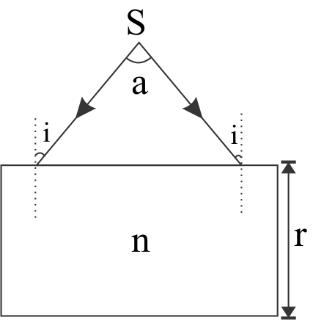
A diverging beam of light from a point source S having divergence angle $\alpha $, falls symmetrically on a glass slab as shown. The angles of incidence of the two extreme rays are equal. If the thickness of the glass slab is t and the refractive index n , then the divergence angle of the emergent beam is:
A. zero
B. $\alpha $
C. ${\sin ^{ - 1}}(1/n)$
D. $2{\sin ^{ - 1}}(1/n)$
Answer
 Verified
606k+ views
Hint:- Here two divergent beam are coming and enters in the glass slab of thickness t and have refractive index of $\mu $.$\therefore $refractive index of slab is more than the air so divergent light beam will bend toward normal in the slab. then there will arise the concept of lateral shift .
Complete step-by-step solution:
As light beams are coming towards the glass slab and due to the high refractive index of the slab the light beams will bend towards the normal.
See figure for more details
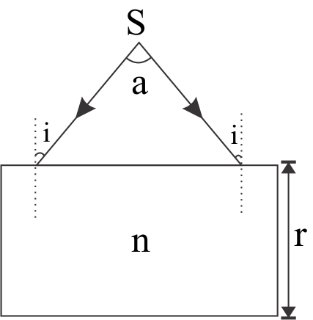
Now by seeing above figure we have concluded that
Firstly light beams are coming towards the glass slab and after entering the light beams are bending towards normal. And when again light beams are coming out from the glass slab they are again shifting as in the previous angle $\alpha $.i.e. this is the concept of lateral shift.
Hence, after shifting the angle between these diverging rays will equal to the previous angle.
So, the angle between two emergent rays will equal to $\alpha $.
Note:- When a beam of light incident parallel on an oblique medium. The light rays will shift laterally in the glass slab. The perpendicular distance between the direction of the incident rays and emergent rays is called lateral shifts.
Complete step-by-step solution:
As light beams are coming towards the glass slab and due to the high refractive index of the slab the light beams will bend towards the normal.
See figure for more details
Now by seeing above figure we have concluded that
Firstly light beams are coming towards the glass slab and after entering the light beams are bending towards normal. And when again light beams are coming out from the glass slab they are again shifting as in the previous angle $\alpha $.i.e. this is the concept of lateral shift.
Hence, after shifting the angle between these diverging rays will equal to the previous angle.
So, the angle between two emergent rays will equal to $\alpha $.
Note:- When a beam of light incident parallel on an oblique medium. The light rays will shift laterally in the glass slab. The perpendicular distance between the direction of the incident rays and emergent rays is called lateral shifts.
Recently Updated Pages
Master Class 12 Business Studies: Engaging Questions & Answers for Success

Master Class 12 Chemistry: Engaging Questions & Answers for Success
Master Class 12 Biology: Engaging Questions & Answers for Success
Class 12 Question and Answer - Your Ultimate Solutions Guide
Master Class 11 English: Engaging Questions & Answers for Success
Master Class 11 Social Science: Engaging Questions & Answers for Success
Trending doubts
Differentiate between Pyramid of energy and pyramid class 12 biology CBSE
Draw the diagram of the pyramid of energy Explain In class 12 biology CBSE
When was the first election held in India a 194748 class 12 sst CBSE
What is the Full Form of PVC, PET, HDPE, LDPE, PP and PS ?
Suicide bags of cells are aEndoplasmic reticulum bLysosome class 12 biology CBSE
The first general election of Lok Sabha was held in class 12 social science CBSE