




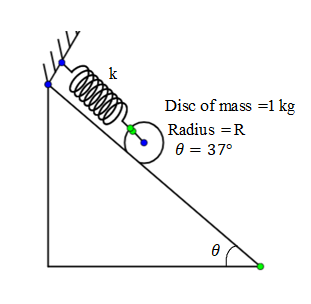
A disc of mass m is connected to an ideal spring of force constant ‘k’. If the disc is released from rest then what is the maximum friction force on the disc (in N). Assuming friction is sufficient for pure rolling.
Answer
 Verified
544.5k+ views
Hint: Friction is defined as the resistive force which opposes the motion of anybody if the surface of contact is not smooth. The acceleration on the disc will be different and be normal acceleration due to gravity as the disc is on the inclined plane.
Formula used:
The formula of the friction is given by,
$ \Rightarrow f = \mu \times N$
Where the friction is $\mu $ and the normal reaction is N.
The formula of the normal reaction at inclined plane is given by,
$ \Rightarrow N = mg\cos \theta $
Where mass is m the acceleration due to gravity is g and angle is inclination is$\theta $.
Complete step by step answer:
It is given in the problem that a disc of mass m is connected to an ideal spring of force constant ‘k’ if the disc is released from rest then we need to find the maximum friction force on the disc in Newton.
The normal reaction of the disc is given by,
$ \Rightarrow N = mg\cos \theta $………eq. (1)
Where mass is m the acceleration due to gravity is g and angle is inclination is$\theta $.
The formula of the friction is given by,
$ \Rightarrow f = \mu \times N$………eq. (2)
Where the friction is$\mu $ and the normal reaction is N.
Replacing the value of normal reaction in the equation (2) we get,
$ \Rightarrow f = \mu \times N$
$ \Rightarrow f = \mu \times mg\cos \theta $
The maximum friction is equal to,
$ \Rightarrow {f_{\max .}} = \mu \times mg\cos \theta $
Mass is 1 kg, and $\theta = 37^\circ $ therefore we get,
$ \Rightarrow {f_{\max .}} = \mu \times mg\cos \theta $
$ \Rightarrow {f_{\max .}} = \mu \times 9 \cdot 8 \times \cos 37^\circ $
$ \Rightarrow {f_{\max .}} = \mu \times 9 \cdot 8 \times 0 \cdot 79864$
$ \Rightarrow {f_{\max .}} = 7 \cdot 827\mu \left( N \right)$.
The maximum friction on the disc is equal to${f_{\max .}} = 7 \cdot 827\mu \left( N \right)$.
Note:
The students are advised to understand and remember the formula of the friction and the normal reaction on the inclined plane .The spring will try to stop the disc and after some extension of the spring the disc will stop also the friction will also oppose the motion of the disc.
Formula used:
The formula of the friction is given by,
$ \Rightarrow f = \mu \times N$
Where the friction is $\mu $ and the normal reaction is N.
The formula of the normal reaction at inclined plane is given by,
$ \Rightarrow N = mg\cos \theta $
Where mass is m the acceleration due to gravity is g and angle is inclination is$\theta $.
Complete step by step answer:
It is given in the problem that a disc of mass m is connected to an ideal spring of force constant ‘k’ if the disc is released from rest then we need to find the maximum friction force on the disc in Newton.
The normal reaction of the disc is given by,
$ \Rightarrow N = mg\cos \theta $………eq. (1)
Where mass is m the acceleration due to gravity is g and angle is inclination is$\theta $.
The formula of the friction is given by,
$ \Rightarrow f = \mu \times N$………eq. (2)
Where the friction is$\mu $ and the normal reaction is N.
Replacing the value of normal reaction in the equation (2) we get,
$ \Rightarrow f = \mu \times N$
$ \Rightarrow f = \mu \times mg\cos \theta $
The maximum friction is equal to,
$ \Rightarrow {f_{\max .}} = \mu \times mg\cos \theta $
Mass is 1 kg, and $\theta = 37^\circ $ therefore we get,
$ \Rightarrow {f_{\max .}} = \mu \times mg\cos \theta $
$ \Rightarrow {f_{\max .}} = \mu \times 9 \cdot 8 \times \cos 37^\circ $
$ \Rightarrow {f_{\max .}} = \mu \times 9 \cdot 8 \times 0 \cdot 79864$
$ \Rightarrow {f_{\max .}} = 7 \cdot 827\mu \left( N \right)$.
The maximum friction on the disc is equal to${f_{\max .}} = 7 \cdot 827\mu \left( N \right)$.
Note:
The students are advised to understand and remember the formula of the friction and the normal reaction on the inclined plane .The spring will try to stop the disc and after some extension of the spring the disc will stop also the friction will also oppose the motion of the disc.
Recently Updated Pages
Master Class 11 Computer Science: Engaging Questions & Answers for Success

Master Class 11 Business Studies: Engaging Questions & Answers for Success
Master Class 11 Economics: Engaging Questions & Answers for Success
Master Class 11 English: Engaging Questions & Answers for Success
Master Class 11 Maths: Engaging Questions & Answers for Success
Master Class 11 Biology: Engaging Questions & Answers for Success
Trending doubts
There are 720 permutations of the digits 1 2 3 4 5 class 11 maths CBSE
Discuss the various forms of bacteria class 11 biology CBSE
Draw a diagram of a plant cell and label at least eight class 11 biology CBSE
Explain zero factorial class 11 maths CBSE
What organs are located on the left side of your body class 11 biology CBSE
Draw a diagram of nephron and explain its structur class 11 biology CBSE