




A dip circle is taken to a geomagnetic equator. The needle is allowed to move in a vertical plane perpendicular to the magnetic meridian. The needle will stay in
A. horizontal direction only
B. vertical direction only
C. any direction except vertical and horizontal
D. any direction it is released
Answer
 Verified
592.8k+ views
Hint: Dip circles are used to measure the angle between earth’s magnetic field and the horizon. In a plane which is perpendicular to the magnetic meridian, the earth’s horizontal component of the magnetic field will be zero. Use this to tell the direction in which the needle will stay.
Complete step by step answer:Dip circle consists of a magnetic needle pivoted at the centre of the vertical circular scale that can rotate in the plane of the scale about the horizon.
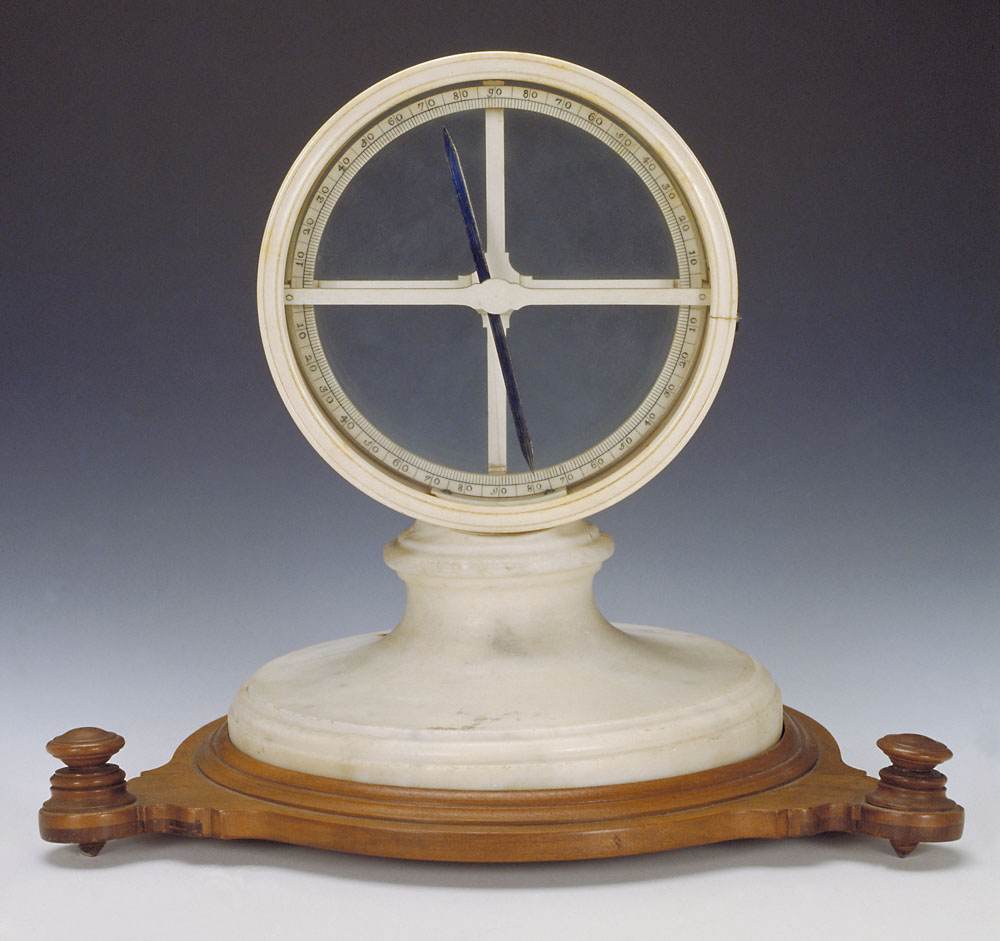
When the dip circle is placed with the plane of the circle in the magnetic meridian of the earth, the needle points in the direction of the earth’s magnetic field.
Here the dip circle is taken to a geomagnetic equator. At the geomagnetic equator, the needle tries to suspend in the horizontal direction.
But here the needle is allowed to move in a vertical plane which is perpendicular to the magnetic meridian.
Therefore, the earth’s horizontal component of the magnetic field will be zero. So it only experiences the earth’s vertical component of the magnetic field and the needle will be aligned with the vertical component.
Therefore, the needle stays in the direction it is released.
Hence, the correct option is Option D, the needle will stay in any direction it is released.
Note:Do not confuse the Geomagnetic equator with the geographic equator. Geomagnetic equator is defined as the line around earth where the magnetic field is horizontal or parallel to the earth’s surface. It does not round up the earth like the geographic equator but instead it connects geomagnetic (north and south) poles.
Complete step by step answer:Dip circle consists of a magnetic needle pivoted at the centre of the vertical circular scale that can rotate in the plane of the scale about the horizon.
When the dip circle is placed with the plane of the circle in the magnetic meridian of the earth, the needle points in the direction of the earth’s magnetic field.
Here the dip circle is taken to a geomagnetic equator. At the geomagnetic equator, the needle tries to suspend in the horizontal direction.
But here the needle is allowed to move in a vertical plane which is perpendicular to the magnetic meridian.
Therefore, the earth’s horizontal component of the magnetic field will be zero. So it only experiences the earth’s vertical component of the magnetic field and the needle will be aligned with the vertical component.
Therefore, the needle stays in the direction it is released.
Hence, the correct option is Option D, the needle will stay in any direction it is released.
Note:Do not confuse the Geomagnetic equator with the geographic equator. Geomagnetic equator is defined as the line around earth where the magnetic field is horizontal or parallel to the earth’s surface. It does not round up the earth like the geographic equator but instead it connects geomagnetic (north and south) poles.
Recently Updated Pages
Master Class 12 Social Science: Engaging Questions & Answers for Success

Master Class 12 Physics: Engaging Questions & Answers for Success
Master Class 12 Maths: Engaging Questions & Answers for Success
Master Class 12 Economics: Engaging Questions & Answers for Success
Master Class 12 Chemistry: Engaging Questions & Answers for Success
Master Class 12 Business Studies: Engaging Questions & Answers for Success
Trending doubts
Which are the Top 10 Largest Countries of the World?
Draw a labelled sketch of the human eye class 12 physics CBSE
Which of the following is the cheapest mode of transport class 12 social science CBSE
Differentiate between homogeneous and heterogeneous class 12 chemistry CBSE
Sulphuric acid is known as the king of acids State class 12 chemistry CBSE
What are the major means of transport Explain each class 12 social science CBSE