




A dietician wishes to mix two types of foods in such a way that the vitamin contents of the mixture contains at least 8 units of vitamin A and 10 units of vitamin C. Food I contains 2 units/kg of vitamin A and 1 unit/kg of vitamin C while Food II contains 1 unit/kg of vitamin A and 2 units/kg of vitamin 1 unit/kg of vitamin C. It costs Rs.5 per kg to purchase food I and Rs.7 per kg to purchase Food II. Determine the maximum cost of such a mixture. Formulate the above as a LPP and solve it graphically.
Answer
 Verified
592.2k+ views
Hint: First, we will try to convert the given statements to the mathematical equations by assuming that mix contains X kg of food I and Y kg of food II. Then we will apply the constraints to maximize the cost of the mixture. After that we will present the constraints graphically and check for the corner points and see which value of the points will give us maximum cost for the mixture.
Complete step by step answer:
First, we need to convert the given problem into mathematical expressions so,
Let the mixture contains X kg of food I
And Y kg of food II
We are given that Food I contains 2 units/kg of vitamin A and 1 unit/kg of vitamin C and
Food II contains 1 unit/kg of vitamin A and 2 units/kg of vitamin 1 unit/kg of vitamin C
And constraints given are that the mixture contains at least 8 units of vitamin A and 10 units of vitamin C.
So, total vitamin A should be greater than or equal to 8 units. And Food I contains 2 units/kg, Food II contains 1 unit/kg of vitamin A, hence we get
$2X+Y\ge 8\,\,....(1)$
And, total vitamin C should be greater than or equal to 10 units. And Food I contains X units/kg, Food II contains Y unit/kg of vitamin C, hence we get
$X+2Y\ge 10\,\,....\left( 2 \right)$
It is also given to us that,
It costs Rs.5 per kg to purchase food I and Rs.7 per kg to purchase Food II and so total cost to buy the mixture will be = $5X+7Y$
And we have to maximize the cost so we need to maximize the equation, $5X+7Y$
And we know that X and Y can’t be negative as they are the variables representing number of Kgs of food so,
$X\ge 0\,and\,Y\ge 0$
Now in short, we have to maximise
$5X+7Y$
And constraints are,
$\begin{align}
& 2X+Y\ge 8\,, \\
& X+2Y\ge 10, \\
& X\ge 0\,and, \\
& Y\ge \,0 \\
\end{align}$
Representing the above constraints graphically we get,
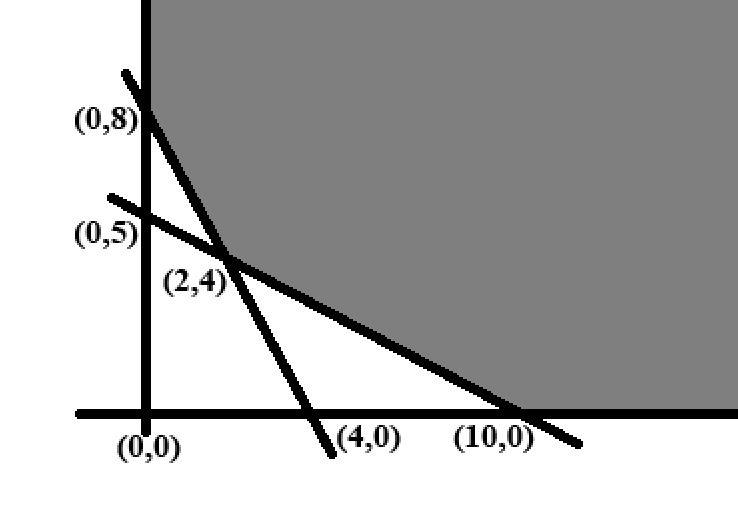
Where shaded area represents valid values according to the constraints,
Now, we will check at the corner points, i.e. (0, 8), (10, 0) and (2, 4)
Now one by one put the above pints in the equation $5X+7Y$ we will get the maximum value at infinity i.e. infinity and minimum value at (2, 4) i.e. 38.
Note:
You need to be careful while making mathematical equations from the given statements and then draw the graph accordingly and try to check at every corner point we get.
Some students also make mistakes while forming equations like they may make the first equation as$2Y+X\ge 8\,\,....(1)$ but that is wrong try to analyse carefully what variables are X and Y and what is asked in the question and make equations accordingly.
Complete step by step answer:
First, we need to convert the given problem into mathematical expressions so,
Let the mixture contains X kg of food I
And Y kg of food II
We are given that Food I contains 2 units/kg of vitamin A and 1 unit/kg of vitamin C and
Food II contains 1 unit/kg of vitamin A and 2 units/kg of vitamin 1 unit/kg of vitamin C
And constraints given are that the mixture contains at least 8 units of vitamin A and 10 units of vitamin C.
So, total vitamin A should be greater than or equal to 8 units. And Food I contains 2 units/kg, Food II contains 1 unit/kg of vitamin A, hence we get
$2X+Y\ge 8\,\,....(1)$
And, total vitamin C should be greater than or equal to 10 units. And Food I contains X units/kg, Food II contains Y unit/kg of vitamin C, hence we get
$X+2Y\ge 10\,\,....\left( 2 \right)$
It is also given to us that,
It costs Rs.5 per kg to purchase food I and Rs.7 per kg to purchase Food II and so total cost to buy the mixture will be = $5X+7Y$
And we have to maximize the cost so we need to maximize the equation, $5X+7Y$
And we know that X and Y can’t be negative as they are the variables representing number of Kgs of food so,
$X\ge 0\,and\,Y\ge 0$
Now in short, we have to maximise
$5X+7Y$
And constraints are,
$\begin{align}
& 2X+Y\ge 8\,, \\
& X+2Y\ge 10, \\
& X\ge 0\,and, \\
& Y\ge \,0 \\
\end{align}$
Representing the above constraints graphically we get,
Where shaded area represents valid values according to the constraints,
Now, we will check at the corner points, i.e. (0, 8), (10, 0) and (2, 4)
Now one by one put the above pints in the equation $5X+7Y$ we will get the maximum value at infinity i.e. infinity and minimum value at (2, 4) i.e. 38.
Note:
You need to be careful while making mathematical equations from the given statements and then draw the graph accordingly and try to check at every corner point we get.
Some students also make mistakes while forming equations like they may make the first equation as$2Y+X\ge 8\,\,....(1)$ but that is wrong try to analyse carefully what variables are X and Y and what is asked in the question and make equations accordingly.
Recently Updated Pages
Master Class 11 Computer Science: Engaging Questions & Answers for Success

Master Class 11 Business Studies: Engaging Questions & Answers for Success
Master Class 11 Economics: Engaging Questions & Answers for Success
Master Class 11 English: Engaging Questions & Answers for Success
Master Class 11 Maths: Engaging Questions & Answers for Success
Master Class 11 Biology: Engaging Questions & Answers for Success
Trending doubts
One Metric ton is equal to kg A 10000 B 1000 C 100 class 11 physics CBSE
There are 720 permutations of the digits 1 2 3 4 5 class 11 maths CBSE
Discuss the various forms of bacteria class 11 biology CBSE
Draw a diagram of a plant cell and label at least eight class 11 biology CBSE
State the laws of reflection of light
10 examples of friction in our daily life