




A diene, buta-1,3-diene was subjected to ozonolysis to prepare aldehydes. Which of the following aldehydes will be obtained during the reaction?
A. \[CHO - CHO + 2HCHO\]
B. \[C{H_3}CHO + 2HCHO\]
C. \[C{H_3}C{H_2}CHO + C{H_3}CHO\]
D. \[2C{H_3}C{H_2}CHO\]
Answer
 Verified
643.5k+ views
Hint: The two step conversion of an alkene or alkyne into an ozonide followed by its reductive cleavage to yield carbonyl compounds is called ozonolysis. It occurs at a low temperature range of \[196 - 200K\].
Complete step by step answer:
Reaction description:
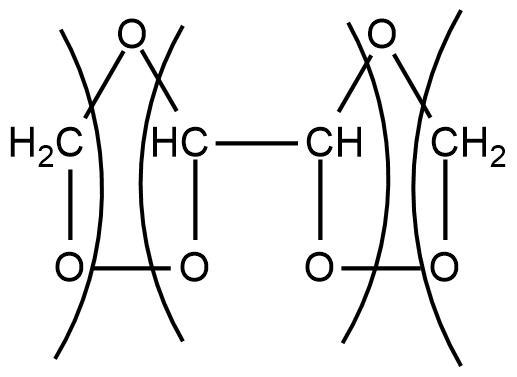
Step1: When ozone is passed through a solution of buta-1,3-diene in some inert solvent such as $C{H_2}C{l_2},CHC{l_3}{\text{ }}or{\text{ }}CC{l_4}$ at low temperature of range \[196 - 200K\], it oxidises it into ozonides as given below:
$C{H_2} = CH - CH = C{H_2} + {O_3}\xrightarrow[{196 - 200K}]{{C{H_2}C{l_2}}}$
These ozonides are unstable compounds and also explosive in nature. So they are not isolated.
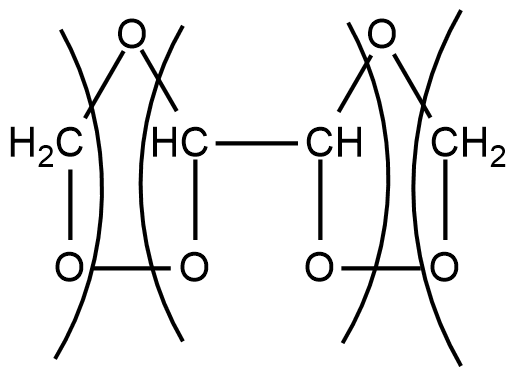
Step2: In second step, these ozonides are reduced, in situ, with zinc dust and water to give one molecule of $CHO$−$CHO$ and 2 molecules of formaldehyde i.e. $HCHO$.
$\xrightarrow[{ - ZnO}]{{Zn/{H_2}O}}CHO - CHO + 2HCHO$
Hence the correct answer is option (A).
Ozonolysis has been exclusively used in the past for the structure elucidation of alkenes. It is the versatile method for locating the position of multiple bonds in an unknown alkene since no two alkenes give the same combination of aldehyde or ketones.
Note:
Ozonides are also reduced by \[{H_2}/Pd\] . Sometimes ozonides give a mixture of ketone and aldehyde also; depending upon the structure of alkene. Instead of \[Zn/{H_2}O\] or catalytic hydrogenation, ozonide can be more conveniently be reduced with dimethyl sulphide,\[{\left( {C{H_3}} \right)_2}S\] and it get oxidised itself to dimethyl sulphoxide.
Complete step by step answer:
Reaction description:
Step1: When ozone is passed through a solution of buta-1,3-diene in some inert solvent such as $C{H_2}C{l_2},CHC{l_3}{\text{ }}or{\text{ }}CC{l_4}$ at low temperature of range \[196 - 200K\], it oxidises it into ozonides as given below:
$C{H_2} = CH - CH = C{H_2} + {O_3}\xrightarrow[{196 - 200K}]{{C{H_2}C{l_2}}}$
These ozonides are unstable compounds and also explosive in nature. So they are not isolated.
Step2: In second step, these ozonides are reduced, in situ, with zinc dust and water to give one molecule of $CHO$−$CHO$ and 2 molecules of formaldehyde i.e. $HCHO$.
$\xrightarrow[{ - ZnO}]{{Zn/{H_2}O}}CHO - CHO + 2HCHO$
Hence the correct answer is option (A).
Ozonolysis has been exclusively used in the past for the structure elucidation of alkenes. It is the versatile method for locating the position of multiple bonds in an unknown alkene since no two alkenes give the same combination of aldehyde or ketones.
Note:
Ozonides are also reduced by \[{H_2}/Pd\] . Sometimes ozonides give a mixture of ketone and aldehyde also; depending upon the structure of alkene. Instead of \[Zn/{H_2}O\] or catalytic hydrogenation, ozonide can be more conveniently be reduced with dimethyl sulphide,\[{\left( {C{H_3}} \right)_2}S\] and it get oxidised itself to dimethyl sulphoxide.
Recently Updated Pages
Which of the following graphs shows the variation of class 12 physics CBSE

Draw a labelled diagram of the human male reproductive class 12 biology CBSE
Describe the experiment to compare the emf of two cells class 12 physics CBSE
What is standard hydrogen electrode
What is conventional current and electric current class 12 physics CBSE
2Bromopentane is treated with an alcoholic KOH solution class 12 chemistry CBSE
Trending doubts
Draw a labelled sketch of the human eye class 12 physics CBSE
Which are the Top 10 Largest Countries of the World?
Draw ray diagrams each showing i myopic eye and ii class 12 physics CBSE
Give one example of a reptile that is viviparous class 12 biology CBSE
Which is the correct genotypic ratio of mendel dihybrid class 12 biology CBSE
Give 10 examples of unisexual and bisexual flowers