




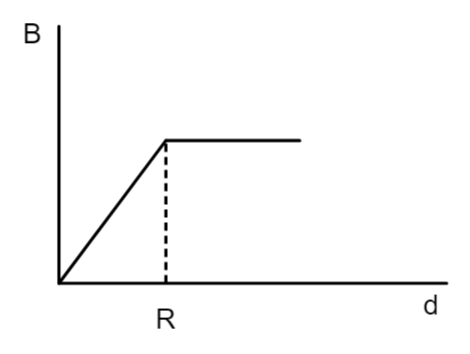
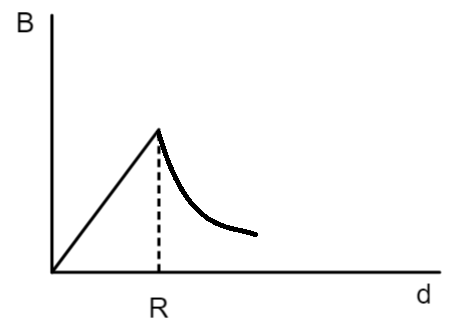
A cylindrical conductor of radius $R$ is carrying a constant current. The plot of the magnitude of the magnetic field $B$ with the distance $d$ from the center of the conductor, is correctly represented by the figure:
A.
B.
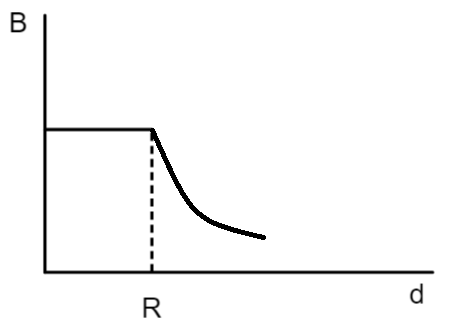
C.
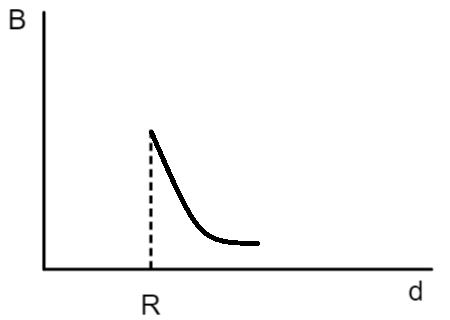
D.
Answer
 Verified
592.8k+ views
Hint: Use the ampere circuital law to determine the magnitude of magnetic field. Ampere circuital law has to be used for regions inside the cylindrical conductor and the region outside the conductor. Place a graph depicting the relationship between magnetic field and distance from the center.
Formula used:
$\oint{B.dl}={{\mu }_{0}}I$
Complete step by step answer:
Ampere circuital law gives us a mathematical relationship between the current and the magnetic field produced by it. The law states that the line integral of magnetic field intensity along an imaginary closed path is equal to the product of current enclosed by the path and the permeability of the medium. The mathematical form of the law can be written as,
$\oint{B.dl}={{\mu }_{0}}I$
Here, $B$ represents a magnetic field, $dl$ is a small length element, ${{\mu }_{o}}$ is permeability of free space and $I$ is the current which produces magnetic fields.
Now, consider a cylindrical conductor of radius $R$ carrying a constant current $I$. Now, consider an imaginary loop of radius $d$ such that $d${I}'=\dfrac{I}{\pi {{R}^{2}}}\times \pi {{d}^{2}}$
Now, let us find the magnetic field using the ampere circuital law. It can be seen as,
\[\begin{align}
& \oint{{{B}_{inside}}.dl}={{\mu }_{0}}{I}' \\
& {{B}_{inside}}\left( 2\pi d \right)={{\mu }_{0}}\left( \dfrac{I}{\pi {{R}^{2}}}\times \pi {{d}^{2}} \right) \\
& {{B}_{inside}}=\dfrac{{{\mu }_{0}}I}{2\pi {{R}^{2}}}d \\
& {{B}_{inside}}\propto d
\end{align}\]
Now, let us consider an imaginary loop of radius \[d\] such that $d>R$. Now, the current passing through this loop is equal to $I$. The magnetic field can be calculated as,
\[\begin{align}
& \oint{{{B}_{outside}}.dl}={{\mu }_{0}}I \\
& {{B}_{outside}}\left( 2\pi d \right)={{\mu }_{0}}I \\
& {{B}_{outside}}=\dfrac{{{\mu }_{0}}I}{2\pi d} \\
& {{B}_{outside}}\propto \dfrac{1}{d}
\end{align}\]
The above obtained relations show that the magnetic field first increases with distance from center linearly till $d=R$ but decreases after it. This type of behaviour can be correctly depicted by the graph below.
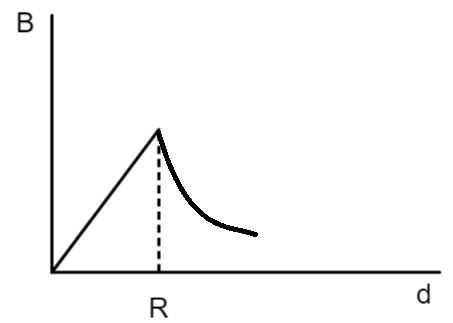
So, the correct answer is “Option D”.
Note:
Correctly determine the amount of current passing through the loop through which magnetic field is to be determined. Correctly interpret the result obtained by the ampere circuital law to obtain a graph. Do not get confused between \[d\] and $R$.
Formula used:
$\oint{B.dl}={{\mu }_{0}}I$
Complete step by step answer:
Ampere circuital law gives us a mathematical relationship between the current and the magnetic field produced by it. The law states that the line integral of magnetic field intensity along an imaginary closed path is equal to the product of current enclosed by the path and the permeability of the medium. The mathematical form of the law can be written as,
$\oint{B.dl}={{\mu }_{0}}I$
Here, $B$ represents a magnetic field, $dl$ is a small length element, ${{\mu }_{o}}$ is permeability of free space and $I$ is the current which produces magnetic fields.
Now, consider a cylindrical conductor of radius $R$ carrying a constant current $I$. Now, consider an imaginary loop of radius $d$ such that $d
Now, let us find the magnetic field using the ampere circuital law. It can be seen as,
\[\begin{align}
& \oint{{{B}_{inside}}.dl}={{\mu }_{0}}{I}' \\
& {{B}_{inside}}\left( 2\pi d \right)={{\mu }_{0}}\left( \dfrac{I}{\pi {{R}^{2}}}\times \pi {{d}^{2}} \right) \\
& {{B}_{inside}}=\dfrac{{{\mu }_{0}}I}{2\pi {{R}^{2}}}d \\
& {{B}_{inside}}\propto d
\end{align}\]
Now, let us consider an imaginary loop of radius \[d\] such that $d>R$. Now, the current passing through this loop is equal to $I$. The magnetic field can be calculated as,
\[\begin{align}
& \oint{{{B}_{outside}}.dl}={{\mu }_{0}}I \\
& {{B}_{outside}}\left( 2\pi d \right)={{\mu }_{0}}I \\
& {{B}_{outside}}=\dfrac{{{\mu }_{0}}I}{2\pi d} \\
& {{B}_{outside}}\propto \dfrac{1}{d}
\end{align}\]
The above obtained relations show that the magnetic field first increases with distance from center linearly till $d=R$ but decreases after it. This type of behaviour can be correctly depicted by the graph below.
So, the correct answer is “Option D”.
Note:
Correctly determine the amount of current passing through the loop through which magnetic field is to be determined. Correctly interpret the result obtained by the ampere circuital law to obtain a graph. Do not get confused between \[d\] and $R$.
Recently Updated Pages
Master Class 12 Social Science: Engaging Questions & Answers for Success

Master Class 12 Physics: Engaging Questions & Answers for Success
Master Class 12 Maths: Engaging Questions & Answers for Success
Master Class 12 Economics: Engaging Questions & Answers for Success
Master Class 12 Chemistry: Engaging Questions & Answers for Success
Master Class 12 Business Studies: Engaging Questions & Answers for Success
Trending doubts
Which are the Top 10 Largest Countries of the World?
Draw a labelled sketch of the human eye class 12 physics CBSE
Explain the structure of megasporangium class 12 biology CBSE
What are the major means of transport Explain each class 12 social science CBSE
How many chromosomes are found in human ovum a 46 b class 12 biology CBSE
The diagram of the section of a maize grain is given class 12 biology CBSE