




A cylinder boiler 4 m high and 3.5 m in diameter has a hemispherical lid. Find the volume of the boiler including the part covered by the lid?
Answer
 Verified
622.5k+ views
Hint: To know the volume of the boiler along with the lid we are going to add the volume of cylinder with volume of hemisphere. We know that the volume of the cylinder is equal to $\pi {{r}^{2}}h$ with r and h as radius and height of the cylinder. We also know that the volume of the hemisphere is equal to $\dfrac{2}{3}\pi {{r}^{3}}$ where r is the radius of the hemisphere. The necessary dimensions to be substituted in the equation are given in the question, draw the figure and get those. Then we can easily find the volume of the boiler.
Complete step-by-step answer:
It is given that the cylindrical boiler is 4 m high and 3.5 m in diameter. The radius of the cylindrical boiler is calculated by dividing the diameter by 2.
$r=\dfrac{3.5}{2}=1.75m$
In the below figure we have drawn a cylinder with radius r and height h.
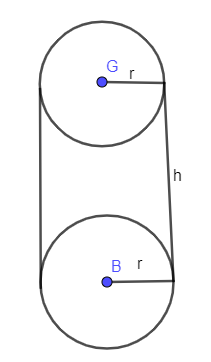
We know that volume of the cylinder is equal to:
$\pi {{r}^{2}}h$
Substituting the value of r as 1.75 m, height as 4 m and $\pi =\dfrac{22}{7}$ in the above equation we get,
$\begin{align}
& \dfrac{22}{7}{{\left( 1.75 \right)}^{2}}\left( 4 \right) \\
& =\dfrac{269.5}{7} \\
& =38.5{{m}^{3}} \\
\end{align}$
In the below diagram we have drawn the cylindrical boiler with a hemispherical lid.
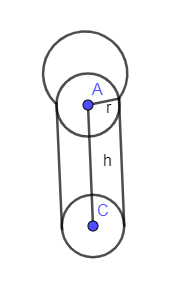
In the above diagram, a hemispherical lid is shown with a radius of 1.75 m. We have taken the radius the same as the cylindrical boiler. The total volume of this figure is the addition of the cylinder and the hemisphere. We have already shown the volume of the cylinder above.
Volume of hemisphere is equal to:
$\dfrac{2}{3}\pi {{r}^{3}}$
Substituting the value of r as 1.75 m in the above expression we get,
$\begin{align}
& \dfrac{2}{3}\left( \dfrac{22}{7} \right){{\left( 1.75 \right)}^{3}} \\
& =\dfrac{44\left( 1.75 \right){{\left( 1.75 \right)}^{2}}}{3\left( 7 \right)} \\
\end{align}$
Dividing 1.75 by 7 we get 0.25 so substituting this value in the above expression we get,
$\begin{align}
& =\dfrac{44{{\left( 1.75 \right)}^{2}}\left( .25 \right)}{3} \\
& =11.23{{m}^{3}} \\
\end{align}$
Adding the volume of cylinder and hemisphere by taking its value from the above solution we get,
$\begin{align}
& \left( 38.5+11.23 \right){{m}^{3}} \\
& =49.73{{m}^{3}} \\
\end{align}$
Hence, the volume of the boiler including the part covered by the lid is $49.73{{m}^{3}}$.
Note: In this problem, as radius of the hemisphere is not given so you might think what radius we should take so the answer is when you put a lid on the vessel while cooking you have seen that the diameter of the lid and vessel is the same. Similarly, the diameter of the cylindrical boiler and the hemispherical lid is the same.
One more thing which is quite observed is that usually students write the volume of hemisphere as $\dfrac{4}{3}\pi {{r}^{3}}$ which is the volume of sphere so try to avoid making such mistake.
Complete step-by-step answer:
It is given that the cylindrical boiler is 4 m high and 3.5 m in diameter. The radius of the cylindrical boiler is calculated by dividing the diameter by 2.
$r=\dfrac{3.5}{2}=1.75m$
In the below figure we have drawn a cylinder with radius r and height h.
We know that volume of the cylinder is equal to:
$\pi {{r}^{2}}h$
Substituting the value of r as 1.75 m, height as 4 m and $\pi =\dfrac{22}{7}$ in the above equation we get,
$\begin{align}
& \dfrac{22}{7}{{\left( 1.75 \right)}^{2}}\left( 4 \right) \\
& =\dfrac{269.5}{7} \\
& =38.5{{m}^{3}} \\
\end{align}$
In the below diagram we have drawn the cylindrical boiler with a hemispherical lid.
In the above diagram, a hemispherical lid is shown with a radius of 1.75 m. We have taken the radius the same as the cylindrical boiler. The total volume of this figure is the addition of the cylinder and the hemisphere. We have already shown the volume of the cylinder above.
Volume of hemisphere is equal to:
$\dfrac{2}{3}\pi {{r}^{3}}$
Substituting the value of r as 1.75 m in the above expression we get,
$\begin{align}
& \dfrac{2}{3}\left( \dfrac{22}{7} \right){{\left( 1.75 \right)}^{3}} \\
& =\dfrac{44\left( 1.75 \right){{\left( 1.75 \right)}^{2}}}{3\left( 7 \right)} \\
\end{align}$
Dividing 1.75 by 7 we get 0.25 so substituting this value in the above expression we get,
$\begin{align}
& =\dfrac{44{{\left( 1.75 \right)}^{2}}\left( .25 \right)}{3} \\
& =11.23{{m}^{3}} \\
\end{align}$
Adding the volume of cylinder and hemisphere by taking its value from the above solution we get,
$\begin{align}
& \left( 38.5+11.23 \right){{m}^{3}} \\
& =49.73{{m}^{3}} \\
\end{align}$
Hence, the volume of the boiler including the part covered by the lid is $49.73{{m}^{3}}$.
Note: In this problem, as radius of the hemisphere is not given so you might think what radius we should take so the answer is when you put a lid on the vessel while cooking you have seen that the diameter of the lid and vessel is the same. Similarly, the diameter of the cylindrical boiler and the hemispherical lid is the same.
One more thing which is quite observed is that usually students write the volume of hemisphere as $\dfrac{4}{3}\pi {{r}^{3}}$ which is the volume of sphere so try to avoid making such mistake.
Recently Updated Pages
Master Class 11 Social Science: Engaging Questions & Answers for Success

Master Class 11 English: Engaging Questions & Answers for Success
Master Class 11 Maths: Engaging Questions & Answers for Success
Master Class 11 Chemistry: Engaging Questions & Answers for Success
Master Class 11 Biology: Engaging Questions & Answers for Success
Master Class 11 Physics: Engaging Questions & Answers for Success
Trending doubts
Differentiate between an exothermic and an endothermic class 11 chemistry CBSE
One Metric ton is equal to kg A 10000 B 1000 C 100 class 11 physics CBSE
Difference Between Prokaryotic Cells and Eukaryotic Cells
There are 720 permutations of the digits 1 2 3 4 5 class 11 maths CBSE
Draw a diagram of a plant cell and label at least eight class 11 biology CBSE
1 Quintal is equal to a 110 kg b 10 kg c 100kg d 1000 class 11 physics CBSE