




A current loop in a magnetic field
A) Experiences a torque whether a field is uniform or non- uniform in all directions
B) Can be in equilibrium in one direction
C) Can be in equilibrium in two orientations, both the states are unstable.
D) Can be in equilibrium in two orientations, one stable while the other is unstable.
Answer
 Verified
617.1k+ views
Hint: A current-carrying coil will have a magnetic moment associated with it. So the magnetic moment when placed in a magnetic field will experience a torque base on the position of the coil with the field.
Complete step by step answer:
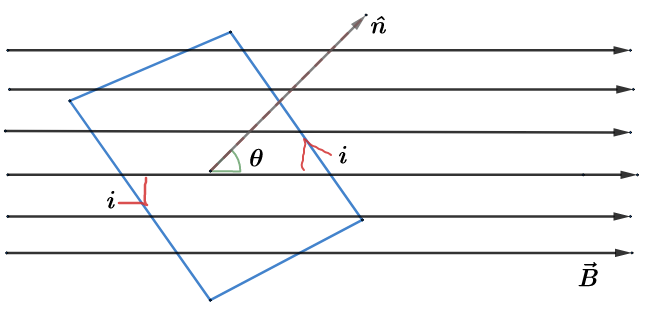
Suppose we have a coil of surface area A which carries a current i. So the magnetic moment associated with the coil is given by, $\text{Magnetic Moment(}\mu \text{)}=i\overrightarrow{\text{A}}$, where $\overrightarrow{\text{A}}$ is the area vector which is perpendicular to the surface area.
So when the coil with a magnetic moment is placed in a magnetic field it experiences a torque which is given by the equation,
Torque$(\tau )=\overrightarrow{\mu }\times \overrightarrow{B}$
Where, the vector B is the magnetic field present. So the torque can be written as,
$\tau =\left( i\overrightarrow{A} \right)\times \overrightarrow{B}=i(\overrightarrow{A}\times \overrightarrow{B})$
Rewriting the cross product in the above equation, we get
$\tau =iAB\sin \theta $
Where, $\text{ }\!\!\theta\!\!\text{ }$ is the angle between the area vector and the magnetic field.
So if the area vector is parallel to the applied magnetic field, i.e. the angle between A and B is zero. The torque acting on the coil will be zero since $\sin (0)$ is zero. So this can be considered as a stable equilibrium position.
If the area vector is anti-parallel to the applied magnetic field, i.e. the angle between A and B is 180 degrees. The torque acting on the coil will be zero since $\sin (180)$ is zero. So this can be considered as an equilibrium position, but since it is opposite to the direction of the magnetic field. This is a point of unstable equilibrium.
So the answer to the question is option (D)- Can be in equilibrium in two orientations, one stable while the other is unstable.
Note:
Since this torque acts perpendicular to the magnetic moment and the magnetic field, then it can cause the magnetic moment to precess around the magnetic field at a certain frequency called the Larmor frequency.
Magnetic torque on the current-carrying coil is the working principle of electric motors and meters.
Complete step by step answer:
Suppose we have a coil of surface area A which carries a current i. So the magnetic moment associated with the coil is given by, $\text{Magnetic Moment(}\mu \text{)}=i\overrightarrow{\text{A}}$, where $\overrightarrow{\text{A}}$ is the area vector which is perpendicular to the surface area.
So when the coil with a magnetic moment is placed in a magnetic field it experiences a torque which is given by the equation,
Torque$(\tau )=\overrightarrow{\mu }\times \overrightarrow{B}$
Where, the vector B is the magnetic field present. So the torque can be written as,
$\tau =\left( i\overrightarrow{A} \right)\times \overrightarrow{B}=i(\overrightarrow{A}\times \overrightarrow{B})$
Rewriting the cross product in the above equation, we get
$\tau =iAB\sin \theta $
Where, $\text{ }\!\!\theta\!\!\text{ }$ is the angle between the area vector and the magnetic field.
So if the area vector is parallel to the applied magnetic field, i.e. the angle between A and B is zero. The torque acting on the coil will be zero since $\sin (0)$ is zero. So this can be considered as a stable equilibrium position.
If the area vector is anti-parallel to the applied magnetic field, i.e. the angle between A and B is 180 degrees. The torque acting on the coil will be zero since $\sin (180)$ is zero. So this can be considered as an equilibrium position, but since it is opposite to the direction of the magnetic field. This is a point of unstable equilibrium.
So the answer to the question is option (D)- Can be in equilibrium in two orientations, one stable while the other is unstable.
Note:
Since this torque acts perpendicular to the magnetic moment and the magnetic field, then it can cause the magnetic moment to precess around the magnetic field at a certain frequency called the Larmor frequency.
Magnetic torque on the current-carrying coil is the working principle of electric motors and meters.
Recently Updated Pages
Master Class 12 Social Science: Engaging Questions & Answers for Success

Master Class 12 Physics: Engaging Questions & Answers for Success
Master Class 12 Maths: Engaging Questions & Answers for Success
Master Class 12 Economics: Engaging Questions & Answers for Success
Master Class 12 Chemistry: Engaging Questions & Answers for Success
Master Class 12 Business Studies: Engaging Questions & Answers for Success
Trending doubts
Which are the Top 10 Largest Countries of the World?
Draw a labelled sketch of the human eye class 12 physics CBSE
Explain the structure of megasporangium class 12 biology CBSE
What are the major means of transport Explain each class 12 social science CBSE
How many chromosomes are found in human ovum a 46 b class 12 biology CBSE
The diagram of the section of a maize grain is given class 12 biology CBSE