




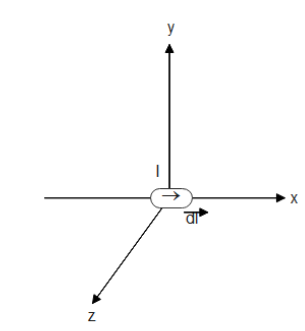
A current \[I\] is flowing in a conductor placed along the x-axis as shown in the figure. Find the magnitude and direction of the magnetic field due to a small current element $\overrightarrow {dl} $ lying at the origin at points (A) $(0,d,0)$ and (B) $(0,0,d)$.
Answer
 Verified
561.3k+ views
Hint: We need to understand Biot-Savart’s law to find the magnetic field at a certain distance due to a current-carrying conductor. And to find the direction of the field, recall the right-hand thumb rule in which the curl fingers represent the direction of the magnetic field.
Complete step by step answer:
First, let us define Biot-Savart’s law. We know that current flowing through a differential length element $dl$ of a conductor produces a differential magnetic field at a distance say ‘r’ from it. The magnitude of this differential magnetic field is given by Biot-Savart’s law.
According to Biot-Savart’s law, the differential magnetic field $db$ produced by the current in the differential length $dl$ at a point at distance r from the length is proportional to the current in the differential length element, length of the element, sine of the angle between the unit vector of differential element and point P and is inversely proportional to the square of the distance between differential length element and point P.
$db = \dfrac{{{\mu _o}}}{{4\pi }}\dfrac{{Idl\sin \theta }}{{{r^2}}}$
Where, ${\mu _o}$ is the permeability of the free space.
Now in the given question $dl \bot \overrightarrow r $ , therefore, substituting the values for the point at the x-axis we get
$B = \dfrac{{{\mu _o}}}{{4\pi }}\dfrac{{Idl}}{{{d^2}}}$
And the direction of the field will be in the z-direction which can be found using the right-hand thumb rule. And it will be the same in both cases due to symmetry. And the direction for the point in the z-axis will be negative x-direction.
Note:Biot-Savart’s law can measure the magnetic field due to a current-carrying conductor of any shape. It is not necessary that the conductor has to be straight. We should always use the right-hand thumb rule to find the direction of the magnetic field.
Complete step by step answer:
First, let us define Biot-Savart’s law. We know that current flowing through a differential length element $dl$ of a conductor produces a differential magnetic field at a distance say ‘r’ from it. The magnitude of this differential magnetic field is given by Biot-Savart’s law.
According to Biot-Savart’s law, the differential magnetic field $db$ produced by the current in the differential length $dl$ at a point at distance r from the length is proportional to the current in the differential length element, length of the element, sine of the angle between the unit vector of differential element and point P and is inversely proportional to the square of the distance between differential length element and point P.
$db = \dfrac{{{\mu _o}}}{{4\pi }}\dfrac{{Idl\sin \theta }}{{{r^2}}}$
Where, ${\mu _o}$ is the permeability of the free space.
Now in the given question $dl \bot \overrightarrow r $ , therefore, substituting the values for the point at the x-axis we get
$B = \dfrac{{{\mu _o}}}{{4\pi }}\dfrac{{Idl}}{{{d^2}}}$
And the direction of the field will be in the z-direction which can be found using the right-hand thumb rule. And it will be the same in both cases due to symmetry. And the direction for the point in the z-axis will be negative x-direction.
Note:Biot-Savart’s law can measure the magnetic field due to a current-carrying conductor of any shape. It is not necessary that the conductor has to be straight. We should always use the right-hand thumb rule to find the direction of the magnetic field.
Recently Updated Pages
Which of the following graphs shows the variation of class 12 physics CBSE

Draw a labelled diagram of the human male reproductive class 12 biology CBSE
Describe the experiment to compare the emf of two cells class 12 physics CBSE
What is standard hydrogen electrode
What is conventional current and electric current class 12 physics CBSE
2Bromopentane is treated with an alcoholic KOH solution class 12 chemistry CBSE
Trending doubts
Draw a labelled sketch of the human eye class 12 physics CBSE
Which are the Top 10 Largest Countries of the World?
Differentiate between homogeneous and heterogeneous class 12 chemistry CBSE
Draw ray diagrams each showing i myopic eye and ii class 12 physics CBSE
Which is the correct genotypic ratio of mendel dihybrid class 12 biology CBSE
What is the Full Form of PVC, PET, HDPE, LDPE, PP and PS ?