




A crack in a glass vessel often shines like a mirror because of:
A) Total reflecting surface
B) Reflection
C) Refraction
D) All
Answer
 Verified
605.7k+ views
Hint:A phenomenon in which the rays of light travel from a denser medium to a rarer medium is known as total internal reflection. This phenomenon occurs when there are two mediums. In this problem, this concept will be used.
Complete step-by-step answer:
Step I:
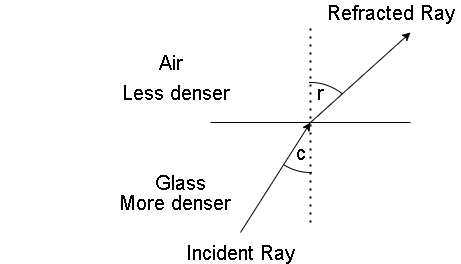
When a ray of light enters from a denser medium to a rarer medium, the angle of incidence should be greater than the critical angle. The critical angle in total internal reflection is the angle of incidence, at which the angle of refraction is ${90^ \circ }$ .
Step II:
Given that there is a crack in the glass vessel, so two mediums will be there. One medium is glass and the other medium is air. This is because the air rushes in, from the crack in the vessel. Since glass is more denser than the air, so the light rays travelling from glass to air will suffer total internal reflection at the critical angle.
Step III:
In case when the two mediums are glass and air, when the angle of incidence is greater than ${42^ \circ }$ , the critical angle is formed. Therefore the glass vessel will shine.
Therefore, option A is the right answer.
Note:The critical angle is basically the angle of incidence beyond which the rays of light passing from a denser medium to a rarer medium will not refract. They will completely suffer reflection instead of refraction. The value of critical angle can be calculated using Snell’s law. While using Snell’s law, the value of angle of refraction should be ${90^ \circ }$ .
Complete step-by-step answer:
Step I:
When a ray of light enters from a denser medium to a rarer medium, the angle of incidence should be greater than the critical angle. The critical angle in total internal reflection is the angle of incidence, at which the angle of refraction is ${90^ \circ }$ .
Step II:
Given that there is a crack in the glass vessel, so two mediums will be there. One medium is glass and the other medium is air. This is because the air rushes in, from the crack in the vessel. Since glass is more denser than the air, so the light rays travelling from glass to air will suffer total internal reflection at the critical angle.
Step III:
In case when the two mediums are glass and air, when the angle of incidence is greater than ${42^ \circ }$ , the critical angle is formed. Therefore the glass vessel will shine.
Therefore, option A is the right answer.
Note:The critical angle is basically the angle of incidence beyond which the rays of light passing from a denser medium to a rarer medium will not refract. They will completely suffer reflection instead of refraction. The value of critical angle can be calculated using Snell’s law. While using Snell’s law, the value of angle of refraction should be ${90^ \circ }$ .
Recently Updated Pages
Master Class 12 Business Studies: Engaging Questions & Answers for Success

Master Class 12 Biology: Engaging Questions & Answers for Success
Master Class 12 Chemistry: Engaging Questions & Answers for Success
Class 12 Question and Answer - Your Ultimate Solutions Guide
Master Class 11 Social Science: Engaging Questions & Answers for Success
Master Class 11 English: Engaging Questions & Answers for Success
Trending doubts
Which is more stable and why class 12 chemistry CBSE
Which are the Top 10 Largest Countries of the World?
Draw a labelled sketch of the human eye class 12 physics CBSE
Differentiate between homogeneous and heterogeneous class 12 chemistry CBSE
What are the major means of transport Explain each class 12 social science CBSE
Sulphuric acid is known as the king of acids State class 12 chemistry CBSE