




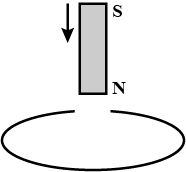
A copper ring having a cut such as not to form a complete loop is held horizontally and a bar magnet is dropped through the ring with its length along the axis of the ring. Then acceleration of the falling magnet is (neglect air friction)
(A) g
(B) less than g
(C) more than g
(D) 0
Answer
 Verified
490.8k+ views
Hint: The best example is of a bar magnet moving in a to and fro motion is the solenoid. We are aware of the fact that on moving a bar magnet between the solenoid, a current is induced in it which always opposes the change in the orientation of the bar magnet. In this case, in place of a solenoid, there is a bar magnet going inside the ring and accelerating with an acceleration which is equal to g. Here we will apply this concept and find the correct option.
Complete step by step answer:
In this case, there will be an acceleration when the bar magnet will enter the copper ring. The copper ring is made of metal, this means that when the magnet passes through the axis of the ring a current will be induced in the ring and on applying Lenz law, the current which is induced in the circuit will oppose the change through which it is induced. Thus, the current which is induced inside the copper ring will oppose any change, i.e., it will be opposing the motion of the bar magnet which is going through it and hence the acceleration will decrease.
So, the acceleration will be less than the acceleration due to gravity.
Note: In this case, we have to imagine a ring and a magnet which is going in between the rings. Then, we will apply the concept which was proposed by Emil Lenz. The current which will be induced will oppose the change through which it actually was produced.
Complete step by step answer:
In this case, there will be an acceleration when the bar magnet will enter the copper ring. The copper ring is made of metal, this means that when the magnet passes through the axis of the ring a current will be induced in the ring and on applying Lenz law, the current which is induced in the circuit will oppose the change through which it is induced. Thus, the current which is induced inside the copper ring will oppose any change, i.e., it will be opposing the motion of the bar magnet which is going through it and hence the acceleration will decrease.
So, the acceleration will be less than the acceleration due to gravity.
Note: In this case, we have to imagine a ring and a magnet which is going in between the rings. Then, we will apply the concept which was proposed by Emil Lenz. The current which will be induced will oppose the change through which it actually was produced.
Recently Updated Pages
Master Class 12 Economics: Engaging Questions & Answers for Success

Master Class 12 Physics: Engaging Questions & Answers for Success
Master Class 12 English: Engaging Questions & Answers for Success
Master Class 12 Social Science: Engaging Questions & Answers for Success
Master Class 12 Maths: Engaging Questions & Answers for Success
Master Class 12 Business Studies: Engaging Questions & Answers for Success
Trending doubts
Which are the Top 10 Largest Countries of the World?
What are the major means of transport Explain each class 12 social science CBSE
Draw a labelled sketch of the human eye class 12 physics CBSE
Why cannot DNA pass through cell membranes class 12 biology CBSE
Differentiate between insitu conservation and exsitu class 12 biology CBSE
Draw a neat and well labeled diagram of TS of ovary class 12 biology CBSE