



A coordination complex of type $M{{X}_{2}}{{Y}_{2}}$ (M – metal ion; X,Y – monodentate ligands), can have either a tetrahedral or a square planar geometry. The maximum number of possible isomers in these two cases are respectively.
A. 1 and 2
B. 2 and 1
C. 1 and 3
D. 3 and 2
Answer
 Verified
594k+ views
Hint: A monodentate ligand, in a complex is attached with the central metal ion, only through one donor site. While a polydentate ligand is attached from more than two donor sites.
Complete step by step solution: Stereo isomerism in chemical complexes leads to various shapes of the complexes. The type $M{{X}_{2}}{{Y}_{2}}$complex can either have tetrahedral or square planar geometry.
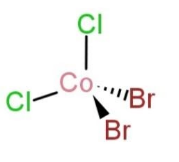
In tetrahedral geometry, the ligands are attached adjacent to the central metal ion, which does not lead to any type of isomerization, so isomer structure is only 1 in this case. The shape is as follows:
While in square planar shape of a complex with the type $M{{X}_{2}}{{Y}_{2}}$, the isomers are cis, and trans. In cis, the groups are at adjacent sides, while in trans, the groups are on opposite sides. So, two isomers exist in this type with square planar. The isomers are:
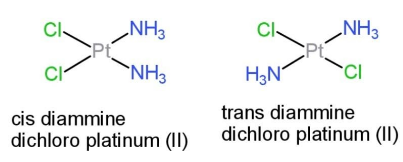
Hence, maximum isomers in tetrahedral geometry can be 1 and that in square planar 2.
Additional information: cis diammine dichloro platinum (II) is also known as cisplatin, which is used in the treatment of cancer.
So, option A is correct.
Note: Some examples of monodentate ligands are, $N{{H}_{3}},\,\,{{H}_{2}}O,\,\,C{{l}^{-}},\,B{{r}^{-}},\,C{{N}^{-}}$, all halogens are monodentate. While polydentate ligands are, oxalate and EDTA.
Complete step by step solution: Stereo isomerism in chemical complexes leads to various shapes of the complexes. The type $M{{X}_{2}}{{Y}_{2}}$complex can either have tetrahedral or square planar geometry.
In tetrahedral geometry, the ligands are attached adjacent to the central metal ion, which does not lead to any type of isomerization, so isomer structure is only 1 in this case. The shape is as follows:
While in square planar shape of a complex with the type $M{{X}_{2}}{{Y}_{2}}$, the isomers are cis, and trans. In cis, the groups are at adjacent sides, while in trans, the groups are on opposite sides. So, two isomers exist in this type with square planar. The isomers are:
Hence, maximum isomers in tetrahedral geometry can be 1 and that in square planar 2.
Additional information: cis diammine dichloro platinum (II) is also known as cisplatin, which is used in the treatment of cancer.
So, option A is correct.
Note: Some examples of monodentate ligands are, $N{{H}_{3}},\,\,{{H}_{2}}O,\,\,C{{l}^{-}},\,B{{r}^{-}},\,C{{N}^{-}}$, all halogens are monodentate. While polydentate ligands are, oxalate and EDTA.
Recently Updated Pages
Explain the structure of megasporangium class 12 biology CBSE

Why is chloroform kept in dark coloured bottles class 12 chemistry CBSE
Derive the balancing condition of a Wheatstone bri class 12 physics CBSE
Draw VI characteristics of a pn junction diode Explain class 12 physics CBSE
Is it possible to carry pride in ones language too class 12 english CBSE
In a population at Hardy Weinberg equilibrium the allele class 12 biology CBSE
Trending doubts
Draw a labelled sketch of the human eye class 12 physics CBSE
Which are the Top 10 Largest Countries of the World?
Draw ray diagrams each showing i myopic eye and ii class 12 physics CBSE
Which is the correct genotypic ratio of mendel dihybrid class 12 biology CBSE
Differentiate between homogeneous and heterogeneous class 12 chemistry CBSE
Which animal never drinks water in its entire life class 12 biology CBSE