




A convex lens used in a simple microscope produces a magnification of 5. The image is formed at the least distance of distant vision. What is the focal length of the lens?
Answer
 Verified
623.7k+ views
Hint: A microscope is a device used to observe tiny objects, so we need a good magnification lens in order to see these tiny objects clearly. The minimum distance from which a healthy human eye can see an object clearly is known as the least distance of distant vision.
Complete step by step answer:
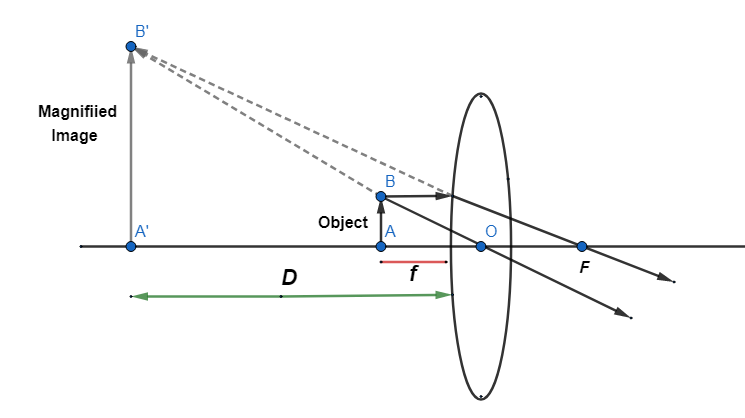
So the simple microscope consists of a single convex lens of focal length f, this lens is placed very close to the object such that the object falls between the focal length f of the convex lens. This leads to the formation of an enlarged image of the image. Most of the time, the lens is adjusted to get an image at the least distance of distant vision (D), so the image will be clear and magnified. The magnification (m) caused by the simple microscope is given by the formula,
$\text{m}=1+\dfrac{\text{D}}{\text{f}}$
Where,
D is the least distance of distant vision which is our image position.
f is the focal length of the lens.
So in the problem, it is given that the magnification of the given simple microscope is 5 and the image is formed at D., So we substitute this in the equation given above,
$5=1+\dfrac{\text{D}}{\text{f}}$
The value of D is 25cm. (For every healthy eye)
$4=\dfrac{25}{\text{f}}$
$\therefore \text{f}=\dfrac{25}{4}=6.25$
So the focal length of the simple microscope is 6.25 cm.
Note:
A simple microscope can produce a magnification of 10-15x times.
A compound microscope is an upgraded version of a simple microscope, which provides magnification up to 1000 times the size of the object.
A compound microscope is produced by using multiple lenses, and its total magnification power is the product of magnification power of each lens.
Complete step by step answer:
So the simple microscope consists of a single convex lens of focal length f, this lens is placed very close to the object such that the object falls between the focal length f of the convex lens. This leads to the formation of an enlarged image of the image. Most of the time, the lens is adjusted to get an image at the least distance of distant vision (D), so the image will be clear and magnified. The magnification (m) caused by the simple microscope is given by the formula,
$\text{m}=1+\dfrac{\text{D}}{\text{f}}$
Where,
D is the least distance of distant vision which is our image position.
f is the focal length of the lens.
So in the problem, it is given that the magnification of the given simple microscope is 5 and the image is formed at D., So we substitute this in the equation given above,
$5=1+\dfrac{\text{D}}{\text{f}}$
The value of D is 25cm. (For every healthy eye)
$4=\dfrac{25}{\text{f}}$
$\therefore \text{f}=\dfrac{25}{4}=6.25$
So the focal length of the simple microscope is 6.25 cm.
Note:
A simple microscope can produce a magnification of 10-15x times.
A compound microscope is an upgraded version of a simple microscope, which provides magnification up to 1000 times the size of the object.
A compound microscope is produced by using multiple lenses, and its total magnification power is the product of magnification power of each lens.
Recently Updated Pages
Master Class 12 Business Studies: Engaging Questions & Answers for Success

Master Class 12 Chemistry: Engaging Questions & Answers for Success
Master Class 12 Biology: Engaging Questions & Answers for Success
Class 12 Question and Answer - Your Ultimate Solutions Guide
Master Class 11 English: Engaging Questions & Answers for Success
Master Class 11 Maths: Engaging Questions & Answers for Success
Trending doubts
Which is more stable and why class 12 chemistry CBSE
Which are the Top 10 Largest Countries of the World?
Draw a labelled sketch of the human eye class 12 physics CBSE
Differentiate between homogeneous and heterogeneous class 12 chemistry CBSE
What are the major means of transport Explain each class 12 social science CBSE
Sulphuric acid is known as the king of acids State class 12 chemistry CBSE