




A convex lens of focal length is $\dfrac{2}{3}$times \[R\]. Find the refractive index of the material.
Answer
 Verified
499.2k+ views
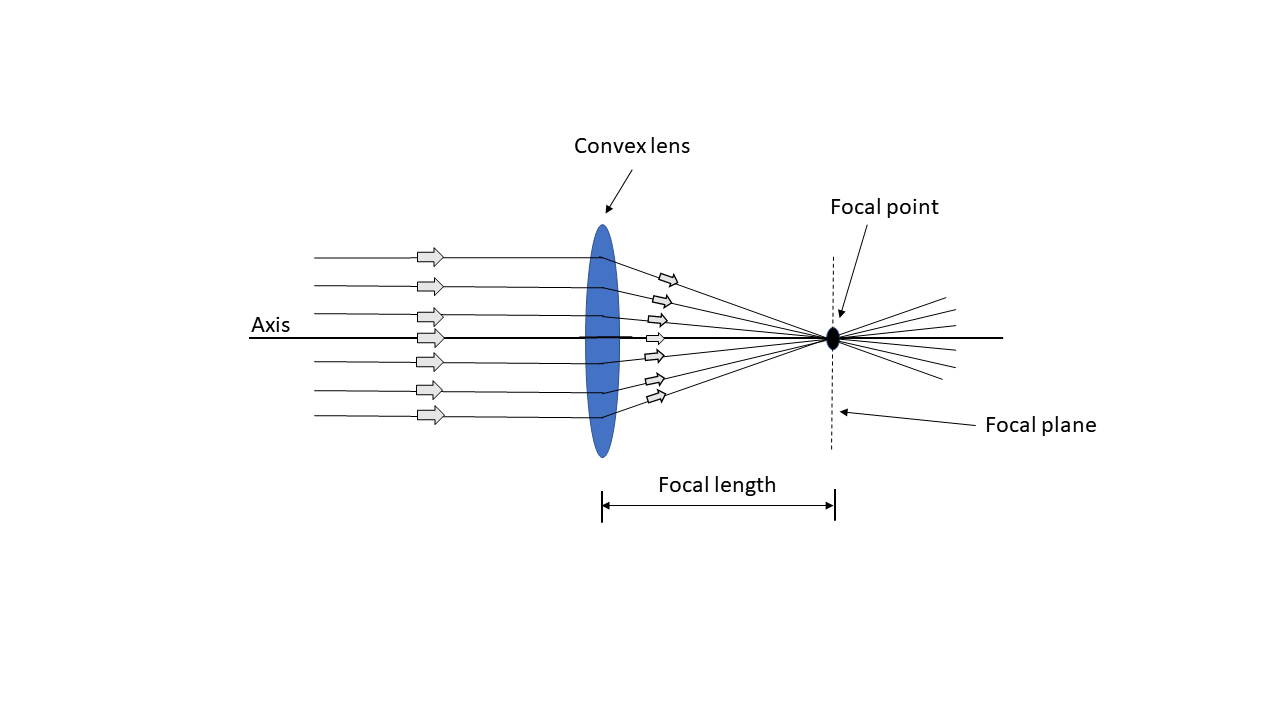
Hint: We are going to find the refractive index of the material with the given focal length is $\dfrac{2}{3}$ times \[R\] .We need to discuss the convex lens and the formula used to find the focal length of the convex lens. A lens is a material having one of the surfaces curved. The convex lens containing a surface bulged on one side is called a simple convex lens. Refractive index is defined as the ratio between the velocity of light in a vacuum$(c)$ and the velocity of light in a given substance $(v)$. It is also the ratio between the sine of the angle of incidence $(\sin i)$ and the angle of refraction $(\sin r)$.
Formula used:
Using Len’s maker's formula, the focal length of a lens is given by
$\dfrac{1}{f} = \left( {n - 1} \right)\left( {\dfrac{1}{{{R_1}}} - \dfrac{1}{{{R_2}}}} \right)$
Where,
$f$- focal length of a lens
$n$- refractive index of the material
${R_1},{R_2}$ - radii of curvature of the lens
Complete step by step solution:
From the given data, the focal length is $f = \dfrac{2}{3}R$.
For convex lens,
${R_1} = + R,{R_2} = - R$.
Applying these values in the above formula,
$\dfrac{1}{f} = \left( {n - 1} \right)\left( {\dfrac{1}{{{R_1}}} - \dfrac{1}{{{R_2}}}} \right)$ , this formula becomes
$ \Rightarrow \dfrac{1}{{\left( {\dfrac{2}{3}R} \right)}} = \left( {n - 1} \right)\left( {\dfrac{1}{R} - \dfrac{1}{{ - R}}} \right)$
$ \Rightarrow \dfrac{3}{{2R}} = \left( {n - 1} \right)\left( {\dfrac{1}{R} + \dfrac{1}{R}} \right)$
$ \Rightarrow \dfrac{3}{{2R}} = \left( {n - 1} \right)\left( {\dfrac{2}{R}} \right)$
$ \Rightarrow \dfrac{3}{{2R}} \times \dfrac{R}{2} = \left( {n - 1} \right)$,
$ \Rightarrow \dfrac{3}{4} = \left( {n - 1} \right)$
$ \Rightarrow n = \left( {\dfrac{3}{4} + 1} \right)$
$ \Rightarrow n = \left( {\dfrac{7}{4}} \right)$
$\therefore n = 1.75$
From the above calculations, we found that the refractive index of the material $n = 1.75$ when the focal length of the convex lens is,
$f = \dfrac{2}{3}R$.
Note:
The collimated beam, when passing through the convex lens, is focused in a spot. The distance between the lens and the point focused by the converging beam is called focal length and that point is known as the focal point. The convex lenses are in cameras, microscopes, eyeglasses, projectors, etc. The Convex lens is mainly used for converging all incident rays to a particular point.
Formula used:
Using Len’s maker's formula, the focal length of a lens is given by
$\dfrac{1}{f} = \left( {n - 1} \right)\left( {\dfrac{1}{{{R_1}}} - \dfrac{1}{{{R_2}}}} \right)$
Where,
$f$- focal length of a lens
$n$- refractive index of the material
${R_1},{R_2}$ - radii of curvature of the lens
Complete step by step solution:
From the given data, the focal length is $f = \dfrac{2}{3}R$.
For convex lens,
${R_1} = + R,{R_2} = - R$.
Applying these values in the above formula,
$\dfrac{1}{f} = \left( {n - 1} \right)\left( {\dfrac{1}{{{R_1}}} - \dfrac{1}{{{R_2}}}} \right)$ , this formula becomes
$ \Rightarrow \dfrac{1}{{\left( {\dfrac{2}{3}R} \right)}} = \left( {n - 1} \right)\left( {\dfrac{1}{R} - \dfrac{1}{{ - R}}} \right)$
$ \Rightarrow \dfrac{3}{{2R}} = \left( {n - 1} \right)\left( {\dfrac{1}{R} + \dfrac{1}{R}} \right)$
$ \Rightarrow \dfrac{3}{{2R}} = \left( {n - 1} \right)\left( {\dfrac{2}{R}} \right)$
$ \Rightarrow \dfrac{3}{{2R}} \times \dfrac{R}{2} = \left( {n - 1} \right)$,
$ \Rightarrow \dfrac{3}{4} = \left( {n - 1} \right)$
$ \Rightarrow n = \left( {\dfrac{3}{4} + 1} \right)$
$ \Rightarrow n = \left( {\dfrac{7}{4}} \right)$
$\therefore n = 1.75$
From the above calculations, we found that the refractive index of the material $n = 1.75$ when the focal length of the convex lens is,
$f = \dfrac{2}{3}R$.
Note:
The collimated beam, when passing through the convex lens, is focused in a spot. The distance between the lens and the point focused by the converging beam is called focal length and that point is known as the focal point. The convex lenses are in cameras, microscopes, eyeglasses, projectors, etc. The Convex lens is mainly used for converging all incident rays to a particular point.
Recently Updated Pages
Master Class 12 Business Studies: Engaging Questions & Answers for Success

Master Class 12 Chemistry: Engaging Questions & Answers for Success
Master Class 12 Biology: Engaging Questions & Answers for Success
Class 12 Question and Answer - Your Ultimate Solutions Guide
Master Class 9 General Knowledge: Engaging Questions & Answers for Success
Master Class 9 Maths: Engaging Questions & Answers for Success
Trending doubts
Which are the Top 10 Largest Countries of the World?
Draw a labelled sketch of the human eye class 12 physics CBSE
Name the crygenes that control cotton bollworm and class 12 biology CBSE
Differentiate between homogeneous and heterogeneous class 12 chemistry CBSE
In a transcription unit the promoter is said to be class 12 biology CBSE
Sulphuric acid is known as the king of acids State class 12 chemistry CBSE