




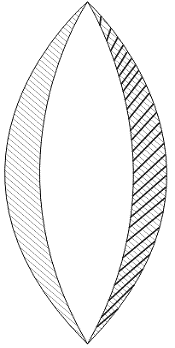
A convex lens is made of 3 layers of glass of 3 different materials as in the figure. A point object is placed on its axis. The number of images of the object are
A. 1
B. 2
C. 3
D. 4
Answer
 Verified
550.5k+ views
Hint: The given convex lens which is made up of three different materials will overall act an equivalent convex lens only. Due to which it will exhibit the same properties as that of any other convex lens and will form the same number of images as any other convex lens.
Complete step by step solution: We are given a convex lens which is made up of three layers of glass which are of three different materials. When the light will pass through these layers of different types of glasses, the ray will undergo refraction but bending will depend on the refractive index of the particular type of glass. The following diagram shows how a light ray will pass through this type of lens.
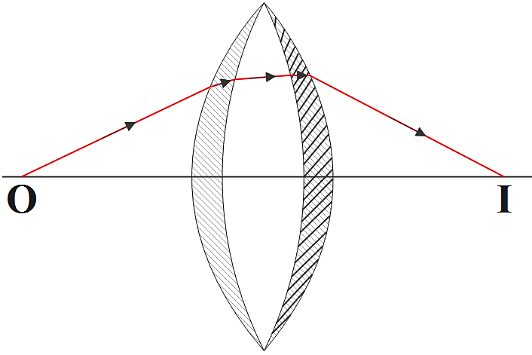
We can say that overall the combination of these three types of material will be equivalent to a convex lens only. This means that it will exhibit the same characteristics as that of a normal convex lens. Since a convex lens always forms only one image, therefore, this lens will also form only one image.
Also, we will have only one focal length for this lens and the number of images formed are equal to the number of focal lengths.
Hence, the correct answer is option A.
Note: It should be noted that though there will be only one image formed by the given lens, the position of the image will not be the same as that of the ordinary convex lens of the same size. The bending of light inside the lens will depend on the refractive index of the material due to which the position of the image formed will be different from that of an ordinary lens.
Complete step by step solution: We are given a convex lens which is made up of three layers of glass which are of three different materials. When the light will pass through these layers of different types of glasses, the ray will undergo refraction but bending will depend on the refractive index of the particular type of glass. The following diagram shows how a light ray will pass through this type of lens.
We can say that overall the combination of these three types of material will be equivalent to a convex lens only. This means that it will exhibit the same characteristics as that of a normal convex lens. Since a convex lens always forms only one image, therefore, this lens will also form only one image.
Also, we will have only one focal length for this lens and the number of images formed are equal to the number of focal lengths.
Hence, the correct answer is option A.
Note: It should be noted that though there will be only one image formed by the given lens, the position of the image will not be the same as that of the ordinary convex lens of the same size. The bending of light inside the lens will depend on the refractive index of the material due to which the position of the image formed will be different from that of an ordinary lens.
Recently Updated Pages
Master Class 12 Economics: Engaging Questions & Answers for Success

Master Class 12 Physics: Engaging Questions & Answers for Success
Master Class 12 English: Engaging Questions & Answers for Success
Master Class 12 Social Science: Engaging Questions & Answers for Success
Master Class 12 Maths: Engaging Questions & Answers for Success
Master Class 12 Business Studies: Engaging Questions & Answers for Success
Trending doubts
Which are the Top 10 Largest Countries of the World?
What are the major means of transport Explain each class 12 social science CBSE
Draw a labelled sketch of the human eye class 12 physics CBSE
Why cannot DNA pass through cell membranes class 12 biology CBSE
Differentiate between insitu conservation and exsitu class 12 biology CBSE
Draw a neat and well labeled diagram of TS of ovary class 12 biology CBSE