



A converging lens is used to form an image on a screen. When the upper half of the lens is covered by an opaque screen-
a. Half of the image will disappear.
b. No part of the image will disappear.
c. Intensity of the image will increase.
d. Intensity of the image will decrease.
$
{\text{A}}{\text{. a and c are true}} \\
{\text{B}}{\text{. a and d are true}} \\
{\text{C}}{\text{. b and c are true}} \\
{\text{D}}{\text{. b and d are true}} \\
$
Answer
 Verified
607.2k+ views
Hint: Think of the number of rays required to form an image. The opaque screen will let less light pass.
Complete answer:
The opaque screen allows less light to pass through. But while the formation of an image at least 2 rays are required, so those 2 rays can come even from the uncovered part of the lens. Therefore, there shall be no effect on the image formation, i.e. no disappearance a complete image.
Image before covering
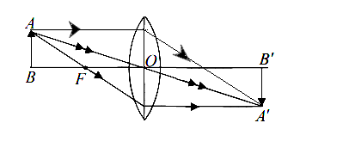
Image after covering
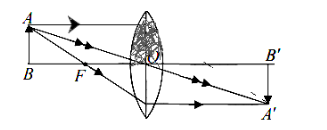
The image still gets formed. There are a million rays emerging out from any visible source for image to form.
On covering half portion of the converging lens with a screen, opaque in nature the image will not disappear.
Although, the intensity of the image will be reduced. We will not obtain a sharp image of the object since only half of the light rays are reaching out to form an image. Therefore, the intensity is halved.
So the impact is seen on intensity only.
So, the correct answer is “Option D”.
Note:
Had it been a concave lens the answer would still have been the same. This can be checked by a ray diagram for the concave lens.
Complete answer:
The opaque screen allows less light to pass through. But while the formation of an image at least 2 rays are required, so those 2 rays can come even from the uncovered part of the lens. Therefore, there shall be no effect on the image formation, i.e. no disappearance a complete image.
Image before covering
Image after covering
The image still gets formed. There are a million rays emerging out from any visible source for image to form.
On covering half portion of the converging lens with a screen, opaque in nature the image will not disappear.
Although, the intensity of the image will be reduced. We will not obtain a sharp image of the object since only half of the light rays are reaching out to form an image. Therefore, the intensity is halved.
So the impact is seen on intensity only.
So, the correct answer is “Option D”.
Note:
Had it been a concave lens the answer would still have been the same. This can be checked by a ray diagram for the concave lens.
Recently Updated Pages
Master Class 12 Business Studies: Engaging Questions & Answers for Success

Master Class 12 Chemistry: Engaging Questions & Answers for Success
Master Class 12 Biology: Engaging Questions & Answers for Success
Class 12 Question and Answer - Your Ultimate Solutions Guide
Master Class 11 English: Engaging Questions & Answers for Success
Master Class 11 Maths: Engaging Questions & Answers for Success
Trending doubts
Which is more stable and why class 12 chemistry CBSE
Which are the Top 10 Largest Countries of the World?
Draw a labelled sketch of the human eye class 12 physics CBSE
Differentiate between homogeneous and heterogeneous class 12 chemistry CBSE
What are the major means of transport Explain each class 12 social science CBSE
Sulphuric acid is known as the king of acids State class 12 chemistry CBSE