




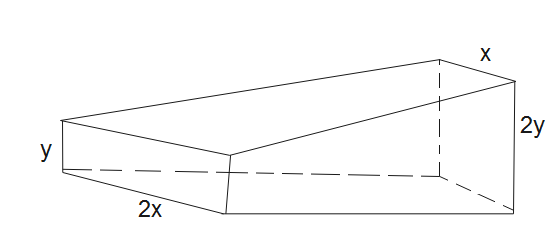
A conductor is made of an isotropic material (resistivity$\rho $) has rectangular cross-section. The horizontal dimensions of the conductor decrease linearly from $2x$ at one end to $x$ on the other end and vertical dimensions increase from $y$ to $2y$ as shown in the figure. The length of the conductor along the axis is equal to $l$ and a battery is connected across the conductor, then
(A). Resistance of the conductor is equal to $\dfrac{4\rho l}{9xy}$
(B). Resistance of the conductor is equal to $\dfrac{9\rho l}{4xy}$
(C). Drift velocity of the conduction electrons is maximum in the middle section
(D). Drift velocity of the conduction electrons is minimum in the middle section
Answer
 Verified
561k+ views
Hint: The conductor given in the above figure has a variable area. So the area through which the charge passes changes continuously. The length along x-axis decreases along z-axis and the length along y-axis increases with increase in z-axis, so a direct relation exists between them. Drift velocity is average velocity of electrons; it depends on current, charge density, magnitude of charge and area of cross section.
Formula used:
$A=x'y'$
${{v}_{d}}=\dfrac{I}{NAQ}$
Complete step-by-step solution:
Given that the dimensions along x-axis decrease linearly with z-axis and the dimensions along the y-axis increase linearly with z-axis.
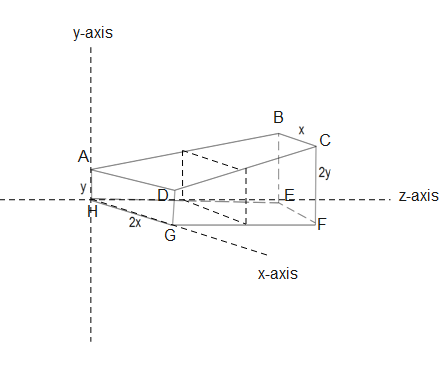
The area of an arbitrary face in the figure through which the charge passes will be-
$\begin{align}
& A=x'y' \\
& \Rightarrow A=(2x-xz)(y+yz) \\
& \Rightarrow A=xy(2-z)(1+z) \\
\end{align}$
We differentiate the above equation with respect to z and equate it to zero to get,
$\begin{align}
& xy(-1)(1+z)+xy(2-z)(1)=0 \\
& \Rightarrow -1-z+2-z=0 \\
& \Rightarrow 2z=1 \\
& \therefore z=0.5 \\
\end{align}$
Therefore, the area will be maximum at $z=0.5$.
The average velocity of charges flowing through a conductor due to the presence of an electric field is known as drift velocity. It is given by-
${{v}_{d}}=\dfrac{I}{NAQ}$
Here,
${{v}_{d}}$ is the drift velocity
$I$ is the current flowing through the conductor
$N$ is the charge density
$A$ is the area of cross section
$Q$ is the magnitude of charge
From the above equation we can see that,
${{v}_{d}}\propto \dfrac{1}{A}$
Drift velocity is inversely proportional to the area. Thus, the drift velocity will be minimum where the area is maximum. Therefore, the drift velocity is minimum at $z=0.5$
Therefore, the drift velocity is minimum in the middle of the conductor.
Hence, the correct option is (D).
Note:
The average velocity of all charges comes out to be zero. Charge flows from a region of high potential to a region of low potential. The drift velocity also depends on the electron mobility; it is the measure of how quickly an electron moves in a conductor or semiconductor. Electron mobility depends on temperature so drift velocity also depends on temperature.
Formula used:
$A=x'y'$
${{v}_{d}}=\dfrac{I}{NAQ}$
Complete step-by-step solution:
Given that the dimensions along x-axis decrease linearly with z-axis and the dimensions along the y-axis increase linearly with z-axis.
The area of an arbitrary face in the figure through which the charge passes will be-
$\begin{align}
& A=x'y' \\
& \Rightarrow A=(2x-xz)(y+yz) \\
& \Rightarrow A=xy(2-z)(1+z) \\
\end{align}$
We differentiate the above equation with respect to z and equate it to zero to get,
$\begin{align}
& xy(-1)(1+z)+xy(2-z)(1)=0 \\
& \Rightarrow -1-z+2-z=0 \\
& \Rightarrow 2z=1 \\
& \therefore z=0.5 \\
\end{align}$
Therefore, the area will be maximum at $z=0.5$.
The average velocity of charges flowing through a conductor due to the presence of an electric field is known as drift velocity. It is given by-
${{v}_{d}}=\dfrac{I}{NAQ}$
Here,
${{v}_{d}}$ is the drift velocity
$I$ is the current flowing through the conductor
$N$ is the charge density
$A$ is the area of cross section
$Q$ is the magnitude of charge
From the above equation we can see that,
${{v}_{d}}\propto \dfrac{1}{A}$
Drift velocity is inversely proportional to the area. Thus, the drift velocity will be minimum where the area is maximum. Therefore, the drift velocity is minimum at $z=0.5$
Therefore, the drift velocity is minimum in the middle of the conductor.
Hence, the correct option is (D).
Note:
The average velocity of all charges comes out to be zero. Charge flows from a region of high potential to a region of low potential. The drift velocity also depends on the electron mobility; it is the measure of how quickly an electron moves in a conductor or semiconductor. Electron mobility depends on temperature so drift velocity also depends on temperature.
Recently Updated Pages
Master Class 12 Economics: Engaging Questions & Answers for Success

Master Class 12 Physics: Engaging Questions & Answers for Success
Master Class 12 English: Engaging Questions & Answers for Success
Master Class 12 Social Science: Engaging Questions & Answers for Success
Master Class 12 Maths: Engaging Questions & Answers for Success
Master Class 12 Business Studies: Engaging Questions & Answers for Success
Trending doubts
Which are the Top 10 Largest Countries of the World?
What are the major means of transport Explain each class 12 social science CBSE
Draw a labelled sketch of the human eye class 12 physics CBSE
Why cannot DNA pass through cell membranes class 12 biology CBSE
Differentiate between insitu conservation and exsitu class 12 biology CBSE
Draw a neat and well labeled diagram of TS of ovary class 12 biology CBSE