




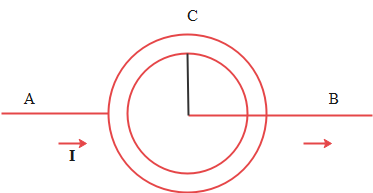
A conductor AB lies along the axis of a circular conducting loop C of radius r. If the current in the conductor AB varies at the rate of $x\,A/s$, then what is the induced emf in the coil?
A. $\dfrac{{{\mu }_{0}}rx}{2}$
B. $\dfrac{1}{4}\pi xr$
C. $\dfrac{{{\mu }_{0}}\pi xr}{2}$
D. zero
Answer
 Verified
580.2k+ views
Hint: The magnitude of induced emf in a circuit is equivalent to rate of change in magnetic flux through the circuit. So, we will find the rate of change of the magnetic flux through the coil. The same value will be the induced emf in the coil.
Formula used:
Magnetic flux of a circuit, $\phi =\mathbf{B}.\mathbf{A}=BA\,\cos \theta $ ; Induced emf, $\epsilon =-\dfrac{d{{\phi }_{B}}}{dt}$
Complete answer:
Magnetic flux $\phi$ is the measurement of magnetic field passing normally through an area. Magnetic flux through an area is given by dot product of magnetic field and area vector.
$\phi =\mathbf{B}.\mathbf{A}$
$\phi =BA\,\cos \theta $
Where $\theta$ is the angle between magnetic field $\mathbf{B}$ and area vector $\mathbf{A}$.
Area vector is defined as the vector of a plane surface. Its magnitude is similar to that of the plane and direction is normal to that plane.
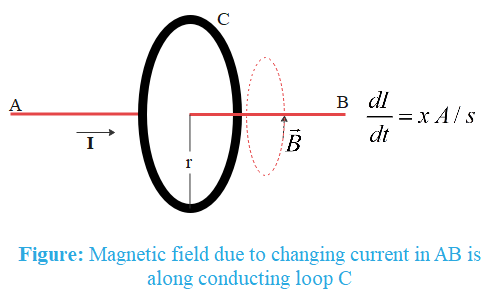
The magnitude of induced emf in a circuit is equivalent to rate of change in magnetic flux through the circuit. Therefore,
$\dfrac{d{{\phi }_{B}}}{dt}=\dfrac{dB}{dt}A\,\cos \theta $ (Since, area is not changing)
Direction of this magnetic field is given by the right hand thumb rule, which states that when we point the thumb of our right hand along the direction of current, the direction of curled fingers gives the direction of the magnetic field.
Applying this rule on straight wire AB, direction of magnetic field is as shown in figure.
The direction of magnetic field lines is always perpendicular to the area vector of the coil. Therefore, $\theta ={{90}^{{}^\circ }}$. This implies that
$\epsilon =-\dfrac{d\phi }{dt}=\dfrac{dB}{dt}A\,\cos {{90}^{{}^\circ }}=0$
So, the correct answer is “Option D”.
Note:
Moving charges can produce both electric and magnetic fields. Stationary charges do not produce magnetic fields.
Direction of the area vector is always normal to the plane of the surface. Sometimes students may assume the direction of the area vector along the diameter which will lead to the wrong result.
Formula used:
Magnetic flux of a circuit, $\phi =\mathbf{B}.\mathbf{A}=BA\,\cos \theta $ ; Induced emf, $\epsilon =-\dfrac{d{{\phi }_{B}}}{dt}$
Complete answer:
Magnetic flux $\phi$ is the measurement of magnetic field passing normally through an area. Magnetic flux through an area is given by dot product of magnetic field and area vector.
$\phi =\mathbf{B}.\mathbf{A}$
$\phi =BA\,\cos \theta $
Where $\theta$ is the angle between magnetic field $\mathbf{B}$ and area vector $\mathbf{A}$.
Area vector is defined as the vector of a plane surface. Its magnitude is similar to that of the plane and direction is normal to that plane.
The magnitude of induced emf in a circuit is equivalent to rate of change in magnetic flux through the circuit. Therefore,
$\dfrac{d{{\phi }_{B}}}{dt}=\dfrac{dB}{dt}A\,\cos \theta $ (Since, area is not changing)
Direction of this magnetic field is given by the right hand thumb rule, which states that when we point the thumb of our right hand along the direction of current, the direction of curled fingers gives the direction of the magnetic field.
Applying this rule on straight wire AB, direction of magnetic field is as shown in figure.
The direction of magnetic field lines is always perpendicular to the area vector of the coil. Therefore, $\theta ={{90}^{{}^\circ }}$. This implies that
$\epsilon =-\dfrac{d\phi }{dt}=\dfrac{dB}{dt}A\,\cos {{90}^{{}^\circ }}=0$
So, the correct answer is “Option D”.
Note:
Moving charges can produce both electric and magnetic fields. Stationary charges do not produce magnetic fields.
Direction of the area vector is always normal to the plane of the surface. Sometimes students may assume the direction of the area vector along the diameter which will lead to the wrong result.
Recently Updated Pages
Master Class 12 Economics: Engaging Questions & Answers for Success

Master Class 12 Physics: Engaging Questions & Answers for Success
Master Class 12 English: Engaging Questions & Answers for Success
Master Class 12 Social Science: Engaging Questions & Answers for Success
Master Class 12 Maths: Engaging Questions & Answers for Success
Master Class 12 Business Studies: Engaging Questions & Answers for Success
Trending doubts
Which are the Top 10 Largest Countries of the World?
What are the major means of transport Explain each class 12 social science CBSE
Draw a labelled sketch of the human eye class 12 physics CBSE
Why cannot DNA pass through cell membranes class 12 biology CBSE
Differentiate between insitu conservation and exsitu class 12 biology CBSE
Draw a neat and well labeled diagram of TS of ovary class 12 biology CBSE