




A compound whose molecules are superimposable on their mirror images even though they contain asymmetric carbon atoms is called:
A.A threo compound
B.A erythro compound
C.A meso compound
D.None of these
Answer
 Verified
599.4k+ views
Hint:A compound whose molecules are superimposable on their mirror images even though they contain asymmetric carbon atoms is called a meso compound. Compounds whose molecules are superimposable on their mirror images are achiral compounds.
Complete answer:
There are two types of compounds when it comes to rotating the compound structure with respect to the bonds. These are chiral and achiral compounds. A chiral compound is a compound which is not identical to its mirror image, that is, it is not superimposable on its mirror image and achiral compounds are those compounds which are superimposable on their mirror image. This property is known as chirality.
Lets understand this with the help of examples propan-2-ol has no asymmetric carbon atom and all the four different groups attached to it are not different and thus it is superimposable on its mirror image so it is achiral and butan-2-ol has four different groups attached to it which makes it not identical to its mirror image and is thus a chiral compound.
A compound which is not capable of optical rotation is called optically inactive and the compounds which can rotate optically are known as optically active and achiral compounds are optically inactive. The stereoisomers which are related to each other as non-superimposable mirror images, that is, if they are chiral compounds then these are called enantiomers.
So, according to the question, compounds whose molecules are superimposable on their mirror images even though it contains asymmetric carbon atoms are called a meso compound. They are optically inactive even though they contain chiral carbon atoms but due to plane of symmetry they are inactive optically.
So, the correct option of the question is option (C) A meso compound.
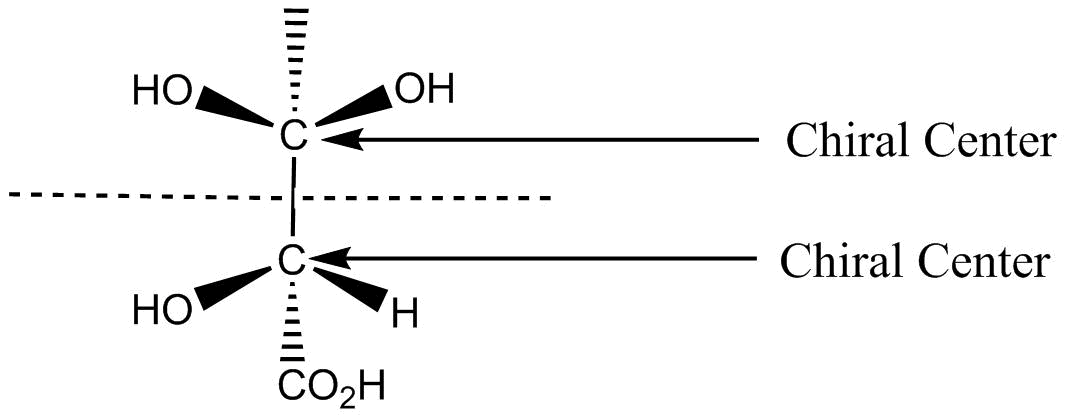
Example of meso compound
Note:
A mixture containing two enantiomers in equal proportions will have zero optical rotation. This is because the rotation of one is cancelled out by the other isomer. This kind of mixture is known as the racemic mixture or racemic modification.
Complete answer:
There are two types of compounds when it comes to rotating the compound structure with respect to the bonds. These are chiral and achiral compounds. A chiral compound is a compound which is not identical to its mirror image, that is, it is not superimposable on its mirror image and achiral compounds are those compounds which are superimposable on their mirror image. This property is known as chirality.
Lets understand this with the help of examples propan-2-ol has no asymmetric carbon atom and all the four different groups attached to it are not different and thus it is superimposable on its mirror image so it is achiral and butan-2-ol has four different groups attached to it which makes it not identical to its mirror image and is thus a chiral compound.
A compound which is not capable of optical rotation is called optically inactive and the compounds which can rotate optically are known as optically active and achiral compounds are optically inactive. The stereoisomers which are related to each other as non-superimposable mirror images, that is, if they are chiral compounds then these are called enantiomers.
So, according to the question, compounds whose molecules are superimposable on their mirror images even though it contains asymmetric carbon atoms are called a meso compound. They are optically inactive even though they contain chiral carbon atoms but due to plane of symmetry they are inactive optically.
So, the correct option of the question is option (C) A meso compound.
Example of meso compound
Note:
A mixture containing two enantiomers in equal proportions will have zero optical rotation. This is because the rotation of one is cancelled out by the other isomer. This kind of mixture is known as the racemic mixture or racemic modification.
Recently Updated Pages
Master Class 12 Business Studies: Engaging Questions & Answers for Success

Master Class 12 Chemistry: Engaging Questions & Answers for Success
Master Class 12 Biology: Engaging Questions & Answers for Success
Class 12 Question and Answer - Your Ultimate Solutions Guide
Master Class 11 English: Engaging Questions & Answers for Success
Master Class 11 Social Science: Engaging Questions & Answers for Success
Trending doubts
Which are the Top 10 Largest Countries of the World?
Draw a labelled sketch of the human eye class 12 physics CBSE
Differentiate between homogeneous and heterogeneous class 12 chemistry CBSE
Why is the cell called the structural and functional class 12 biology CBSE
Draw ray diagrams each showing i myopic eye and ii class 12 physics CBSE
Which is the correct genotypic ratio of mendel dihybrid class 12 biology CBSE