




A closed container contains N molecules at P atm and T K. If the absolute temperature is doubled:
A.Number of molecules present in the container will become \[2N\].
B.Number of molecules present in the container will become \[N/2\].
C.Gas pressure becomes \[2P\].
D.Gas pressure becomes \[P/2\].
Answer
 Verified
629.7k+ views
Hint: We have to know about Gay-Lussac’s law. We can state Gay-Lussac’s law as the pressure exerted by the gas is directly proportional to the absolute temperature at fixed mass and constant volume. The pressure of a gas at constant volume decreases constantly when it’s cooled until the gas undergoes the process of condensation and turns to a liquid. We can obtain a linear plot by graphing the relationship between pressure at constant volume and absolute temperature for a given mass of a gas.
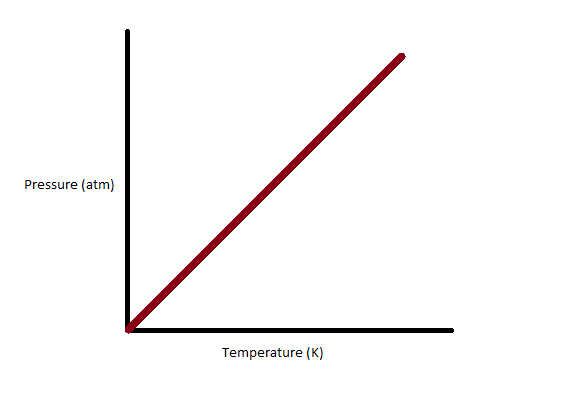
Complete step by step answer:At constant volume, for a fixed mass, the ratio of the initial temperature and pressure is equal to the ratio of final temperature and pressure is implied by Gay-Lussac’s law.
We can express the statement by using the formula,
$\left( {\dfrac{{{P_1}}}{{{T_1}}}} \right) = \left( {\dfrac{{{P_2}}}{{{T_2}}}} \right)$
Here, The initial pressure is expressed as ${P_1}$.
The final pressure is expressed as ${P_2}$.
The initial temperature is expressed as ${T_1}$.
The final temperature is expressed as ${T_2}$.
We know that for a given mass, at constant volume
$P\alpha T$
We can write the proportionality constant expression for initial pressure and temperature as,
$
\dfrac{{{\text{Initial}}\,{\text{pressure}}}}{{{\text{Initial}}\,{\text{temperature}}}}{\text{ = constant}} \\
\dfrac{{{P_1}}}{{{T_1}}}{\text{ = }}k \\
$
We can write the proportionality constant expression for final pressure and temperature as,
$
\dfrac{{{\text{Final}}\,{\text{pressure}}}}{{{\text{Final}}\,{\text{temperature}}}}{\text{ = constant}} \\
\dfrac{{{P_2}}}{{{T_2}}} = k \\
$
Therefore, we can write the obtain expressions for initial pressure and temperature along with final pressure and temperature as,
$\dfrac{{P{_1}}}{{{T_1}}} = \dfrac{{{P_2}}}{{{T_1}}} = k\,\,\left( {or} \right)\,\,{P_1}{T_1} = {P_2}{T_2}$
A closed container contains the N number of molecules at Pressure P atm, temperature T K.
Since it is a closed container, the number of molecules would remain the same.
Let Pressure be P be the initial pressure.
$\dfrac{{{P_1}}}{{{T_1}}} = \dfrac{{{P_2}}}{{{T_2}}}$
The absolute temperature is doubled, then ${T_2} = 2{T_1}$
The expression becomes,
$\dfrac{P}{{{T_1}}} = \dfrac{{{P_2}}}{{2{T_1}}}$
Since, the temperature is doubled, ${P_2} = 2P$
The absolute temperature is doubled, the pressure of the gas will also be doubled.
$\therefore $Option C is correct.
Note:
Let us discuss an example of Gay-Lussac’s law
When we heat a pressurized aerosol such as deodorant can (or) can of spray-paint, there would be an increase in the pressure exerted by the gas on the container, this could lead into an explosion. This is the reason why several pressurized containers contain warning labels telling us why the container must be kept apart from fire and has to be stored in an environment that is cool.
Complete step by step answer:At constant volume, for a fixed mass, the ratio of the initial temperature and pressure is equal to the ratio of final temperature and pressure is implied by Gay-Lussac’s law.
We can express the statement by using the formula,
$\left( {\dfrac{{{P_1}}}{{{T_1}}}} \right) = \left( {\dfrac{{{P_2}}}{{{T_2}}}} \right)$
Here, The initial pressure is expressed as ${P_1}$.
The final pressure is expressed as ${P_2}$.
The initial temperature is expressed as ${T_1}$.
The final temperature is expressed as ${T_2}$.
We know that for a given mass, at constant volume
$P\alpha T$
We can write the proportionality constant expression for initial pressure and temperature as,
$
\dfrac{{{\text{Initial}}\,{\text{pressure}}}}{{{\text{Initial}}\,{\text{temperature}}}}{\text{ = constant}} \\
\dfrac{{{P_1}}}{{{T_1}}}{\text{ = }}k \\
$
We can write the proportionality constant expression for final pressure and temperature as,
$
\dfrac{{{\text{Final}}\,{\text{pressure}}}}{{{\text{Final}}\,{\text{temperature}}}}{\text{ = constant}} \\
\dfrac{{{P_2}}}{{{T_2}}} = k \\
$
Therefore, we can write the obtain expressions for initial pressure and temperature along with final pressure and temperature as,
$\dfrac{{P{_1}}}{{{T_1}}} = \dfrac{{{P_2}}}{{{T_1}}} = k\,\,\left( {or} \right)\,\,{P_1}{T_1} = {P_2}{T_2}$
A closed container contains the N number of molecules at Pressure P atm, temperature T K.
Since it is a closed container, the number of molecules would remain the same.
Let Pressure be P be the initial pressure.
$\dfrac{{{P_1}}}{{{T_1}}} = \dfrac{{{P_2}}}{{{T_2}}}$
The absolute temperature is doubled, then ${T_2} = 2{T_1}$
The expression becomes,
$\dfrac{P}{{{T_1}}} = \dfrac{{{P_2}}}{{2{T_1}}}$
Since, the temperature is doubled, ${P_2} = 2P$
The absolute temperature is doubled, the pressure of the gas will also be doubled.
$\therefore $Option C is correct.
Note:
Let us discuss an example of Gay-Lussac’s law
When we heat a pressurized aerosol such as deodorant can (or) can of spray-paint, there would be an increase in the pressure exerted by the gas on the container, this could lead into an explosion. This is the reason why several pressurized containers contain warning labels telling us why the container must be kept apart from fire and has to be stored in an environment that is cool.
Recently Updated Pages
Master Class 5 English: Engaging Questions & Answers for Success

Master Class 5 Maths: Engaging Questions & Answers for Success
Master Class 5 Social Science: Engaging Questions & Answers for Success
Master Class 5 Science: Engaging Questions & Answers for Success
Class 5 Question and Answer - Your Ultimate Solutions Guide
Master Class 9 General Knowledge: Engaging Questions & Answers for Success
Trending doubts
Which are the Top 10 Largest Countries of the World?
The total number of vertebrae in man is a30 b31 c32 class 12 biology CBSE
Draw a labelled sketch of the human eye class 12 physics CBSE
The number of cranial nerves in a frog is A 10 pairs class 12 biology CBSE
Differentiate between homogeneous and heterogeneous class 12 chemistry CBSE
Differentiate between Pyramid of energy and pyramid class 12 biology CBSE