



A circus tent is cylindrical to a height of 6m and conical above it. If its diameter is 105 m and slant height of the conical portion is 50 m then the total area of canvas required to build the tent is (Use $ \pi = \dfrac{{22}}{7} $ )
A. $ 10230{m^2} $
B. $ 11230{m^2} $
C. $ 14230{m^2} $
D. $ 12340{m^2} $
Answer
 Verified
619.2k+ views
Hint: The tent is made of a cylinder and a cone mounted on it. The diameter is 105 m, height of the cylinder is 6 m and slant height of the cone is 50 m. To find the area of the canvas required to build the tent add the curved surface area of the cylinder and the curved surface area of the cone.
Complete step-by-step answer:
Curved surface area of a cylinder is $ 2\pi rh $ , where r is the radius of the cylinder and h is the height of the cylinder.
Curved surface area of a cone is $ \pi rL $ , where r is the radius of the base of the cone and L is the slant height of the cone.
We are given that a circus tent is cylindrical to a height of 6m and conical above it and its diameter is 105 m and slant height of the conical portion is 50 m.
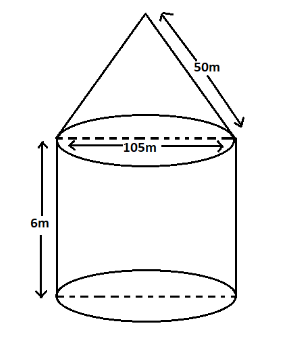
Radius = $ \dfrac{{105}}{2}m $
We have to find the total area of the canvas required to build the tent.
Total area of canvas required = Curved surface area of the cylindrical portion + Curved surface area of the conical portion.
Curved surface area of the cylindrical portion is $ 2\pi rh $
$
\Rightarrow C.S.{A_{cylinder}} = 2\pi rh \\
\Rightarrow r = \dfrac{{105}}{2},h = 6,\pi = \dfrac{{22}}{7} \\
\Rightarrow \to C.S.{A_{cylinder}} = 2 \times \dfrac{{22}}{7} \times \dfrac{{105}}{2} \times 6 \\
\therefore C.S.{A_{cylinder}} = 1980{m^2} \\
$
Curved surface area of the conical portion is $ \pi rL $
$
C.S.{A_{cone}} = \pi rL \\
\Rightarrow r = \dfrac{{105}}{2},L = 50 \\
\Rightarrow \to C.S.{A_{cone}} = \dfrac{{22}}{7} \times \dfrac{{105}}{2} \times 50 \\
\therefore C.S.{A_{cone}} = 8250{m^2} \\
$
Total area = $ C.S.{A_{cylinder}} + C.S.{A_{cone}} = 1980 + 8250 = 10230{m^2} $
The correct option is Option A, $ 10230{m^2} $
So, the correct answer is “Option A”.
Note: Curved surface area is the area of curved surface which is not flat whereas total surface area is the sum of the curved surface area and area of the flat surfaces. Here we have used curved surface area because there is no base and top of the cylinder for the tent; no base for the cone. As there are no flat surfaces so we have to take the curved surface areas. Do not confuse curved surface area with total surface area.
Complete step-by-step answer:
Curved surface area of a cylinder is $ 2\pi rh $ , where r is the radius of the cylinder and h is the height of the cylinder.
Curved surface area of a cone is $ \pi rL $ , where r is the radius of the base of the cone and L is the slant height of the cone.
We are given that a circus tent is cylindrical to a height of 6m and conical above it and its diameter is 105 m and slant height of the conical portion is 50 m.
Radius = $ \dfrac{{105}}{2}m $
We have to find the total area of the canvas required to build the tent.
Total area of canvas required = Curved surface area of the cylindrical portion + Curved surface area of the conical portion.
Curved surface area of the cylindrical portion is $ 2\pi rh $
$
\Rightarrow C.S.{A_{cylinder}} = 2\pi rh \\
\Rightarrow r = \dfrac{{105}}{2},h = 6,\pi = \dfrac{{22}}{7} \\
\Rightarrow \to C.S.{A_{cylinder}} = 2 \times \dfrac{{22}}{7} \times \dfrac{{105}}{2} \times 6 \\
\therefore C.S.{A_{cylinder}} = 1980{m^2} \\
$
Curved surface area of the conical portion is $ \pi rL $
$
C.S.{A_{cone}} = \pi rL \\
\Rightarrow r = \dfrac{{105}}{2},L = 50 \\
\Rightarrow \to C.S.{A_{cone}} = \dfrac{{22}}{7} \times \dfrac{{105}}{2} \times 50 \\
\therefore C.S.{A_{cone}} = 8250{m^2} \\
$
Total area = $ C.S.{A_{cylinder}} + C.S.{A_{cone}} = 1980 + 8250 = 10230{m^2} $
The correct option is Option A, $ 10230{m^2} $
So, the correct answer is “Option A”.
Note: Curved surface area is the area of curved surface which is not flat whereas total surface area is the sum of the curved surface area and area of the flat surfaces. Here we have used curved surface area because there is no base and top of the cylinder for the tent; no base for the cone. As there are no flat surfaces so we have to take the curved surface areas. Do not confuse curved surface area with total surface area.
Recently Updated Pages
Master Class 11 English: Engaging Questions & Answers for Success

Master Class 11 Social Science: Engaging Questions & Answers for Success
Master Class 11 Maths: Engaging Questions & Answers for Success
Master Class 11 Biology: Engaging Questions & Answers for Success
Master Class 11 Physics: Engaging Questions & Answers for Success
Master Class 11 Chemistry: Engaging Questions & Answers for Success
Trending doubts