




A circular metallic loop is kept above the wire AB as shown:
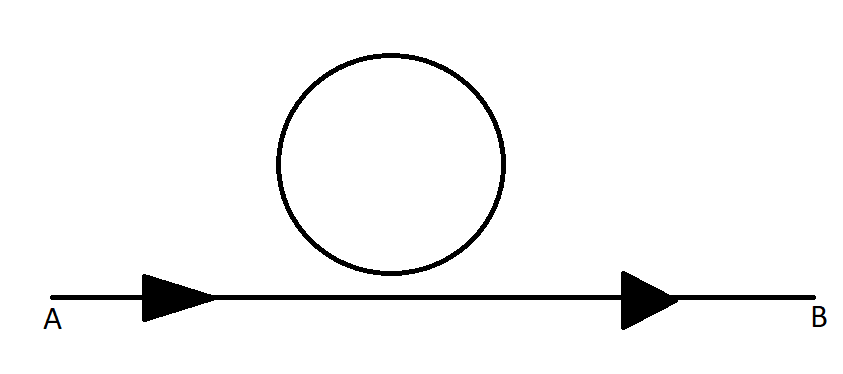
What is the direction of induced current produced in the loop, if the current flowing in the straight wire,
i) is steady, i.e., does not vary?
ii) is increasing in magnitude?
Justify your answer in each case.
Answer
 Verified
568.2k+ views
Hint: 1. The changing magnetic field caused by the material's motion induces a current in the loop of wire proportional to the change in the field.
2. The magnetic flux \[{\phi _b}\] through a surface is the component of the magnetic field passing through that surface. The magnetic flux through some surfaces is proportional to the number of field lines passing through that surface. The magnetic flux passing through a surface of vector area A is
$
{\phi _B} = B.A \\
\Rightarrow {\phi _B} = BA\cos \theta \\ $
3. The strength of the current induced will depend on the changing magnetic flux.
Complete solution:
Let us take the first statement which states that the current is steady
As the current is steady so the magnetic flux linked with the loop will be constant so there will be no change in magnetic flux thus there will be no induced current in the loop
The current is induced in the loop only when there is any fluctuation in magnetic flux
The current is induced to oppose the fluctuation in magnetic flux so if the flux is constant so there will not be induced current.
Now let us take the second statement which says that the current is of increasing magnitude,
Where we know that the flow rate of current is changing thus it will give rise to the fluctuating magnetic flux and the fluctuation in magnetic flux will result in the induction of current in the loop.
The direction of the induced current will be given by Lenz’s law which states that an induced current has a direction such that the magnetic field due to the induced current opposes the change in the magnetic flux that induces the current. In other words, An induced emf acts to oppose the change that produces it.
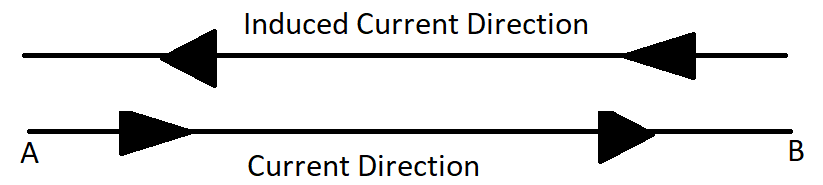
Here in the wire AB, the current is flowing from left to right now as per the lens’s rule the current of induced current has to be opposite to this so the direction of induced current will be right to left since this is a circular loop so the current direction will be in the clockwise direction.
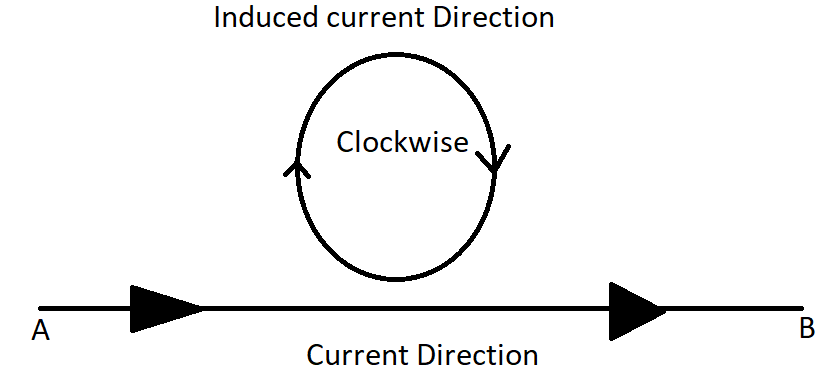
i) There will be no induced emf as current flow is steady so magnetic flux will also be constant so no induced current.
ii) As the current is moving left to right the direction of the induced current will be opposite to it i.e., right to left or we can say clockwise direction in a circular loop.
Note: A current is only induced when there is a fluctuation in magnetic flux
The induced current will always flow in the direction opposite to the current inducing it
Current induced will always tends to oppose the fluctuation in magnetic flux caused by the current inducing it.
2. The magnetic flux \[{\phi _b}\] through a surface is the component of the magnetic field passing through that surface. The magnetic flux through some surfaces is proportional to the number of field lines passing through that surface. The magnetic flux passing through a surface of vector area A is
$
{\phi _B} = B.A \\
\Rightarrow {\phi _B} = BA\cos \theta \\ $
3. The strength of the current induced will depend on the changing magnetic flux.
Complete solution:
Let us take the first statement which states that the current is steady
As the current is steady so the magnetic flux linked with the loop will be constant so there will be no change in magnetic flux thus there will be no induced current in the loop
The current is induced in the loop only when there is any fluctuation in magnetic flux
The current is induced to oppose the fluctuation in magnetic flux so if the flux is constant so there will not be induced current.
Now let us take the second statement which says that the current is of increasing magnitude,
Where we know that the flow rate of current is changing thus it will give rise to the fluctuating magnetic flux and the fluctuation in magnetic flux will result in the induction of current in the loop.
The direction of the induced current will be given by Lenz’s law which states that an induced current has a direction such that the magnetic field due to the induced current opposes the change in the magnetic flux that induces the current. In other words, An induced emf acts to oppose the change that produces it.
Here in the wire AB, the current is flowing from left to right now as per the lens’s rule the current of induced current has to be opposite to this so the direction of induced current will be right to left since this is a circular loop so the current direction will be in the clockwise direction.
i) There will be no induced emf as current flow is steady so magnetic flux will also be constant so no induced current.
ii) As the current is moving left to right the direction of the induced current will be opposite to it i.e., right to left or we can say clockwise direction in a circular loop.
Note: A current is only induced when there is a fluctuation in magnetic flux
The induced current will always flow in the direction opposite to the current inducing it
Current induced will always tends to oppose the fluctuation in magnetic flux caused by the current inducing it.
Recently Updated Pages
Master Class 12 Economics: Engaging Questions & Answers for Success

Master Class 12 Physics: Engaging Questions & Answers for Success
Master Class 12 English: Engaging Questions & Answers for Success
Master Class 12 Social Science: Engaging Questions & Answers for Success
Master Class 12 Maths: Engaging Questions & Answers for Success
Master Class 12 Business Studies: Engaging Questions & Answers for Success
Trending doubts
Why cannot DNA pass through cell membranes class 12 biology CBSE
Draw a neat and well labeled diagram of TS of ovary class 12 biology CBSE
In a human foetus the limbs and digits develop after class 12 biology CBSE
AABbCc genotype forms how many types of gametes a 4 class 12 biology CBSE
Differentiate between homogeneous and heterogeneous class 12 chemistry CBSE
The correct structure of ethylenediaminetetraacetic class 12 chemistry CBSE