




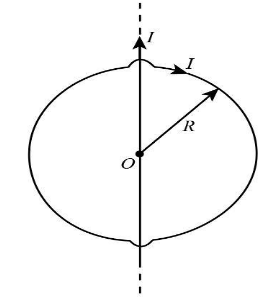
A circular conducting loop of radius R carries current I. Another straight infinite conductor carrying current I passes through the diameter of this loop as shown in the figure. The magnitude of force exerted by the straight conductor of the loop is,
(A) \[\pi {\mu _0}{I^2}\]
(B) \[{\mu _0}{I^2}\]
(C) \[\dfrac{{{\mu _0}{I^2}}}{{2\pi }}\]
(D) \[\dfrac{{{\mu _0}{I^2}}}{\pi }\]
Answer
 Verified
608.7k+ views
Hint: We will use the expression for the magnetic field due to the straight conductor at a point on the loop that is in direct proportionality with the current flowing through it and inversely with the distance between them.
Complete step by step answer:
Let us consider point P and point Q, as shown in the figure below. We will also consider an element of radius R at point P having an angle \[d\theta \].
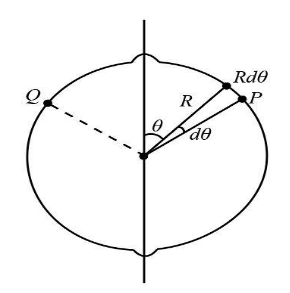
We can write the magnitude of the force exerted by the straight conductor at point P as below:
\[B = \dfrac{{{\mu _0}}}{{2\pi }}\dfrac{I}{r}\]……(1)
Here B is the magnetic field at point P, \[{\mu _0}\] is the magnetic permeability of free space and r is the perpendicular distance between the straight conductor and point P.
We can resolve the radius R into two components, one in horizontal and other in the vertical direction. We can write the expression for the horizontal component as below which is equal to the distance between the straight conductor and point P.
\[r = R\sin \theta \]
We will substitute \[R\sin \theta \] for r in equation (1) to get the expression for force due to the straight conductor at point P.
\[B = \dfrac{{{\mu _0}}}{{2\pi }}\dfrac{I}{{R\sin \theta }}\]
We can write the expression for the magnetic force at point P due to the straight conductor as below:
\[dF = I \cdot dl \cdot B\]……(2)
Here dl is the length of length at which force is acting.
We can write the expression for elemental length dl as below:
\[dl = Rd\theta \]
We can substitute \[Rd\theta \] for dl in equation (2).
\[
\Rightarrow dF = I\left( {Rd\theta } \right)B\\
\Rightarrow dF = RBld\theta
\]
Using the concept of thumb rule, we can say that the force at point P and point Q is acting tangentially to the loop. We can resolve the elemental force dF in x-direction and y-direction, the x component of both the forces is cancelling each other and y component is the final value of resultant force; therefore we can write:
\[F' = 2dF\sin \theta \]
We will substitute \[RBld\theta \] for dF in the above expression.
\[F' = 2\left( {RBld\theta } \right)\sin \theta \]
We will now substitute \[\dfrac{{{\mu _0}}}{{2\pi }}\dfrac{I}{{R\sin \theta }}\] for B in the above expression and integrating it to find the magnitude of the force on the loop.
\[
\Rightarrow F = \int\limits_0^\pi {2R\dfrac{{{\mu _0}}}{{2\pi }}\dfrac{I}{{R\sin \theta }}ld\theta \sin \theta } \\
\Rightarrow F = \dfrac{{{\mu _0}{I^2}}}{\pi }\left[ \theta \right]_0^\pi \\
\Rightarrow F = \dfrac{{{\mu _0}{I^2}}}{\pi }\left[ {\pi - 0} \right]\\
\therefore F = {\mu _0}{I^2}
\]
Here F is the resultant force on the loop.
Therefore, the magnitude of force due to the straight conductor on the loop is \[{\mu _0}{I^2}\], and option (B) is correct.
Note:We can note that we integrated the final expression of force from zero to \[\pi \] because we just considered the half of the loop, which is starting from zero and going up to \[\pi \]. We could have done it differently by considering the elemental forces at different places.
Complete step by step answer:
Let us consider point P and point Q, as shown in the figure below. We will also consider an element of radius R at point P having an angle \[d\theta \].
We can write the magnitude of the force exerted by the straight conductor at point P as below:
\[B = \dfrac{{{\mu _0}}}{{2\pi }}\dfrac{I}{r}\]……(1)
Here B is the magnetic field at point P, \[{\mu _0}\] is the magnetic permeability of free space and r is the perpendicular distance between the straight conductor and point P.
We can resolve the radius R into two components, one in horizontal and other in the vertical direction. We can write the expression for the horizontal component as below which is equal to the distance between the straight conductor and point P.
\[r = R\sin \theta \]
We will substitute \[R\sin \theta \] for r in equation (1) to get the expression for force due to the straight conductor at point P.
\[B = \dfrac{{{\mu _0}}}{{2\pi }}\dfrac{I}{{R\sin \theta }}\]
We can write the expression for the magnetic force at point P due to the straight conductor as below:
\[dF = I \cdot dl \cdot B\]……(2)
Here dl is the length of length at which force is acting.
We can write the expression for elemental length dl as below:
\[dl = Rd\theta \]
We can substitute \[Rd\theta \] for dl in equation (2).
\[
\Rightarrow dF = I\left( {Rd\theta } \right)B\\
\Rightarrow dF = RBld\theta
\]
Using the concept of thumb rule, we can say that the force at point P and point Q is acting tangentially to the loop. We can resolve the elemental force dF in x-direction and y-direction, the x component of both the forces is cancelling each other and y component is the final value of resultant force; therefore we can write:
\[F' = 2dF\sin \theta \]
We will substitute \[RBld\theta \] for dF in the above expression.
\[F' = 2\left( {RBld\theta } \right)\sin \theta \]
We will now substitute \[\dfrac{{{\mu _0}}}{{2\pi }}\dfrac{I}{{R\sin \theta }}\] for B in the above expression and integrating it to find the magnitude of the force on the loop.
\[
\Rightarrow F = \int\limits_0^\pi {2R\dfrac{{{\mu _0}}}{{2\pi }}\dfrac{I}{{R\sin \theta }}ld\theta \sin \theta } \\
\Rightarrow F = \dfrac{{{\mu _0}{I^2}}}{\pi }\left[ \theta \right]_0^\pi \\
\Rightarrow F = \dfrac{{{\mu _0}{I^2}}}{\pi }\left[ {\pi - 0} \right]\\
\therefore F = {\mu _0}{I^2}
\]
Here F is the resultant force on the loop.
Therefore, the magnitude of force due to the straight conductor on the loop is \[{\mu _0}{I^2}\], and option (B) is correct.
Note:We can note that we integrated the final expression of force from zero to \[\pi \] because we just considered the half of the loop, which is starting from zero and going up to \[\pi \]. We could have done it differently by considering the elemental forces at different places.
Recently Updated Pages
Master Class 12 Business Studies: Engaging Questions & Answers for Success

Master Class 12 Biology: Engaging Questions & Answers for Success
Master Class 12 Chemistry: Engaging Questions & Answers for Success
Class 12 Question and Answer - Your Ultimate Solutions Guide
Master Class 11 Social Science: Engaging Questions & Answers for Success
Master Class 11 English: Engaging Questions & Answers for Success
Trending doubts
Which are the Top 10 Largest Countries of the World?
Draw a labelled sketch of the human eye class 12 physics CBSE
Differentiate between homogeneous and heterogeneous class 12 chemistry CBSE
Sulphuric acid is known as the king of acids State class 12 chemistry CBSE
Why is the cell called the structural and functional class 12 biology CBSE
Which is the correct genotypic ratio of mendel dihybrid class 12 biology CBSE