




A circle, having radius “r” has a line charge distribution over its circumference having linear charge density $\lambda = {\lambda _0}{\cos ^2}\theta $. Calculate the total electric charge residing on the circumference of the circle. $\left[ {\int\limits_0^{2\pi } {{{\cos }^2}\theta d\theta = \pi } } \right]$
Answer
 Verified
648.9k+ views
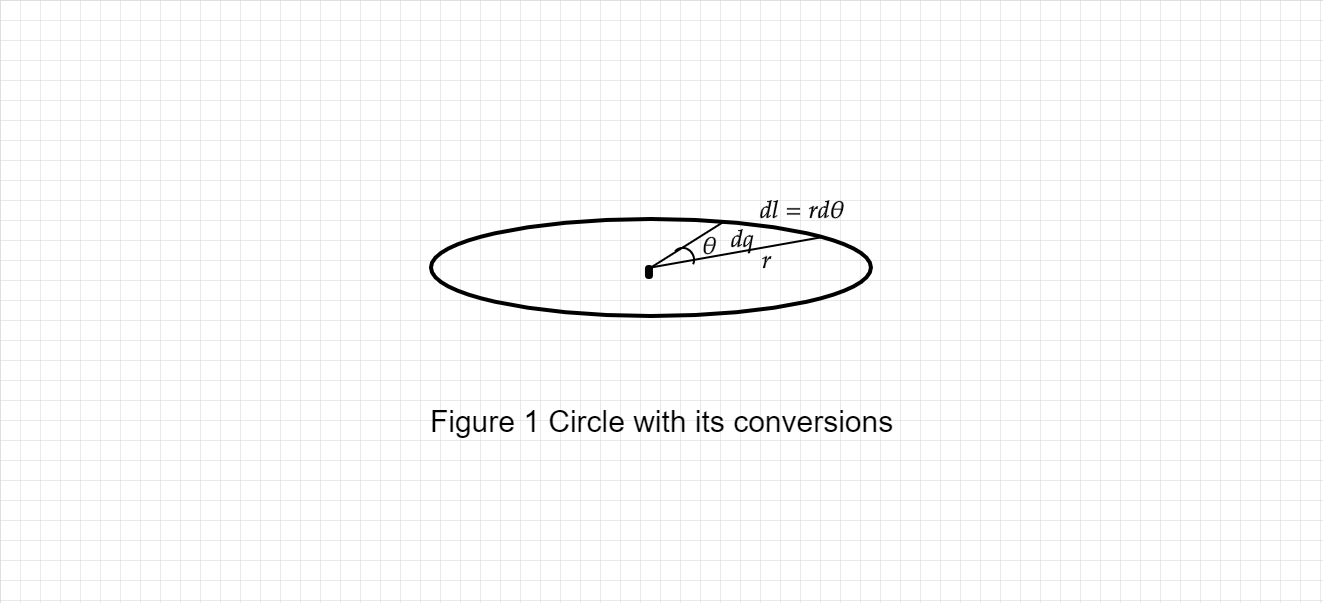
Hint: The differential charge element for length $dl$ from circumference in terms of $d\theta $ is $dl = rd\theta $
Formula Used:
1. $Q = \int {dq} $ over the entire domain. …… (a)
2. Charge density, $\lambda = \dfrac{{dq}}{{dl}}$ …… (b)
3. Differential element, $dl = rd\theta $ …… (c)
4. Given required integral to use, $\int\limits_0^{2\pi } {{{\cos }^2}\theta d\theta = \pi } $ …… (d)
Complete step by step answer:
Given,
charge density $\lambda = {\lambda _0}{\cos ^2}\theta $ …… (1)
radius of circle $ = r$
Step 1 of 6:
Figure 1 shows the relationship between variables of integrand $d\theta $ and $dl$
Step 2 of 6:
Substituting values from equation (c) in equation (b) we get
$\lambda = \dfrac{{dq}}{{rd\theta }}$ where $dl = rd\theta $
$ \Rightarrow dq = \lambda dl = \lambda rd\theta $ …… (2)
Step 3 of 6:
Putting value from equation (2) in equation (a) gives us
$Q = \int {dq} $$ \Rightarrow Q = \int {\lambda rd\theta } $ where $Q$is total charge distribution on given domain …… (3)
Step 4 of 6:
Substituting equation (1) in equation (3) we get
\[Q = \int {{\lambda _0}r{{\cos }^2}\theta d\theta } \] where ${\lambda _0}$ and $r$ are constants …… (4)
Step 5 of 6:
Moving constants out of integration and supplying integration limit 0 to 2$\pi $ we get-
$Q = {\lambda _0}r\int\limits_0^{2\pi } {{{\cos }^2}\theta d\theta } $ …… (5)
Step 6 of 6:
Substituting value from equation (d) in equation (5) we get $Q = \pi {\lambda _0}r$
Correct Answer:
$Q = \pi {\lambda _0}r$
Additional Information:
Integrals like equations (d) are very useful in solving problems with circular symmetric axis. Above problem is solved in the polar coordinate system. Similarly, if surface or volume charge density is given then, one should focus on change of variable in integration so that it transforms into some known integral form. For example, equation (d)
Note: We should always try to solve our problem considering the given hints from the question itself. Here, integration was already provided which saved a lot of time.
Formula Used:
1. $Q = \int {dq} $ over the entire domain. …… (a)
2. Charge density, $\lambda = \dfrac{{dq}}{{dl}}$ …… (b)
3. Differential element, $dl = rd\theta $ …… (c)
4. Given required integral to use, $\int\limits_0^{2\pi } {{{\cos }^2}\theta d\theta = \pi } $ …… (d)
Complete step by step answer:
Given,
charge density $\lambda = {\lambda _0}{\cos ^2}\theta $ …… (1)
radius of circle $ = r$
Step 1 of 6:
Figure 1 shows the relationship between variables of integrand $d\theta $ and $dl$
Step 2 of 6:
Substituting values from equation (c) in equation (b) we get
$\lambda = \dfrac{{dq}}{{rd\theta }}$ where $dl = rd\theta $
$ \Rightarrow dq = \lambda dl = \lambda rd\theta $ …… (2)
Step 3 of 6:
Putting value from equation (2) in equation (a) gives us
$Q = \int {dq} $$ \Rightarrow Q = \int {\lambda rd\theta } $ where $Q$is total charge distribution on given domain …… (3)
Step 4 of 6:
Substituting equation (1) in equation (3) we get
\[Q = \int {{\lambda _0}r{{\cos }^2}\theta d\theta } \] where ${\lambda _0}$ and $r$ are constants …… (4)
Step 5 of 6:
Moving constants out of integration and supplying integration limit 0 to 2$\pi $ we get-
$Q = {\lambda _0}r\int\limits_0^{2\pi } {{{\cos }^2}\theta d\theta } $ …… (5)
Step 6 of 6:
Substituting value from equation (d) in equation (5) we get $Q = \pi {\lambda _0}r$
Correct Answer:
$Q = \pi {\lambda _0}r$
Additional Information:
Integrals like equations (d) are very useful in solving problems with circular symmetric axis. Above problem is solved in the polar coordinate system. Similarly, if surface or volume charge density is given then, one should focus on change of variable in integration so that it transforms into some known integral form. For example, equation (d)
Note: We should always try to solve our problem considering the given hints from the question itself. Here, integration was already provided which saved a lot of time.
Recently Updated Pages
Basicity of sulphurous acid and sulphuric acid are

Master Class 12 Economics: Engaging Questions & Answers for Success
Master Class 12 Biology: Engaging Questions & Answers for Success
Master Class 11 English: Engaging Questions & Answers for Success
Master Class 11 Physics: Engaging Questions & Answers for Success
Master Class 11 Computer Science: Engaging Questions & Answers for Success
Trending doubts
Draw a labelled sketch of the human eye class 12 physics CBSE
The chemical formula of tear gas is A CO Cl 2 B C 10 class 12 chemistry CBSE
Draw ray diagrams each showing i myopic eye and ii class 12 physics CBSE
Which are the Top 10 Largest Countries of the World?
Differentiate between homogeneous and heterogeneous class 12 chemistry CBSE
Which is the correct genotypic ratio of mendel dihybrid class 12 biology CBSE