




A circle drawn through any point P on the parabola ${{y}^{2}}=4x$ has its centre on the tangent drawn at P. The circle also passes through the point of intersection of tangent and directrix T. Then the circle passes through
(a) (1, 0)
(b) (0, 0)
(c) $\left( \dfrac{1}{2},0 \right)$
(d) (-1, 0)
Answer
 Verified
603.6k+ views
Hint: First, by using the parametric form, the coordinates of point P can be taken as $\left( {{t}^{2}},2t \right)$. Then, by using the equation of tangent at P is given by $y\times 2t=2\left( x+{{t}^{2}} \right)$. Hen, P and T are the endpoints of the diameter of the circle given and also we can write the equation of the circle as$\left( x+1 \right)\left( x-{{t}^{2}} \right)+\left( y-2t \right)\left( y-t+\dfrac{1}{t} \right)=0$.
Complete step-by-step answer:
In this question, we are supposed to find the point where the circle also passes through the point of intersection of tangent and directrix T.
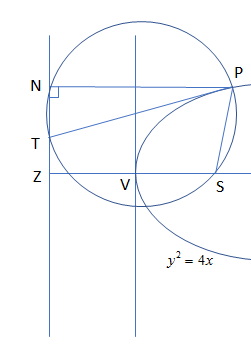
So, we can see from the figure thatcircle through the point P and point T from the figure shown above.
Moreover, its centre will be at some point on the tangent through P and we have the end points of the diameter as point P and has tangent’s intersection with the directrix T.
Now, by using the parametric form, the coordinates of point P can be taken as $\left( {{t}^{2}},2t \right)$.
Now, by using the equation of tangent at P is given by:
$y\times 2t=2\left( x+{{t}^{2}} \right)$
So, the equation of the directrix is x=-1.
Now, the coordinates of point of intersection for the tangent and directrix at T as:
$\left( -1,t-\dfrac{1}{t} \right)$
Since, P and T are the endpoints of the diameter of the circle given and also we can write the equation of the circle as:
$\left( x+1 \right)\left( x-{{t}^{2}} \right)+\left( y-2t \right)\left( y-t+\dfrac{1}{t} \right)=0$
So, from the above equation, (1, 0) satisfies the equation of the circle.
So, the circle passes through the point (1, 0).
So, the correct answer is “Option A”.
Note: Now, to solve these types of questions we need to know some of the basic rules to deal with the tangent to the given curve which is a circle. So, the basic equation of the tangent to the circle is:
$\left( x+1 \right)\left( x-{{t}^{2}} \right)+\left( y-2t \right)\left( y-t+\dfrac{1}{t} \right)=0$ for the directrix as $\left( -1,t-\dfrac{1}{t} \right)$.
Similarly, we can find the equation for any curve.
Complete step-by-step answer:
In this question, we are supposed to find the point where the circle also passes through the point of intersection of tangent and directrix T.
So, we can see from the figure thatcircle through the point P and point T from the figure shown above.
Moreover, its centre will be at some point on the tangent through P and we have the end points of the diameter as point P and has tangent’s intersection with the directrix T.
Now, by using the parametric form, the coordinates of point P can be taken as $\left( {{t}^{2}},2t \right)$.
Now, by using the equation of tangent at P is given by:
$y\times 2t=2\left( x+{{t}^{2}} \right)$
So, the equation of the directrix is x=-1.
Now, the coordinates of point of intersection for the tangent and directrix at T as:
$\left( -1,t-\dfrac{1}{t} \right)$
Since, P and T are the endpoints of the diameter of the circle given and also we can write the equation of the circle as:
$\left( x+1 \right)\left( x-{{t}^{2}} \right)+\left( y-2t \right)\left( y-t+\dfrac{1}{t} \right)=0$
So, from the above equation, (1, 0) satisfies the equation of the circle.
So, the circle passes through the point (1, 0).
So, the correct answer is “Option A”.
Note: Now, to solve these types of questions we need to know some of the basic rules to deal with the tangent to the given curve which is a circle. So, the basic equation of the tangent to the circle is:
$\left( x+1 \right)\left( x-{{t}^{2}} \right)+\left( y-2t \right)\left( y-t+\dfrac{1}{t} \right)=0$ for the directrix as $\left( -1,t-\dfrac{1}{t} \right)$.
Similarly, we can find the equation for any curve.
Recently Updated Pages
Master Class 11 Social Science: Engaging Questions & Answers for Success

Master Class 11 English: Engaging Questions & Answers for Success
Master Class 11 Maths: Engaging Questions & Answers for Success
Master Class 11 Chemistry: Engaging Questions & Answers for Success
Master Class 11 Biology: Engaging Questions & Answers for Success
Master Class 11 Physics: Engaging Questions & Answers for Success
Trending doubts
Differentiate between an exothermic and an endothermic class 11 chemistry CBSE
One Metric ton is equal to kg A 10000 B 1000 C 100 class 11 physics CBSE
Difference Between Prokaryotic Cells and Eukaryotic Cells
There are 720 permutations of the digits 1 2 3 4 5 class 11 maths CBSE
Draw a diagram of a plant cell and label at least eight class 11 biology CBSE
Which chemical is known as king of chemicals A H 2 class 11 chemistry CBSE