




A charged ring of radius 0.5 m has a 0.002$\pi $m gap. If the ring carries a charge of +1 C, the electric field at the center is:
A. $7.5 \times {10^7}N{C^{ - 1}}$
B. $7.2 \times {10^7}N{C^{ - 1}}$
C. $6.2 \times {10^7}N{C^{ - 1}}$
D. $6.5 \times {10^7}N{C^{ - 1}}$
Answer
 Verified
641.7k+ views
Hint: In this question, we have to remember the concept of finding the electric field due to a circular loop of charge. We have to remember that if charge is not present in the gap, the electric field at the center would be because of the rest of the ring.
Formula used: $dq = \dfrac{q}{{2\pi a}}dl$, $\dfrac{1}{{4\pi {\varepsilon _0}}} \times \dfrac{q}{{{x^2}}}.$
Complete step-by-step solution -
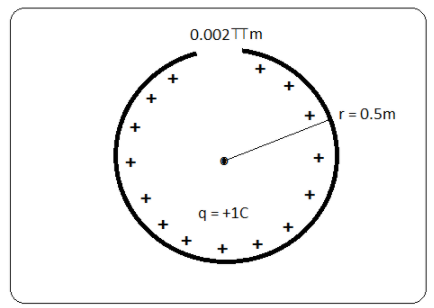
Given that, the radius of ring = 0.5m and gap = $0.002\pi m$ and the ring carries a charge of +1 C.
We know that charge on the elementary length is given by,
$ \Rightarrow dq = \dfrac{q}{{2\pi a}}dl$ .
Now, the charge on the elementary length opposite to the gap will be,
$
\Rightarrow q = \dfrac{Q}{{2\pi \times r}} \times gap \\
\Rightarrow q = \dfrac{1}{{2\pi \times 0.5}} \times 0.002\pi \\
\Rightarrow q = 2 \times {10^{ - 3}}C \\
$.
Now, suppose that the charge is also present in the gap so the electric field at the centre will be zero.
So, if the charge is not present in the gap, the electric field at the centre would be because of the rest of the ring, which should be equal and opposite to the electric field produced due to the charge in the gap.
We know that, electric field at a distance x = $\dfrac{1}{{4\pi {\varepsilon _0}}} \times \dfrac{q}{{{x^2}}}.$ ……….(i)
Here, q = $2 \times {10^{ - 3}}C$ and x = 0.5m and the factor, $\dfrac{1}{{4\pi {\varepsilon _0}}} = 9 \times {10^9}N{m^2}{C^{ - 2}}.$
Putting these values in equation (i), we get
$
\Rightarrow E = 9 \times {10^9}N{m^2}{C^{ - 2}} \times \dfrac{{2 \times {{10}^{ - 3}}C}}{{(0.5 \times 0.5){m^2}}}. \\
\Rightarrow E = 9 \times {10^9}N{m^2}{C^{ - 2}} \times \dfrac{{2 \times {{10}^{ - 3}}C}}{{0.25{m^2}}} \\
$
Solving this, we get
$ \Rightarrow E = 7.2 \times {10^7}N{C^{ - 1}}.$
Hence, the electric field at the centre is $7.2 \times {10^7}N{C^{ - 1}}$.
Therefore, the correct answer is option (B).
Note: Whenever we are asked such types of questions, we have to remember some basic points of finding the electric field due to a circular charged ring. First we have to find out the charge on the elementary length and then we will use that value of charge to find out the electric field using the formula. Then the electric field due to the elementary length will be that electric field. Through this we will get the answer.
Formula used: $dq = \dfrac{q}{{2\pi a}}dl$, $\dfrac{1}{{4\pi {\varepsilon _0}}} \times \dfrac{q}{{{x^2}}}.$
Complete step-by-step solution -
Given that, the radius of ring = 0.5m and gap = $0.002\pi m$ and the ring carries a charge of +1 C.
We know that charge on the elementary length is given by,
$ \Rightarrow dq = \dfrac{q}{{2\pi a}}dl$ .
Now, the charge on the elementary length opposite to the gap will be,
$
\Rightarrow q = \dfrac{Q}{{2\pi \times r}} \times gap \\
\Rightarrow q = \dfrac{1}{{2\pi \times 0.5}} \times 0.002\pi \\
\Rightarrow q = 2 \times {10^{ - 3}}C \\
$.
Now, suppose that the charge is also present in the gap so the electric field at the centre will be zero.
So, if the charge is not present in the gap, the electric field at the centre would be because of the rest of the ring, which should be equal and opposite to the electric field produced due to the charge in the gap.
We know that, electric field at a distance x = $\dfrac{1}{{4\pi {\varepsilon _0}}} \times \dfrac{q}{{{x^2}}}.$ ……….(i)
Here, q = $2 \times {10^{ - 3}}C$ and x = 0.5m and the factor, $\dfrac{1}{{4\pi {\varepsilon _0}}} = 9 \times {10^9}N{m^2}{C^{ - 2}}.$
Putting these values in equation (i), we get
$
\Rightarrow E = 9 \times {10^9}N{m^2}{C^{ - 2}} \times \dfrac{{2 \times {{10}^{ - 3}}C}}{{(0.5 \times 0.5){m^2}}}. \\
\Rightarrow E = 9 \times {10^9}N{m^2}{C^{ - 2}} \times \dfrac{{2 \times {{10}^{ - 3}}C}}{{0.25{m^2}}} \\
$
Solving this, we get
$ \Rightarrow E = 7.2 \times {10^7}N{C^{ - 1}}.$
Hence, the electric field at the centre is $7.2 \times {10^7}N{C^{ - 1}}$.
Therefore, the correct answer is option (B).
Note: Whenever we are asked such types of questions, we have to remember some basic points of finding the electric field due to a circular charged ring. First we have to find out the charge on the elementary length and then we will use that value of charge to find out the electric field using the formula. Then the electric field due to the elementary length will be that electric field. Through this we will get the answer.
Recently Updated Pages
Master Class 12 Business Studies: Engaging Questions & Answers for Success

Master Class 12 Chemistry: Engaging Questions & Answers for Success
Master Class 12 Biology: Engaging Questions & Answers for Success
Class 12 Question and Answer - Your Ultimate Solutions Guide
Master Class 11 English: Engaging Questions & Answers for Success
Master Class 11 Social Science: Engaging Questions & Answers for Success
Trending doubts
Which are the Top 10 Largest Countries of the World?
Draw a labelled sketch of the human eye class 12 physics CBSE
Differentiate between homogeneous and heterogeneous class 12 chemistry CBSE
Differentiate between Pyramid of energy and pyramid class 12 biology CBSE
Why is the cell called the structural and functional class 12 biology CBSE
Draw the diagram of the pyramid of energy Explain In class 12 biology CBSE