




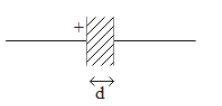
A charged parallel plate capacitor of distance (d) has energy ${U_0}$. A slab of dielectric constant (K) and thickness (d) is then introduced between the plates of the capacitor. The new energy of the system is given by:
$
{\text{A}}{\text{. }}K{U_0} \\
{\text{B}}{\text{. }}{K^2}{U_0} \\
{\text{C}}{\text{. }}\dfrac{{{U_0}}}{K} \\
{\text{D}}{\text{. }}\dfrac{{{U_0}}}{{{K^2}}} \\
$
Answer
 Verified
585.9k+ views
Hint: We first require the expression for the energy stored between the plates of a capacitor. When a dielectric of dielectric constant K is introduced between the plates of the capacitor then the capacitance increases by a factor of K. Using this information in the expression for energy, we can obtain the required answer.
Complete answer:
We are given a charged parallel plate capacitor which has distance (d) between its plates. Let ${U_0}$ be the electrical energy which is stored inside this capacitor. It is given as
${U_0} = \dfrac{1}{2}C{V^2}$
Here C is the value of the capacitance of the given capacitor while V is the potential difference between the plates of the capacitor. The value of capacitance can be given as
$C = \dfrac{{{ \in _0}A}}{d}$
Here ${ \in _0}$ is the permittivity of the vacuum since initially we only have a vacuum between the plates of the capacitor. A is the area of the plates of the capacitor while d represents the distance between the plates of the capacitor.
Now we are given that a slab of dielectric constant (K) and thickness (d) is then introduced between the plates of the capacitor. We need to find out the new energy stored in the capacitor.
When we add a new dielectric material to the capacitor then its capacitance increases by a factor of K which is the dielectric constant of slab. Therefore, the new capacitance can be written as
$C' = KC$
Now using this in expression for energy stored in the capacitor, we get the new energy to be
$U = \dfrac{1}{2}C'{V^2} = K \times \dfrac{1}{2}C{V^2} = K{U_0}$
Hence, the correct answer is option A.
Note:
It should be noted that the thickness of the slab which is introduced between the plates of the capacitor is equal to the distance between the plates of the capacitor. Due to which there is no effect of this parameter on the capacitance and hence, the amount of energy stored in the capacitor.
Complete answer:
We are given a charged parallel plate capacitor which has distance (d) between its plates. Let ${U_0}$ be the electrical energy which is stored inside this capacitor. It is given as
${U_0} = \dfrac{1}{2}C{V^2}$
Here C is the value of the capacitance of the given capacitor while V is the potential difference between the plates of the capacitor. The value of capacitance can be given as
$C = \dfrac{{{ \in _0}A}}{d}$
Here ${ \in _0}$ is the permittivity of the vacuum since initially we only have a vacuum between the plates of the capacitor. A is the area of the plates of the capacitor while d represents the distance between the plates of the capacitor.
Now we are given that a slab of dielectric constant (K) and thickness (d) is then introduced between the plates of the capacitor. We need to find out the new energy stored in the capacitor.
When we add a new dielectric material to the capacitor then its capacitance increases by a factor of K which is the dielectric constant of slab. Therefore, the new capacitance can be written as
$C' = KC$
Now using this in expression for energy stored in the capacitor, we get the new energy to be
$U = \dfrac{1}{2}C'{V^2} = K \times \dfrac{1}{2}C{V^2} = K{U_0}$
Hence, the correct answer is option A.
Note:
It should be noted that the thickness of the slab which is introduced between the plates of the capacitor is equal to the distance between the plates of the capacitor. Due to which there is no effect of this parameter on the capacitance and hence, the amount of energy stored in the capacitor.
Recently Updated Pages
Master Class 12 Economics: Engaging Questions & Answers for Success

Master Class 12 Physics: Engaging Questions & Answers for Success
Master Class 12 English: Engaging Questions & Answers for Success
Master Class 12 Social Science: Engaging Questions & Answers for Success
Master Class 12 Maths: Engaging Questions & Answers for Success
Master Class 12 Business Studies: Engaging Questions & Answers for Success
Trending doubts
Which are the Top 10 Largest Countries of the World?
What are the major means of transport Explain each class 12 social science CBSE
Draw a labelled sketch of the human eye class 12 physics CBSE
Why cannot DNA pass through cell membranes class 12 biology CBSE
Differentiate between insitu conservation and exsitu class 12 biology CBSE
Draw a neat and well labeled diagram of TS of ovary class 12 biology CBSE