




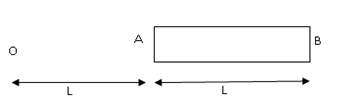
A charge \[Q\] is uniformly distributed over a long rod AB of length \[L\] as shown in the figure. The electric potential at the point O lying at distance \[L\] from the end A is
\[\dfrac{Q}{{8\pi {\varepsilon _0}L}}\]
\[\dfrac{{3Q}}{{4\pi {\varepsilon _0}L}}\]
\[\dfrac{Q}{{4\pi {\varepsilon _0}L\ln 2}}\]
\[\dfrac{{Q\ln 2}}{{4\pi {\varepsilon _0}L}}\]
Answer
 Verified
593.4k+ views
Hint: We are asked to find the potential at point O due to rod AB. First find the line charge density of the rod. Take a small element from the rod and find its potential at the given point. Use this potential due to an element of rod AB to find the potential due to the whole rod AB at the given point.
Complete step by step answer:
Given, the length of the rod AB is \[L\] and charge \[Q\] is uniformly distributed over the rod AB.
Let \[\lambda \] be the line charge density, line charge density can be written as,
\[\lambda = \dfrac{{{\text{Charge}}\,}}{{{\text{Length}}}}\]
\[ \Rightarrow \lambda = \dfrac{Q}{L}\]
First, we take a small element \[dx\] of the rod AB at a distance \[x\] from point O.
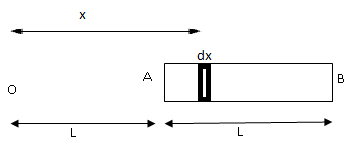
Self-made diagram
Potential at O due to the element \[dx\] can be written as,
\[dV = \dfrac{1}{{4\pi {\varepsilon _0}}}\dfrac{Q}{x}\] (i)
For length \[L\], line charge density is, \[\lambda = \dfrac{Q}{L}\] and for \[dx\] length line charge density will be
\[\lambda = \dfrac{Q}{{dx}}\]
\[ \Rightarrow Q = \lambda dx\]
Now, substituting this value of \[Q\] in equation (i), we get
\[dV = \dfrac{1}{{4\pi {\varepsilon _0}}}\dfrac{{\lambda dx}}{x}\] (ii)
This is the potential due to a small element \[dx\]. To find the potential due to the whole rod AB we integrate equation (iii) from \[L\] to \[2L\]. We take \[L\] to \[2L\]because the distance between point O and one end of the rod is \[2L\] and the other end is \[L\] .
\[\therefore V = \int\limits_L^{2L} {\dfrac{1}{{4\pi {\varepsilon _0}}}\dfrac{{\lambda dx}}{x}} \\\
\Rightarrow V = \dfrac{\lambda }{{4\pi {\varepsilon _0}}}\int\limits_L^{2L} {\dfrac{{dx}}{x}} \\\
\Rightarrow V = \dfrac{\lambda }{{4\pi {\varepsilon _0}}}\left[ {\ln x} \right]_L^{2L} \\\]
\[\Rightarrow V = \dfrac{\lambda }{{4\pi {\varepsilon _0}}}\left[ {\ln (2L) - \ln (L)} \right] \\\
\Rightarrow V = \dfrac{\lambda }{{4\pi {\varepsilon _0}}}\ln \dfrac{{2L}}{L} \\\
\Rightarrow V = \dfrac{\lambda }{{4\pi {\varepsilon _0}}}\ln 2 \\\]
For, whole length \[L\] the line charge density is \[\lambda = \dfrac{Q}{L}\]. So, the potential will be
\[V = \dfrac{{Q\ln 2}}{{4\pi {\varepsilon _0}L}}\]
Therefore, the potential at point O at distance \[L\] from one end of rod AB is \[V = \dfrac{{Q\ln 2}}{{4\pi {\varepsilon _0}L}}\]
\[V = \dfrac{{Q\ln 2}}{{4\pi {\varepsilon _0}L}}\]
So, the correct answer is “Option D”.
Note:
In problems where potential due to the whole object is difficult to find, always take a small element of the object and find its potential at the given point and integrate this value to find the potential of the object at the given point. Here, the charge was uniformly distributed but if the charge is non uniform then we would need to find their dependence on length.
Complete step by step answer:
Given, the length of the rod AB is \[L\] and charge \[Q\] is uniformly distributed over the rod AB.
Let \[\lambda \] be the line charge density, line charge density can be written as,
\[\lambda = \dfrac{{{\text{Charge}}\,}}{{{\text{Length}}}}\]
\[ \Rightarrow \lambda = \dfrac{Q}{L}\]
First, we take a small element \[dx\] of the rod AB at a distance \[x\] from point O.
Self-made diagram
Potential at O due to the element \[dx\] can be written as,
\[dV = \dfrac{1}{{4\pi {\varepsilon _0}}}\dfrac{Q}{x}\] (i)
For length \[L\], line charge density is, \[\lambda = \dfrac{Q}{L}\] and for \[dx\] length line charge density will be
\[\lambda = \dfrac{Q}{{dx}}\]
\[ \Rightarrow Q = \lambda dx\]
Now, substituting this value of \[Q\] in equation (i), we get
\[dV = \dfrac{1}{{4\pi {\varepsilon _0}}}\dfrac{{\lambda dx}}{x}\] (ii)
This is the potential due to a small element \[dx\]. To find the potential due to the whole rod AB we integrate equation (iii) from \[L\] to \[2L\]. We take \[L\] to \[2L\]because the distance between point O and one end of the rod is \[2L\] and the other end is \[L\] .
\[\therefore V = \int\limits_L^{2L} {\dfrac{1}{{4\pi {\varepsilon _0}}}\dfrac{{\lambda dx}}{x}} \\\
\Rightarrow V = \dfrac{\lambda }{{4\pi {\varepsilon _0}}}\int\limits_L^{2L} {\dfrac{{dx}}{x}} \\\
\Rightarrow V = \dfrac{\lambda }{{4\pi {\varepsilon _0}}}\left[ {\ln x} \right]_L^{2L} \\\]
\[\Rightarrow V = \dfrac{\lambda }{{4\pi {\varepsilon _0}}}\left[ {\ln (2L) - \ln (L)} \right] \\\
\Rightarrow V = \dfrac{\lambda }{{4\pi {\varepsilon _0}}}\ln \dfrac{{2L}}{L} \\\
\Rightarrow V = \dfrac{\lambda }{{4\pi {\varepsilon _0}}}\ln 2 \\\]
For, whole length \[L\] the line charge density is \[\lambda = \dfrac{Q}{L}\]. So, the potential will be
\[V = \dfrac{{Q\ln 2}}{{4\pi {\varepsilon _0}L}}\]
Therefore, the potential at point O at distance \[L\] from one end of rod AB is \[V = \dfrac{{Q\ln 2}}{{4\pi {\varepsilon _0}L}}\]
\[V = \dfrac{{Q\ln 2}}{{4\pi {\varepsilon _0}L}}\]
So, the correct answer is “Option D”.
Note:
In problems where potential due to the whole object is difficult to find, always take a small element of the object and find its potential at the given point and integrate this value to find the potential of the object at the given point. Here, the charge was uniformly distributed but if the charge is non uniform then we would need to find their dependence on length.
Recently Updated Pages
Master Class 12 Business Studies: Engaging Questions & Answers for Success

Master Class 12 Chemistry: Engaging Questions & Answers for Success
Master Class 12 Biology: Engaging Questions & Answers for Success
Class 12 Question and Answer - Your Ultimate Solutions Guide
Master Class 11 English: Engaging Questions & Answers for Success
Master Class 11 Maths: Engaging Questions & Answers for Success
Trending doubts
Which is more stable and why class 12 chemistry CBSE
Which are the Top 10 Largest Countries of the World?
Draw a labelled sketch of the human eye class 12 physics CBSE
Differentiate between homogeneous and heterogeneous class 12 chemistry CBSE
What are the major means of transport Explain each class 12 social science CBSE
Sulphuric acid is known as the king of acids State class 12 chemistry CBSE