




A charge of $8mC$ is located at the origin. Calculate the work done in moving a small charge of $-2\times {{10}^{-9}}C$ from a point $P\left( 0,0,3cm \right)$, $Q\left( 0,4cm,0 \right)$ via a point $R\left( 0,6cm,9cm \right)$.
Answer
 Verified
621.9k+ views
Hint: The initial distance between the charges should be found from both the points. Then calculate the work done taking the small charge from P to Q. this depends on the initial and final position only. That is dependent on the path followed. These all may help you to solve this question.
Complete step by step answer:
from the question, we can understand that a bigger charge is located at the origin which is having a magnitude given by,
$q=8mC=8\times {{10}^{-3}}C$
And also a smaller charge is having a magnitude given as,
${{q}_{0}}=-2\times {{10}^{-9}}C$
This smaller charge is being taken from the point$P\left( 0,0,3cm \right),Q\left( 0,4cm,0 \right)\text{ via a point }R\left( 0,6cm,9cm \right)$
This has been shown in the figure.
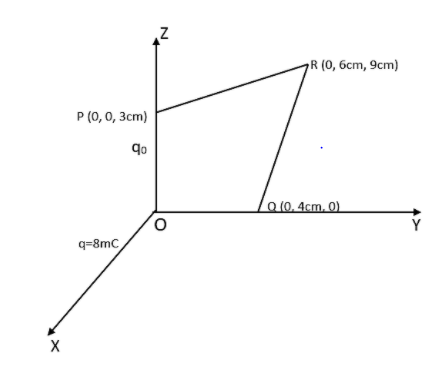
Let us assume that the initial distance between larger charge $q$ and smaller charge ${{q}_{0}}$ are given as ${{r}_{P}}$. The value of this separation is determined as,
\[{{r}_{P}}=3cm=0.03m\]
And the final separation between the larger charge and the smaller charge is given by the equation,
\[{{r}_{Q}}=4cm=0.04m\]
Therefore the work done in taking the charge from the point P to Q can be found out. It is not dependent on the path followed. It depends only on the initial and final positions of the charges. That is the distance between \[{{r}_{Q}}\text{ and }{{r}_{P}}\].
Hence we can write that the work done will be,
\[W=\dfrac{1}{4\pi {{\varepsilon }_{0}}}q{{q}_{0}}\left[ \dfrac{1}{{{r}_{Q}}}-\dfrac{1}{{{r}_{P}}} \right]\]
Where \[{{\varepsilon }_{0}}\] be the permittivity of the medium.
So let us substitute the given values in it to get the answer.
\[W=9\times {{10}^{9}}\times 8\times {{10}^{-3}}\times -2\times {{10}^{-9}}\left[ \dfrac{1}{0.04}-\dfrac{1}{0.03} \right]\]
That is firstly we can do the brackets of the equation,
\[W=9\times {{10}^{9}}\times 8\times {{10}^{-3}}\times -2\times {{10}^{-9}}\times \left[ \dfrac{-0.01}{1.2\times {{10}^{-3}}} \right]\]
Now we can do the multiplications in the equation,
\[W=\dfrac{1.44\times {{10}^{-3}}}{1.2\times {{10}^{-3}}}\]
Simplifying this equation will give,
\[W=1200\times {{10}^{-3}}J=1.2J\]
Therefore the correct answer for the question has been obtained. The work done to take the charge from P to Q has been calculated.
Note:
The permittivity of free space is found to be a physical constant frequently used in electromagnetism. It indicates the ability of a vacuum to allow electric fields. It is used to define the energy stored within an electric field and capacitance.
Complete step by step answer:
from the question, we can understand that a bigger charge is located at the origin which is having a magnitude given by,
$q=8mC=8\times {{10}^{-3}}C$
And also a smaller charge is having a magnitude given as,
${{q}_{0}}=-2\times {{10}^{-9}}C$
This smaller charge is being taken from the point$P\left( 0,0,3cm \right),Q\left( 0,4cm,0 \right)\text{ via a point }R\left( 0,6cm,9cm \right)$
This has been shown in the figure.
Let us assume that the initial distance between larger charge $q$ and smaller charge ${{q}_{0}}$ are given as ${{r}_{P}}$. The value of this separation is determined as,
\[{{r}_{P}}=3cm=0.03m\]
And the final separation between the larger charge and the smaller charge is given by the equation,
\[{{r}_{Q}}=4cm=0.04m\]
Therefore the work done in taking the charge from the point P to Q can be found out. It is not dependent on the path followed. It depends only on the initial and final positions of the charges. That is the distance between \[{{r}_{Q}}\text{ and }{{r}_{P}}\].
Hence we can write that the work done will be,
\[W=\dfrac{1}{4\pi {{\varepsilon }_{0}}}q{{q}_{0}}\left[ \dfrac{1}{{{r}_{Q}}}-\dfrac{1}{{{r}_{P}}} \right]\]
Where \[{{\varepsilon }_{0}}\] be the permittivity of the medium.
So let us substitute the given values in it to get the answer.
\[W=9\times {{10}^{9}}\times 8\times {{10}^{-3}}\times -2\times {{10}^{-9}}\left[ \dfrac{1}{0.04}-\dfrac{1}{0.03} \right]\]
That is firstly we can do the brackets of the equation,
\[W=9\times {{10}^{9}}\times 8\times {{10}^{-3}}\times -2\times {{10}^{-9}}\times \left[ \dfrac{-0.01}{1.2\times {{10}^{-3}}} \right]\]
Now we can do the multiplications in the equation,
\[W=\dfrac{1.44\times {{10}^{-3}}}{1.2\times {{10}^{-3}}}\]
Simplifying this equation will give,
\[W=1200\times {{10}^{-3}}J=1.2J\]
Therefore the correct answer for the question has been obtained. The work done to take the charge from P to Q has been calculated.
Note:
The permittivity of free space is found to be a physical constant frequently used in electromagnetism. It indicates the ability of a vacuum to allow electric fields. It is used to define the energy stored within an electric field and capacitance.
Recently Updated Pages
Master Class 12 Business Studies: Engaging Questions & Answers for Success

Master Class 12 Chemistry: Engaging Questions & Answers for Success
Master Class 12 Biology: Engaging Questions & Answers for Success
Class 12 Question and Answer - Your Ultimate Solutions Guide
Master Class 11 English: Engaging Questions & Answers for Success
Master Class 11 Social Science: Engaging Questions & Answers for Success
Trending doubts
Which are the Top 10 Largest Countries of the World?
Draw a labelled sketch of the human eye class 12 physics CBSE
Differentiate between homogeneous and heterogeneous class 12 chemistry CBSE
Why is the cell called the structural and functional class 12 biology CBSE
Draw ray diagrams each showing i myopic eye and ii class 12 physics CBSE
Which is the correct genotypic ratio of mendel dihybrid class 12 biology CBSE