




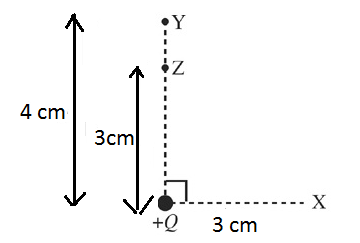
A charge of ${{10}^{-9}}C$ moves from $X$ to $Z$. Find the work done by the electric field due to the charge $Q=2C$ in moving the charge from $X$ to $Z$. The value of coulomb's constant is $9\times {{10}^{9}}N{{m}^{2}}{{C}^{-2}}$.
A. $0J$
B. $150J$
C. $300J$
D. $500J$
E. $1000J$
Answer
 Verified
591.3k+ views
Hint: The concept to be used is that change in electrostatic potential energy due to a conservative force is equal to negative of work done by that force.Electrostatic force is a conservative force.The electrostatic potential energy of charges is product of charge and potential at that point
Difference in electrostatic potential energy is charge multiplied by the potential difference between two points.
Complete answer:
The electrostatic potential will be developed by the electric field of bigger charge of $Q=2C$in which the smaller charge of ${{10}^{-9}}C$ in moving from $X$ to $Z$ point
The electric potential due to a charge $Q$ is defined as$\dfrac{kQ}{R}$ where $k$ is Coulombs’ constant and R is distance from charge .
Since change in potential from $X$ to $Z$ point when multiplied by smaller charge will be responsible for change in electrostatic potential energy which will be the work done by the electric field of bigger stationary charge in moving from $X$ to$Z$ .
Work done=change in potential energy = charge $\times$ change in potential from $X$ to $Z$ .
Since the points $X$ and $Z$ are at the same distance from charge $Q$ so potential at both points will be the same as seen from the formula and hence change in potential and potential energy will be $0$ and hence work done by electric field will be $0$.
So, the correct answer is “Option A”.
Note:
Electrostatic potential and electrostatic potential energy are both scalar quantities and electric fields are vector quantities.The above said rule of change in potential energy is equal to work done is not applicable when non-conservative forces are acting.
Difference in electrostatic potential energy is charge multiplied by the potential difference between two points.
Complete answer:
The electrostatic potential will be developed by the electric field of bigger charge of $Q=2C$in which the smaller charge of ${{10}^{-9}}C$ in moving from $X$ to $Z$ point
The electric potential due to a charge $Q$ is defined as$\dfrac{kQ}{R}$ where $k$ is Coulombs’ constant and R is distance from charge .
Since change in potential from $X$ to $Z$ point when multiplied by smaller charge will be responsible for change in electrostatic potential energy which will be the work done by the electric field of bigger stationary charge in moving from $X$ to$Z$ .
Work done=change in potential energy = charge $\times$ change in potential from $X$ to $Z$ .
Since the points $X$ and $Z$ are at the same distance from charge $Q$ so potential at both points will be the same as seen from the formula and hence change in potential and potential energy will be $0$ and hence work done by electric field will be $0$.
So, the correct answer is “Option A”.
Note:
Electrostatic potential and electrostatic potential energy are both scalar quantities and electric fields are vector quantities.The above said rule of change in potential energy is equal to work done is not applicable when non-conservative forces are acting.
Recently Updated Pages
In a plane electromagnetic wave the electric field class 12 physics CBSE

A plane electromagnetic wave travels in vacuum along class 12 physics CBSE
Basicity of sulphurous acid and sulphuric acid are
The magnetic field in a plane electromagnetic wave class 11 physics CBSE
Master Class 12 English: Engaging Questions & Answers for Success
Master Class 12 Social Science: Engaging Questions & Answers for Success
Trending doubts
Which are the Top 10 Largest Countries of the World?
Draw a labelled sketch of the human eye class 12 physics CBSE
Which state in the country is at the forefront in controlling class 12 social science CBSE
Mention the role of cyanobacteria as a biofertiliz class 12 biology ICSE
Where is the largest hydroelectric power station located class 12 biology CBSE
Which country did Danny Casey play for class 12 english CBSE