




A chain is held on a frictionless horizontal table with one-fourth of its length hanging over the edge. If the chain has length l and mass M, what is the work required to pull the hanging part back on the table?
Answer
 Verified
598.5k+ views
Hint: Since the part of the chain is hanging around the table, the work done on bringing up the hanging part of the chain will be equal to the product of the weight exerted by the hanging portion of the chain and the distance to which the chain has to be pulled upwards.
Complete step by step answer:
Consider the chain hanging from a frictionless table, such that only one-fourth of the total length $l$ of it is hanging down the table.
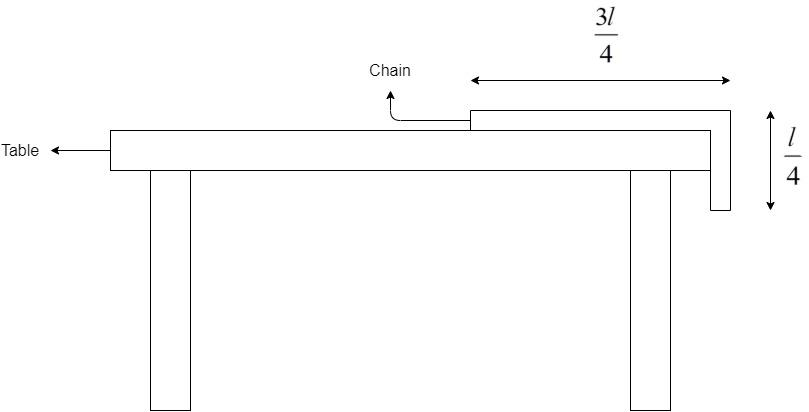
Assuming that the distribution of mass in the chain is constant throughout the chain, we can say that the portion of the chain of mass m hanging from the table has the mass equal to $\dfrac{m}{4}$ as shown below
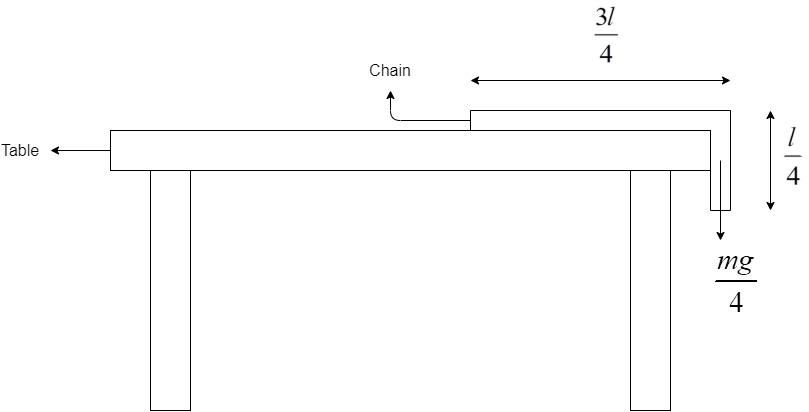
This portion of mass exerts weight in the downward direction equal to,
Weight of the entire chain, $F = mg$
Weight of the hanging portion,
$\Rightarrow F = \dfrac{m}{4}g = \dfrac{{mg}}{4}$
The work done is moving the hanging portion of the chain up,
$W = F \times S$
where S is the distance to be moved and F is the weight exerted by the hanging portion.
Here, the weight of the hanging portion acts on the centroid of the hanging portion which is nothing but the center of the hanging portion.
Length of the hanging portion is $\dfrac{l}{4}$
$\therefore S = \dfrac{{\dfrac{l}{4}}}{2} = \dfrac{l}{8}$
Substituting in the above equation of work done,
$W = F \times S$
$\Rightarrow W = \dfrac{{mg}}{4} \times \dfrac{l}{8}$
$\Rightarrow W = \dfrac{{mgl}}{{32}}$
Therefore, the work done in lifting the hanging portion, $W = \dfrac{1}{{32}}mgl$.
Note:
In this problem, it is mentioned as a frictionless tabletop surface. If there is friction present, then,
The coefficient of friction would be given as $\mu $.
Then, the weight F to be considered in the equation of work above, should be considered as:
$\Rightarrow F = \dfrac{{mg}}{4} - \mu \dfrac{{mg}}{4} = \dfrac{{mg}}{4}\left( {1 - \mu } \right)$
This value of the force should be substituted in the equation of the work.
Complete step by step answer:
Consider the chain hanging from a frictionless table, such that only one-fourth of the total length $l$ of it is hanging down the table.
Assuming that the distribution of mass in the chain is constant throughout the chain, we can say that the portion of the chain of mass m hanging from the table has the mass equal to $\dfrac{m}{4}$ as shown below
This portion of mass exerts weight in the downward direction equal to,
Weight of the entire chain, $F = mg$
Weight of the hanging portion,
$\Rightarrow F = \dfrac{m}{4}g = \dfrac{{mg}}{4}$
The work done is moving the hanging portion of the chain up,
$W = F \times S$
where S is the distance to be moved and F is the weight exerted by the hanging portion.
Here, the weight of the hanging portion acts on the centroid of the hanging portion which is nothing but the center of the hanging portion.
Length of the hanging portion is $\dfrac{l}{4}$
$\therefore S = \dfrac{{\dfrac{l}{4}}}{2} = \dfrac{l}{8}$
Substituting in the above equation of work done,
$W = F \times S$
$\Rightarrow W = \dfrac{{mg}}{4} \times \dfrac{l}{8}$
$\Rightarrow W = \dfrac{{mgl}}{{32}}$
Therefore, the work done in lifting the hanging portion, $W = \dfrac{1}{{32}}mgl$.
Note:
In this problem, it is mentioned as a frictionless tabletop surface. If there is friction present, then,
The coefficient of friction would be given as $\mu $.
Then, the weight F to be considered in the equation of work above, should be considered as:
$\Rightarrow F = \dfrac{{mg}}{4} - \mu \dfrac{{mg}}{4} = \dfrac{{mg}}{4}\left( {1 - \mu } \right)$
This value of the force should be substituted in the equation of the work.
Recently Updated Pages
Three beakers labelled as A B and C each containing 25 mL of water were taken A small amount of NaOH anhydrous CuSO4 and NaCl were added to the beakers A B and C respectively It was observed that there was an increase in the temperature of the solutions contained in beakers A and B whereas in case of beaker C the temperature of the solution falls Which one of the following statements isarecorrect i In beakers A and B exothermic process has occurred ii In beakers A and B endothermic process has occurred iii In beaker C exothermic process has occurred iv In beaker C endothermic process has occurred

Master Class 11 Social Science: Engaging Questions & Answers for Success
Master Class 11 Physics: Engaging Questions & Answers for Success
Master Class 11 Maths: Engaging Questions & Answers for Success
Master Class 11 Economics: Engaging Questions & Answers for Success
Master Class 11 Computer Science: Engaging Questions & Answers for Success
Three beakers labelled as A B and C each containing 25 mL of water were taken A small amount of NaOH anhydrous CuSO4 and NaCl were added to the beakers A B and C respectively It was observed that there was an increase in the temperature of the solutions contained in beakers A and B whereas in case of beaker C the temperature of the solution falls Which one of the following statements isarecorrect i In beakers A and B exothermic process has occurred ii In beakers A and B endothermic process has occurred iii In beaker C exothermic process has occurred iv In beaker C endothermic process has occurred
Master Class 11 Social Science: Engaging Questions & Answers for Success
Master Class 11 Physics: Engaging Questions & Answers for Success
Trending doubts
One Metric ton is equal to kg A 10000 B 1000 C 100 class 11 physics CBSE
There are 720 permutations of the digits 1 2 3 4 5 class 11 maths CBSE
State and prove Bernoullis theorem class 11 physics CBSE
Draw a diagram of a plant cell and label at least eight class 11 biology CBSE
Difference Between Prokaryotic Cells and Eukaryotic Cells
1 Quintal is equal to a 110 kg b 10 kg c 100kg d 1000 class 11 physics CBSE