




A centrifuge accelerates uniformly from rest to 15,000 rpm in 220 s. Through how many revolutions did it turn in this time?
Answer
 Verified
558k+ views
Hint: To calculate the number of revolutions made by accelerating the centrifuge from rest, we divide the total displacement (computed from its acceleration using the equations of motion) in the given amount of time by $2\pi $ radians (1 revolution $=2\pi $ radians).
Complete answer:
A centrifuge is a machine which rotates in high speed and uses centrifugal force to separate fluids of different densities or to separate suspended solid particles in liquids. It has a container which holds the substance and rotates with high speed with the help of the motor as shown in the figure below.
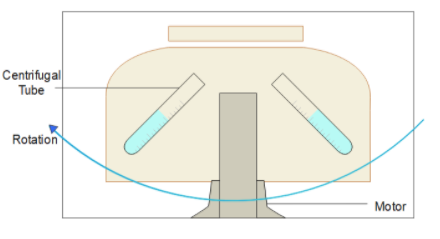
Centrifuge uses the principle of centrifugal force, which is a force that comes into play due to an object’s inertia, that is moving in a circular path and its direction is inwards towards the centre of the circular path.
According to the question, the centrifuge accelerates uniformly from rest to 15,000 rpm.
Hence, the initial angular velocity is zero (${{\omega }_{i}}=0$). The final angular velocity is,
${{\omega }_{f}}=15000\times 2\pi \times \dfrac{1}{60}=500\pi $ radians/ s ….(i)
The angular acceleration is given by,
$a=\dfrac{{{\omega }_{f}}-{{\omega }_{i}}}{t}=\dfrac{500\pi -0}{220}=7.1364$ radians /${{s}^{2}}$ ….(ii) (since, $t=220s$)
Now, we calculate the total angular displacement using the rotational kinematic equation of motion, we get,
$\theta ={{\omega }_{i}}+\dfrac{1}{2}a{{t}^{2}}$
$\Rightarrow \theta =0+\dfrac{1}{2}\times 7.1364\times {{(220)}^{2}}=172700=1.727\times {{10}^{5}}$radians (since, ${{\omega }_{i}}=0$)
The number of revolutions is given by dividing the total displacement by $2\pi $ radians, since we know 1 revolution $=2\pi $ radians, we get,
$\dfrac{1.727\times {{10}^{5}}}{2\pi }=27500=2.75\times {{10}^{4}}$ revolutions
Thus, when a centrifuge accelerates uniformly from rest to 15,000 rpm in 220 seconds it turns $2.75\times {{10}^{4}}$ revolutions in this amount of time.
Note:
It is important to remember the rotational kinematic equation of motion and other equations of motion to solve these questions. The concept of centrifugal force is used in many applications and should be clear. Before proceeding in the calculations it is important to convert rpm (revolutions/minute) to radians/ second.
Complete answer:
A centrifuge is a machine which rotates in high speed and uses centrifugal force to separate fluids of different densities or to separate suspended solid particles in liquids. It has a container which holds the substance and rotates with high speed with the help of the motor as shown in the figure below.
Centrifuge uses the principle of centrifugal force, which is a force that comes into play due to an object’s inertia, that is moving in a circular path and its direction is inwards towards the centre of the circular path.
According to the question, the centrifuge accelerates uniformly from rest to 15,000 rpm.
Hence, the initial angular velocity is zero (${{\omega }_{i}}=0$). The final angular velocity is,
${{\omega }_{f}}=15000\times 2\pi \times \dfrac{1}{60}=500\pi $ radians/ s ….(i)
The angular acceleration is given by,
$a=\dfrac{{{\omega }_{f}}-{{\omega }_{i}}}{t}=\dfrac{500\pi -0}{220}=7.1364$ radians /${{s}^{2}}$ ….(ii) (since, $t=220s$)
Now, we calculate the total angular displacement using the rotational kinematic equation of motion, we get,
$\theta ={{\omega }_{i}}+\dfrac{1}{2}a{{t}^{2}}$
$\Rightarrow \theta =0+\dfrac{1}{2}\times 7.1364\times {{(220)}^{2}}=172700=1.727\times {{10}^{5}}$radians (since, ${{\omega }_{i}}=0$)
The number of revolutions is given by dividing the total displacement by $2\pi $ radians, since we know 1 revolution $=2\pi $ radians, we get,
$\dfrac{1.727\times {{10}^{5}}}{2\pi }=27500=2.75\times {{10}^{4}}$ revolutions
Thus, when a centrifuge accelerates uniformly from rest to 15,000 rpm in 220 seconds it turns $2.75\times {{10}^{4}}$ revolutions in this amount of time.
Note:
It is important to remember the rotational kinematic equation of motion and other equations of motion to solve these questions. The concept of centrifugal force is used in many applications and should be clear. Before proceeding in the calculations it is important to convert rpm (revolutions/minute) to radians/ second.
Recently Updated Pages
Master Class 12 Economics: Engaging Questions & Answers for Success

Master Class 12 Physics: Engaging Questions & Answers for Success
Master Class 12 English: Engaging Questions & Answers for Success
Master Class 12 Social Science: Engaging Questions & Answers for Success
Master Class 12 Maths: Engaging Questions & Answers for Success
Master Class 12 Business Studies: Engaging Questions & Answers for Success
Trending doubts
Which are the Top 10 Largest Countries of the World?
What are the major means of transport Explain each class 12 social science CBSE
Draw a labelled sketch of the human eye class 12 physics CBSE
Why cannot DNA pass through cell membranes class 12 biology CBSE
Differentiate between insitu conservation and exsitu class 12 biology CBSE
Draw a neat and well labeled diagram of TS of ovary class 12 biology CBSE