




A cell that lacks chloroplast does not _______.
Answer
 Verified
545.1k+ views
Hint: Chloroplasts are the cell organelles in plants that convert light energy into a stable energy using the photosynthetic process. Life sustains on the Earth by this process. The chloroplasts also provide for the synthesis of fatty acids, isoprenoids, membrane lipids, tetrapyrroles, starch, and hormones in plants.
Complete answer:
Chloroplasts play a crucial part within the process of photosynthesis in plants. The chloroplast absorbs the energy in sunlight and uses it to supply food which is made using the process of photosynthesis. Thus, if a cell lacks chloroplast, it cannot synthesise food and hence cannot liberarte oxygen, which is a product of photosynthesis.
Functions of Chloroplasts:
Food producers: A chloroplast may be a green organelle which some eukaryotes, like plants and algae, have in their cells. It's responsible for photosynthesis which is the method which produces the energy which the organism must survive. A chloroplast uses energy from light to form food from $CO_2$ and $H_2$O.
Green appearance: Chloroplasts are made from pigments which absorb sunlight, especially blue and red light and reflect green light. That's why they seem green in colour.
Slow down the atmospheric phenomenon: Human cells haven't any chloroplasts. Despite this, chloroplasts are essential to human life. These organelles in plants and algae lookout of the oxygen production on earth. They also absorb enormous amounts of $CO_2$ during the method of photosynthesis, removing it from the atmosphere and helping to limit the atmospheric phenomenon.
Note:
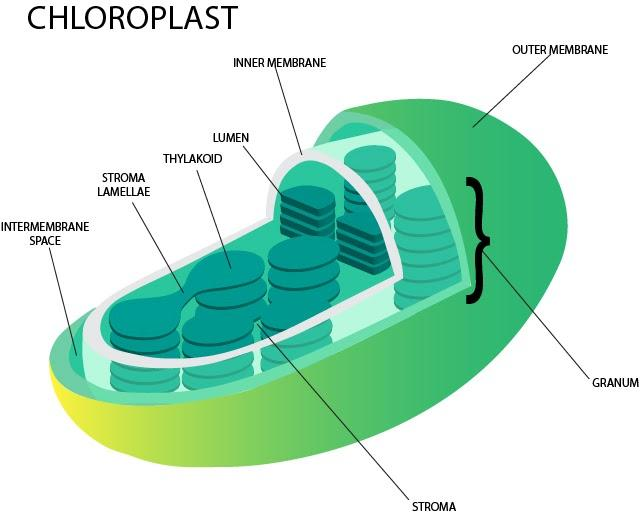
Chloroplasts are enclosed by an envelope of two membranes which encompass a complex membrane system, the thylakoids, including grana and lamellae. Additionally, starch grains, plastoglobules, stromules, eyespots, pyrenoids, etc. also are important structures of chloroplasts. It's widely accepted that chloroplasts evolved from a free-living photosynthetic cyanobacterium, which was engulfed by a eukaryotic cell.
Complete answer:
Chloroplasts play a crucial part within the process of photosynthesis in plants. The chloroplast absorbs the energy in sunlight and uses it to supply food which is made using the process of photosynthesis. Thus, if a cell lacks chloroplast, it cannot synthesise food and hence cannot liberarte oxygen, which is a product of photosynthesis.
Functions of Chloroplasts:
Food producers: A chloroplast may be a green organelle which some eukaryotes, like plants and algae, have in their cells. It's responsible for photosynthesis which is the method which produces the energy which the organism must survive. A chloroplast uses energy from light to form food from $CO_2$ and $H_2$O.
Green appearance: Chloroplasts are made from pigments which absorb sunlight, especially blue and red light and reflect green light. That's why they seem green in colour.
Slow down the atmospheric phenomenon: Human cells haven't any chloroplasts. Despite this, chloroplasts are essential to human life. These organelles in plants and algae lookout of the oxygen production on earth. They also absorb enormous amounts of $CO_2$ during the method of photosynthesis, removing it from the atmosphere and helping to limit the atmospheric phenomenon.
Note:
Chloroplasts are enclosed by an envelope of two membranes which encompass a complex membrane system, the thylakoids, including grana and lamellae. Additionally, starch grains, plastoglobules, stromules, eyespots, pyrenoids, etc. also are important structures of chloroplasts. It's widely accepted that chloroplasts evolved from a free-living photosynthetic cyanobacterium, which was engulfed by a eukaryotic cell.
Recently Updated Pages
Master Class 11 English: Engaging Questions & Answers for Success

Master Class 11 Maths: Engaging Questions & Answers for Success
Class 11 Question and Answer - Your Ultimate Solutions Guide
Master Class 11 Biology: Engaging Questions & Answers for Success
Master Class 11 Physics: Engaging Questions & Answers for Success
Master Class 11 Accountancy: Engaging Questions & Answers for Success
Trending doubts
Differentiate between an exothermic and an endothermic class 11 chemistry CBSE
One Metric ton is equal to kg A 10000 B 1000 C 100 class 11 physics CBSE
Difference Between Prokaryotic Cells and Eukaryotic Cells
There are 720 permutations of the digits 1 2 3 4 5 class 11 maths CBSE
Draw a diagram of a plant cell and label at least eight class 11 biology CBSE
1 Quintal is equal to a 110 kg b 10 kg c 100kg d 1000 class 11 physics CBSE