




A cell of emf $E$ and internal resistance $r$is connected across a variable load resistor $R$. Draw the plots of the terminal voltage $V$versus $\left( i \right)R$ and $\left( ii \right)$ the current $I$. It is found that when $R=4\Omega$ , the current is $1A$ and when $R$ is increased to $9\Omega ,$ the current reduces to $0.5A$. Find the values of the emf $E$ and internal resistance $r$.
Answer
 Verified
587.4k+ views
Hint: When we connect a battery to a circuit, the voltage that we read is not always the same as the emf of the battery. The voltage that we read is actually called the terminal voltage of the circuit. Typically, when we connect a battery to a device, that device will have its own resistance which is called the internal resistance. Hence, we shall find the terminal voltage of the circuit.
Complete step by step answer:
The terminal voltage, $V$ is given as:
$V=E-Ir$ ------(1)
Where,
$E=$emf of cell
$I=$ current
$r=$ internal resistance
By Ohm’s law, $V=IR$
Where,
$R=$ total resistance
The total resistance of circuit = load resistor $+$ internal resistance
Thus, total resistance $=R+r$
Therefore, current of circuit, $I=\dfrac{E}{\left( R+r \right)}$ ----- (2)
Substituting value of current in equation (1),
$\Rightarrow V=E-\dfrac{E}{\left( R+r \right)}r$
$\Rightarrow V=\dfrac{ER}{R+r}$
$\Rightarrow V=\dfrac{E}{\left( 1+{r}/{R}\; \right)}$ ------- (3)
Given that when $R=4\Omega$, then $I=1A$;
Substituting these in equation (2);
$\Rightarrow 1=\dfrac{E}{\left( 4+r \right)}$
$\Rightarrow 4+r=E$ --------(4)
Also given that when $R=9\Omega$, then $I=0.5A$;
Substituting these in equation (2);
$\Rightarrow 0.5=\dfrac{E}{\left( 9+r \right)}$
$\Rightarrow \dfrac{1}{2}\left( 9+r \right)=E$ ------- (5)
Simultaneously solving equations (4) and (5),
$\Rightarrow 4+r=\dfrac{9+r}{2}$
$\Rightarrow 8+2r=9+r$
$\therefore r=1\Omega$
Putting $r=1\Omega$ in equation (4);
$\Rightarrow 4+1=E$
$\therefore E=5V$
Therefore, the value of the emf, $E=5V$ and internal resistance, $r=1\Omega$.
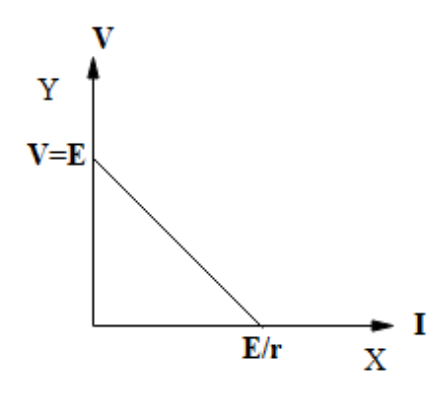
From equation (1), $V=E-Ir$,
we see that the terminal voltage is directly proportional to the negative of current, $V\propto -I$,
hence it represents a straight-line graph with a negative slope.
When $V=E,$ the current flowing through the circuit is zero.
When $I=\dfrac{E}{r},$ the terminal voltage of the circuit is zero.
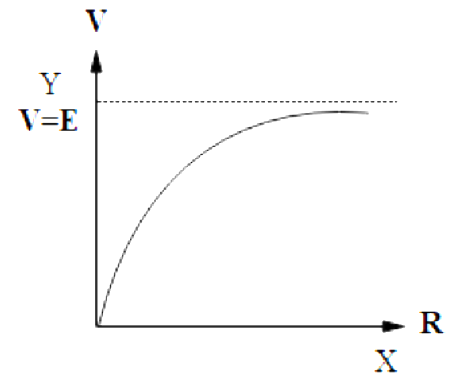
From equation (3), $V=\dfrac{E}{\left( 1+{r}/{R}\; \right)}$
$\Rightarrow V=\dfrac{ER}{R+r}$ ,
we have the terminal voltage directly proportional to the load resistance till it is less than the emf of the cell. When the terminal voltage becomes equal to the emf of the cell, it becomes constant with respect to the load resistance.
Note: When any connected device will draw current from the battery, the energy of battery decreases and hence the terminal voltage also decreases. So as the current increases, the terminal voltage decreases. This is primarily because of the fact that the device also poses a significant amount of resistance to the flowing current in the circuit.
Complete step by step answer:
The terminal voltage, $V$ is given as:
$V=E-Ir$ ------(1)
Where,
$E=$emf of cell
$I=$ current
$r=$ internal resistance
By Ohm’s law, $V=IR$
Where,
$R=$ total resistance
The total resistance of circuit = load resistor $+$ internal resistance
Thus, total resistance $=R+r$
Therefore, current of circuit, $I=\dfrac{E}{\left( R+r \right)}$ ----- (2)
Substituting value of current in equation (1),
$\Rightarrow V=E-\dfrac{E}{\left( R+r \right)}r$
$\Rightarrow V=\dfrac{ER}{R+r}$
$\Rightarrow V=\dfrac{E}{\left( 1+{r}/{R}\; \right)}$ ------- (3)
Given that when $R=4\Omega$, then $I=1A$;
Substituting these in equation (2);
$\Rightarrow 1=\dfrac{E}{\left( 4+r \right)}$
$\Rightarrow 4+r=E$ --------(4)
Also given that when $R=9\Omega$, then $I=0.5A$;
Substituting these in equation (2);
$\Rightarrow 0.5=\dfrac{E}{\left( 9+r \right)}$
$\Rightarrow \dfrac{1}{2}\left( 9+r \right)=E$ ------- (5)
Simultaneously solving equations (4) and (5),
$\Rightarrow 4+r=\dfrac{9+r}{2}$
$\Rightarrow 8+2r=9+r$
$\therefore r=1\Omega$
Putting $r=1\Omega$ in equation (4);
$\Rightarrow 4+1=E$
$\therefore E=5V$
Therefore, the value of the emf, $E=5V$ and internal resistance, $r=1\Omega$.
From equation (1), $V=E-Ir$,
we see that the terminal voltage is directly proportional to the negative of current, $V\propto -I$,
hence it represents a straight-line graph with a negative slope.
When $V=E,$ the current flowing through the circuit is zero.
When $I=\dfrac{E}{r},$ the terminal voltage of the circuit is zero.
From equation (3), $V=\dfrac{E}{\left( 1+{r}/{R}\; \right)}$
$\Rightarrow V=\dfrac{ER}{R+r}$ ,
we have the terminal voltage directly proportional to the load resistance till it is less than the emf of the cell. When the terminal voltage becomes equal to the emf of the cell, it becomes constant with respect to the load resistance.
Note: When any connected device will draw current from the battery, the energy of battery decreases and hence the terminal voltage also decreases. So as the current increases, the terminal voltage decreases. This is primarily because of the fact that the device also poses a significant amount of resistance to the flowing current in the circuit.
Recently Updated Pages
Master Class 12 Economics: Engaging Questions & Answers for Success

Master Class 12 English: Engaging Questions & Answers for Success
Master Class 12 Social Science: Engaging Questions & Answers for Success
Master Class 12 Maths: Engaging Questions & Answers for Success
Master Class 12 Physics: Engaging Questions & Answers for Success
Master Class 9 General Knowledge: Engaging Questions & Answers for Success
Trending doubts
Which are the Top 10 Largest Countries of the World?
Draw a labelled sketch of the human eye class 12 physics CBSE
Differentiate between homogeneous and heterogeneous class 12 chemistry CBSE
Sulphuric acid is known as the king of acids State class 12 chemistry CBSE
Why is the cell called the structural and functional class 12 biology CBSE
A dentist uses a small mirror that gives a magnification class 12 physics CBSE