




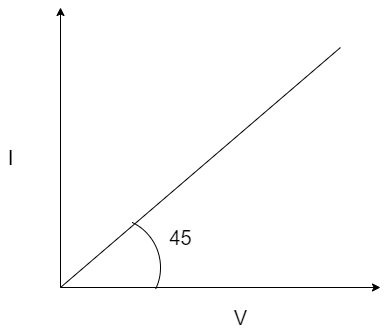
A cell of e.m.f. 1.5V and internal resistance $0.5\Omega $ is connected to a conductor whose V-I graph is as shown in figure. Then the terminal voltage of the cell is:
A) $0.75V$
B) $1.0V$
C) $1.25V$
D) $1.5V$
Answer
 Verified
578.1k+ views
Hint: Recall that the resistance is defined as the opposition to the flow of electrons in a conductor. Also the Ohm’s law is used here. According to this law, the current flowing through any circuit is directly proportional to the voltage and inversely proportional to the resistance.
Complete step by step answer:
Step I:
Given that the e.m.f of the cell is $ = 1.5V$
And internal resistance$r = 0.5\Omega $
The resistance of the conductor can be known by using Ohm’s law. As per Ohm’s law
$V = IR$
$\Rightarrow R = \dfrac{V}{I}$
Step II:
But since the graph is linear, this means that
$V = I$
Therefore, $R = 1\Omega $
The total resistance of the conductor is given by= Resistance of the conductor + internal resistance
$\Rightarrow R_{total} = 1 + 0.5$
$\Rightarrow R_{total}= 1.5\Omega $
Step III:
Again using Ohm’s law to find the value of current in the circuit.
$I = \dfrac{V}{R}$
e.m.f. of a cell is the potential difference across the terminals of a cell when no current is flowing in the circuit. So finding the value of current
$\Rightarrow I = \dfrac{{1.5}}{{1.5}}$
$\Rightarrow I = 1A$
The potential difference that is applied between the terminals of the battery is known as terminal voltage. The voltage across the terminal is given by
=e.m.f.-voltage drop across internal resistance
$\Rightarrow $ Terminal voltage $ = 1.5 - (1 \times 0.5)$
$\Rightarrow $ Terminal voltage $ = 1.0V$
Therefore the terminal voltage across the circuit is $1V$. Hence Option B is the right answer.
Note:
It is to be noted that the terminal voltage is always less than the e.m.f. of the cell. This is because when the current passes through the internal resistance of the conductor or the circuit then it causes some potential drop. But when no current passes the voltage across the terminals is the e.m.f.
Complete step by step answer:
Step I:
Given that the e.m.f of the cell is $ = 1.5V$
And internal resistance$r = 0.5\Omega $
The resistance of the conductor can be known by using Ohm’s law. As per Ohm’s law
$V = IR$
$\Rightarrow R = \dfrac{V}{I}$
Step II:
But since the graph is linear, this means that
$V = I$
Therefore, $R = 1\Omega $
The total resistance of the conductor is given by= Resistance of the conductor + internal resistance
$\Rightarrow R_{total} = 1 + 0.5$
$\Rightarrow R_{total}= 1.5\Omega $
Step III:
Again using Ohm’s law to find the value of current in the circuit.
$I = \dfrac{V}{R}$
e.m.f. of a cell is the potential difference across the terminals of a cell when no current is flowing in the circuit. So finding the value of current
$\Rightarrow I = \dfrac{{1.5}}{{1.5}}$
$\Rightarrow I = 1A$
The potential difference that is applied between the terminals of the battery is known as terminal voltage. The voltage across the terminal is given by
=e.m.f.-voltage drop across internal resistance
$\Rightarrow $ Terminal voltage $ = 1.5 - (1 \times 0.5)$
$\Rightarrow $ Terminal voltage $ = 1.0V$
Therefore the terminal voltage across the circuit is $1V$. Hence Option B is the right answer.
Note:
It is to be noted that the terminal voltage is always less than the e.m.f. of the cell. This is because when the current passes through the internal resistance of the conductor or the circuit then it causes some potential drop. But when no current passes the voltage across the terminals is the e.m.f.
Recently Updated Pages
Master Class 12 Economics: Engaging Questions & Answers for Success

Master Class 12 Physics: Engaging Questions & Answers for Success
Master Class 12 English: Engaging Questions & Answers for Success
Master Class 12 Social Science: Engaging Questions & Answers for Success
Master Class 12 Maths: Engaging Questions & Answers for Success
Master Class 12 Business Studies: Engaging Questions & Answers for Success
Trending doubts
Which are the Top 10 Largest Countries of the World?
What are the major means of transport Explain each class 12 social science CBSE
Draw a labelled sketch of the human eye class 12 physics CBSE
Why cannot DNA pass through cell membranes class 12 biology CBSE
Differentiate between insitu conservation and exsitu class 12 biology CBSE
Draw a neat and well labeled diagram of TS of ovary class 12 biology CBSE