




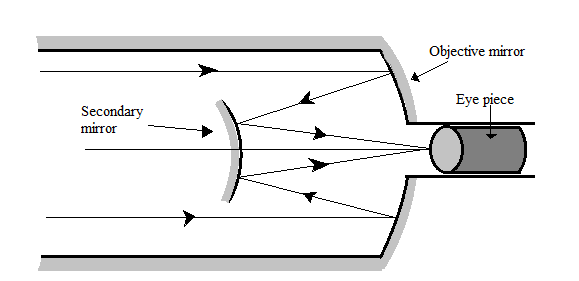
A Cassegrain telescope uses two mirrors as shown in the above figure. Such a telescope is built with the mirrors $20mm$ apart. If the radius of curvature of the large mirror is $220mm$ and the small mirror is $140mm$, where will the final image of an object at infinity be?
Answer
 Verified
611.7k+ views
Hint:In order to solve this question you have to know the concept of mirror formula for concave and convex mirror. Always remember that when there is given a Cassegrain telescope like in above diagram then the image formed by the objective will act as a virtual object for the secondary mirror.
Formula used:
Mirror formula is given as
$\dfrac{1}{v} + \dfrac{1}{u} = \dfrac{1}{f}$
Where $v$ is the distance where the final image formed
$u$ is the distance of the object from the mirror
$f$ is the focal length of the mirror
Complete step by step solution:
The distance between the objective mirror and the secondary mirror is given in the question, $d = 20mm$
The radius of the curvature of the objective mirror is also given in the question, ${R_1} = 220mm$
Hence, the focal length of the objective mirror is, ${f_1} = \dfrac{{{R_1}}}{2} = 110mm$
Also the radius of curvature of the secondary mirror is given in the question, ${R_2} = 70mm$
Hence, the focal length of the secondary mirror is, ${f_2} = \dfrac{{{R_2}}}{2} = 70mm$
The image formed by the objective mirror with an object placed at infinity, will act as a virtual object for the secondary mirror.
Hence, the image distance which acts as an object for the secondary mirror is,
$u = {f_1} - d$
On putting the values, we get
$ \Rightarrow u = 110 - 20 = 90mm$
Now, Applying the mirror formula for the secondary mirror,
$\dfrac{1}{v} + \dfrac{1}{u} = \dfrac{1}{{{f_2}}}$
On putting all the values, we get
$\dfrac{1}{v} + \dfrac{1}{{90}} = \dfrac{1}{{70}}$
On solving this we get
$ \Rightarrow v = 315mm$
Hence, the final image of an object at infinity will be formed $315mm$ away from the secondary mirror.
Note:The Cassegrain telescope is an reflecting astronomical telescope, in which light ray is incident on a concave mirror known as objective mirror and then the reflected ray incident on a smaller convex mirror known as secondary mirror and then finally this ray is also gets reflected through a hole in the concave mirror onto a eyepiece to finally form the image.
Formula used:
Mirror formula is given as
$\dfrac{1}{v} + \dfrac{1}{u} = \dfrac{1}{f}$
Where $v$ is the distance where the final image formed
$u$ is the distance of the object from the mirror
$f$ is the focal length of the mirror
Complete step by step solution:
The distance between the objective mirror and the secondary mirror is given in the question, $d = 20mm$
The radius of the curvature of the objective mirror is also given in the question, ${R_1} = 220mm$
Hence, the focal length of the objective mirror is, ${f_1} = \dfrac{{{R_1}}}{2} = 110mm$
Also the radius of curvature of the secondary mirror is given in the question, ${R_2} = 70mm$
Hence, the focal length of the secondary mirror is, ${f_2} = \dfrac{{{R_2}}}{2} = 70mm$
The image formed by the objective mirror with an object placed at infinity, will act as a virtual object for the secondary mirror.
Hence, the image distance which acts as an object for the secondary mirror is,
$u = {f_1} - d$
On putting the values, we get
$ \Rightarrow u = 110 - 20 = 90mm$
Now, Applying the mirror formula for the secondary mirror,
$\dfrac{1}{v} + \dfrac{1}{u} = \dfrac{1}{{{f_2}}}$
On putting all the values, we get
$\dfrac{1}{v} + \dfrac{1}{{90}} = \dfrac{1}{{70}}$
On solving this we get
$ \Rightarrow v = 315mm$
Hence, the final image of an object at infinity will be formed $315mm$ away from the secondary mirror.
Note:The Cassegrain telescope is an reflecting astronomical telescope, in which light ray is incident on a concave mirror known as objective mirror and then the reflected ray incident on a smaller convex mirror known as secondary mirror and then finally this ray is also gets reflected through a hole in the concave mirror onto a eyepiece to finally form the image.
Recently Updated Pages
Master Class 12 Business Studies: Engaging Questions & Answers for Success

Master Class 12 Chemistry: Engaging Questions & Answers for Success
Master Class 12 Biology: Engaging Questions & Answers for Success
Class 12 Question and Answer - Your Ultimate Solutions Guide
Master Class 11 English: Engaging Questions & Answers for Success
Master Class 11 Social Science: Engaging Questions & Answers for Success
Trending doubts
Which are the Top 10 Largest Countries of the World?
Draw a labelled sketch of the human eye class 12 physics CBSE
Differentiate between homogeneous and heterogeneous class 12 chemistry CBSE
In order to find out the different types of gametes class 12 biology NEET_UG
Why is the cell called the structural and functional class 12 biology CBSE
Draw ray diagrams each showing i myopic eye and ii class 12 physics CBSE