




A carrom board (4ft X 4ft square) has the queen at the centre. The queen, hit by the striker moves to the front edge, rebounds and goes in the hole behind the striking line. Find the magnitude of displacement of the queen:
(i) from the centre to the front edge
(ii) from the front edge to the hole and
(iii) from the centre of the hole.
Answer
 Verified
582k+ views
Hint: In this question, we will first use the relation of incidence angle and reflection angle; this will help us to find the required displacement for our question. Further, we will discuss the basics of light and law of reflection. We will also see the difference between reflection and refraction for our better understanding.
Formula used:
$\tan i = \tan r$
Complete step by step solution:
As we know by law of reflection, angle of incidence is equal to angle of reflection.
$\tan i = \tan r.........(1)$
Now, as we know from the basics of trigonometry:
$\tan \theta = \dfrac{{perpendicular}}{{base}}$
So, by substituting the values from the diagram in equation (1) we get:
$\eqalign{& \dfrac{{2 - x}}{x} = \dfrac{4}{2} \cr
& \Rightarrow 4 - 2x = x \cr
& \Rightarrow x = \dfrac{2}{3} \cr} $
Now, we get the value of BD as:
$BD = 2 - \dfrac{2}{3} = \dfrac{4}{3}$
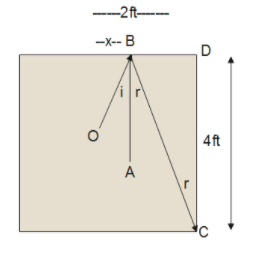
So, the displacement of queen from the front edge to hole BC, which is given by:
$B\vec C = \dfrac{{2\hat i}}{3} + 2\hat j$
Now, we can calculate the magnitude of displacement, which is given by:
$O\vec B = \sqrt {{{\left( {\dfrac{2}{3}} \right)}^2} + {2^2}} = \dfrac{2}{3}\sqrt {10} ft$
Thus, displacement of queen from center to front edge is given by:
$B\vec C = \dfrac{{4\hat i}}{3} - 4\hat j$
Now, we can calculate the magnitude of displacement, which is given by:
$B\vec C = \sqrt {{{\left( {\dfrac{4}{3}} \right)}^2} + {4^2}} = \dfrac{4}{3}\sqrt {10} ft$
Thus, the displacement of queen from the center to hole is given as:
$O\vec C = 2\hat i - 2\hat j$
Now, we can calculate the magnitude of displacement, which is given by:
$O\vec C = \sqrt {{{\left( 2 \right)}^2} + {2^2}} = 2\sqrt 2 ft$
Therefore, we get the required result for all the three cases.
Additional information:
As we know that the light has dual property, and so its behavior is very unpredictable. So, from this we get to know that light can be wave or it can be a particle.
Also, when a beam of light or ray of light is observed approaching and thus reflecting off of a flat mirror i.e., smooth surface, then at that time the behavior of the light as it reflects follows a law which is known as the law of reflection. The law of reflection states that when a beam or ray of light gets reflected from a smooth surface, the angle of the reflected ray is equal to the angle of the incident ray.
Further, we know that light rays or beams of light change their direction when it gets reflected off a surface, they move from one transparent medium into another, or they can also travel through a medium whose composition is continuously changing with time.
Note:
We should always remember the difference between the two phenomena by light i.e., reflection and refraction. Here, reflection is observed, when a beam or ray of light falling on a smooth surface changes its direction, and refraction is defined as the bending of light towards normal when the light is travelling from rarer medium to denser medium.
Formula used:
$\tan i = \tan r$
Complete step by step solution:
As we know by law of reflection, angle of incidence is equal to angle of reflection.
$\tan i = \tan r.........(1)$
Now, as we know from the basics of trigonometry:
$\tan \theta = \dfrac{{perpendicular}}{{base}}$
So, by substituting the values from the diagram in equation (1) we get:
$\eqalign{& \dfrac{{2 - x}}{x} = \dfrac{4}{2} \cr
& \Rightarrow 4 - 2x = x \cr
& \Rightarrow x = \dfrac{2}{3} \cr} $
Now, we get the value of BD as:
$BD = 2 - \dfrac{2}{3} = \dfrac{4}{3}$
So, the displacement of queen from the front edge to hole BC, which is given by:
$B\vec C = \dfrac{{2\hat i}}{3} + 2\hat j$
Now, we can calculate the magnitude of displacement, which is given by:
$O\vec B = \sqrt {{{\left( {\dfrac{2}{3}} \right)}^2} + {2^2}} = \dfrac{2}{3}\sqrt {10} ft$
Thus, displacement of queen from center to front edge is given by:
$B\vec C = \dfrac{{4\hat i}}{3} - 4\hat j$
Now, we can calculate the magnitude of displacement, which is given by:
$B\vec C = \sqrt {{{\left( {\dfrac{4}{3}} \right)}^2} + {4^2}} = \dfrac{4}{3}\sqrt {10} ft$
Thus, the displacement of queen from the center to hole is given as:
$O\vec C = 2\hat i - 2\hat j$
Now, we can calculate the magnitude of displacement, which is given by:
$O\vec C = \sqrt {{{\left( 2 \right)}^2} + {2^2}} = 2\sqrt 2 ft$
Therefore, we get the required result for all the three cases.
Additional information:
As we know that the light has dual property, and so its behavior is very unpredictable. So, from this we get to know that light can be wave or it can be a particle.
Also, when a beam of light or ray of light is observed approaching and thus reflecting off of a flat mirror i.e., smooth surface, then at that time the behavior of the light as it reflects follows a law which is known as the law of reflection. The law of reflection states that when a beam or ray of light gets reflected from a smooth surface, the angle of the reflected ray is equal to the angle of the incident ray.
Further, we know that light rays or beams of light change their direction when it gets reflected off a surface, they move from one transparent medium into another, or they can also travel through a medium whose composition is continuously changing with time.
Note:
We should always remember the difference between the two phenomena by light i.e., reflection and refraction. Here, reflection is observed, when a beam or ray of light falling on a smooth surface changes its direction, and refraction is defined as the bending of light towards normal when the light is travelling from rarer medium to denser medium.
Recently Updated Pages
Master Class 12 Business Studies: Engaging Questions & Answers for Success

Master Class 12 Chemistry: Engaging Questions & Answers for Success
Master Class 12 Biology: Engaging Questions & Answers for Success
Class 12 Question and Answer - Your Ultimate Solutions Guide
Master Class 11 English: Engaging Questions & Answers for Success
Master Class 11 Maths: Engaging Questions & Answers for Success
Trending doubts
Which is more stable and why class 12 chemistry CBSE
Which are the Top 10 Largest Countries of the World?
Draw a labelled sketch of the human eye class 12 physics CBSE
Differentiate between homogeneous and heterogeneous class 12 chemistry CBSE
What are the major means of transport Explain each class 12 social science CBSE
Sulphuric acid is known as the king of acids State class 12 chemistry CBSE