




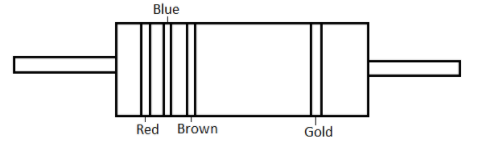
A carbon resistor has coloured bands as shown in the figure below. The resistance of the resistor is
$A)\text{ }26\Omega \pm 10\%$
$B)\text{ }26\Omega \pm 5\%$
$C)\text{ }260\Omega \pm 5\%$
$D)\text{ }260\Omega \pm 10\%$
Answer
 Verified
624.9k+ views
Hint: This problem can be solved by recalling the colour codes and the values represented by the colours on the first, second, third and fourth bands of a carbon resistor. By interpreting the values of the coloured bands we will get the required value of the resistance of the carbon resistor.
Complete step-by-step answer:
The bands on a carbon resistor imply a specific meaning and are used to mark the resistance of the resistor, which in usual terms cannot be written on its body since the resistors are usually very small.
Now, let us analyze the given carbon resistor.
It is a four band resistor meaning the first and second band gives the first and second digits respectively. The third band will give the number of trailing zeroes that have to be added and the fourth band will give the tolerance value of the resistor.
The first band is of red colour. This implies that the first digit of the resistance is $2$.
The second band is of blue colour. This implies that the second digit in the resistance value is $6$.
The third band is of brown colour. This implies that one trailing zero has to be added to the resistance value.
Finally the band indicating the tolerance is gold. This implies a tolerance of $\pm 5\%$.
Therefore, the total value of the resistance will be $260\Omega \pm 5\%$.
Therefore, the correct option is $C)\text{ }260\Omega \pm 5\%$.
Note:A good way to remember the sequence of the colours in increasing number value for the carbon resistor colour coding scheme is through the use of the mnemonic “B.B. ROY of Great Britain has a very good wife.” where the underlined letters stand for the colours in the correct order, that is, Black, Brown, Red, Orange, Yellow, Green, Blue, Violet, Grey and White.
Complete step-by-step answer:
The bands on a carbon resistor imply a specific meaning and are used to mark the resistance of the resistor, which in usual terms cannot be written on its body since the resistors are usually very small.
Now, let us analyze the given carbon resistor.
It is a four band resistor meaning the first and second band gives the first and second digits respectively. The third band will give the number of trailing zeroes that have to be added and the fourth band will give the tolerance value of the resistor.
The first band is of red colour. This implies that the first digit of the resistance is $2$.
The second band is of blue colour. This implies that the second digit in the resistance value is $6$.
The third band is of brown colour. This implies that one trailing zero has to be added to the resistance value.
Finally the band indicating the tolerance is gold. This implies a tolerance of $\pm 5\%$.
Therefore, the total value of the resistance will be $260\Omega \pm 5\%$.
Therefore, the correct option is $C)\text{ }260\Omega \pm 5\%$.
Note:A good way to remember the sequence of the colours in increasing number value for the carbon resistor colour coding scheme is through the use of the mnemonic “B.B. ROY of Great Britain has a very good wife.” where the underlined letters stand for the colours in the correct order, that is, Black, Brown, Red, Orange, Yellow, Green, Blue, Violet, Grey and White.
Recently Updated Pages
Master Class 12 Economics: Engaging Questions & Answers for Success

Master Class 12 English: Engaging Questions & Answers for Success
Master Class 12 Social Science: Engaging Questions & Answers for Success
Master Class 12 Maths: Engaging Questions & Answers for Success
Master Class 12 Physics: Engaging Questions & Answers for Success
Master Class 9 General Knowledge: Engaging Questions & Answers for Success
Trending doubts
Which are the Top 10 Largest Countries of the World?
Draw a labelled sketch of the human eye class 12 physics CBSE
Differentiate between homogeneous and heterogeneous class 12 chemistry CBSE
Sulphuric acid is known as the king of acids State class 12 chemistry CBSE
Why is the cell called the structural and functional class 12 biology CBSE
Draw ray diagrams each showing i myopic eye and ii class 12 physics CBSE