




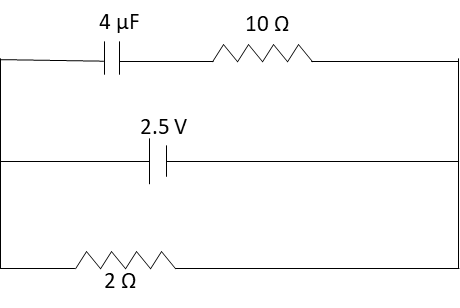
A capacitor of \[4\,\mu {\text{F}}\] is connected in the circuit. The internal resistance of the battery is \[0.5\,\Omega \]. The amount of charge on the capacitor plates will be
A. 0
B.\[4\,\mu {\text{C}}\]
C.\[16\,\mu {\text{C}}\]
D.\[8\,\mu {\text{C}}\]
Answer
 Verified
603.9k+ views
Hint: Use the equation for the electric current flowing through the main resistance and the internal resistance. Also, use the expression for Ohm’s law and determine the potential difference across the internal resistance and then capacitor. Use the equation for the charge stored on the plates of the capacitor.
Formula used:
The current \[I\] flowing through the main resistance and the internal resistance is
\[I = \dfrac{V}{{R + r}}\] …… (1)
Here, \[V\] is the potential difference, \[R\] is the main resistance and \[r\] is the internal resistance.
The expression for Ohm’s law is
\[V = IR\] …… (2)
Here, \[V\] is the potential difference, \[I\] is the current and \[R\] is the resistance.
The charge stored \[Q\] on the capacitor is
\[Q = CV\] …… (3)
Here, \[C\] is the capacitance and \[V\] is the potential difference across the plates of the capacitor.
Complete step by step answer:
From the given circuit diagram, it can be seen that no current flows through the resistor with resistance \[10\,\Omega \] as the capacitor is open circuited.
We have given that the internal resistance of the battery is \[0.5\,\Omega \].
\[r = 0.5\,\Omega \]
We can determine the current flowing through the main and internal resistance using equation (1).
Substitute \[2.5\,{\text{V}}\] for \[V\], \[2\,\Omega \] for \[R\] and \[0.5\,\Omega \] for \[r\] in equation (1).
\[I = \dfrac{{2.5\,{\text{V}}}}{{\left( {2\,\Omega } \right) + \left( {0.5\,\Omega } \right)}}\]
\[ \Rightarrow I = 1\,{\text{A}}\]
Hence, the current flowing through the lower arm of the given circuit is \[1\,{\text{A}}\].
We can calculate the potential difference \[{V_r}\] across the internal resistance.
Substitute \[1\,{\text{A}}\] for \[I\] and \[0.5\,\Omega \] for \[r\] in equation (2).
\[{V_r} = \left( {1\,{\text{A}}} \right)\left( {0.5\,\Omega } \right)\]
\[ \Rightarrow {V_r} = 0.5\,{\text{V}}\]
Hence, the potential difference across the internal resistance is \[0.5\,{\text{V}}\].
The potential difference \[{V_c}\] across the \[4\,\mu {\text{F}}\] capacitor is the difference of the potential difference \[V\] of the battery and the potential difference \[{V_r}\] across the internal resistance.
\[{V_c} = V - {V_r}\]
Substitute \[2.5\,{\text{V}}\] for \[V\] and \[0.5\,{\text{V}}\] for \[{V_r}\] in the above equation.
\[{V_c} = 2.5\,{\text{V}} - 0.5\,{\text{V}}\]
\[ \Rightarrow {V_c} = 2\,{\text{V}}\]
This gives the potential difference across the capacitor.
Let us now calculate the amount of charge through the capacitor.
Substitute \[4\,\mu {\text{F}}\] for \[C\] and \[2\,{\text{V}}\] for \[V\] in equation (3).
\[Q = \left( {4\,\mu {\text{F}}} \right)\left( {2\,{\text{V}}} \right)\]
\[ \Rightarrow Q = \left( {4 \times {{10}^{ - 6}}\,{\text{F}}} \right)\left( {2\,{\text{V}}} \right)\]
\[ \Rightarrow Q = 8\,\mu {\text{C}}\]
Therefore, the amount of charge on the capacitor plates is \[8\,\mu {\text{C}}\].
Hence, the correct option is D.
Note:
The students may determine the current flowing through the circuit considering all the resistors connected in the circuit. But the capacitor is open circuited and hence, no current flows through the \[10\,\Omega \] resistor. So, this resistor should not be considered while determining the current through the circuit.
Formula used:
The current \[I\] flowing through the main resistance and the internal resistance is
\[I = \dfrac{V}{{R + r}}\] …… (1)
Here, \[V\] is the potential difference, \[R\] is the main resistance and \[r\] is the internal resistance.
The expression for Ohm’s law is
\[V = IR\] …… (2)
Here, \[V\] is the potential difference, \[I\] is the current and \[R\] is the resistance.
The charge stored \[Q\] on the capacitor is
\[Q = CV\] …… (3)
Here, \[C\] is the capacitance and \[V\] is the potential difference across the plates of the capacitor.
Complete step by step answer:
From the given circuit diagram, it can be seen that no current flows through the resistor with resistance \[10\,\Omega \] as the capacitor is open circuited.
We have given that the internal resistance of the battery is \[0.5\,\Omega \].
\[r = 0.5\,\Omega \]
We can determine the current flowing through the main and internal resistance using equation (1).
Substitute \[2.5\,{\text{V}}\] for \[V\], \[2\,\Omega \] for \[R\] and \[0.5\,\Omega \] for \[r\] in equation (1).
\[I = \dfrac{{2.5\,{\text{V}}}}{{\left( {2\,\Omega } \right) + \left( {0.5\,\Omega } \right)}}\]
\[ \Rightarrow I = 1\,{\text{A}}\]
Hence, the current flowing through the lower arm of the given circuit is \[1\,{\text{A}}\].
We can calculate the potential difference \[{V_r}\] across the internal resistance.
Substitute \[1\,{\text{A}}\] for \[I\] and \[0.5\,\Omega \] for \[r\] in equation (2).
\[{V_r} = \left( {1\,{\text{A}}} \right)\left( {0.5\,\Omega } \right)\]
\[ \Rightarrow {V_r} = 0.5\,{\text{V}}\]
Hence, the potential difference across the internal resistance is \[0.5\,{\text{V}}\].
The potential difference \[{V_c}\] across the \[4\,\mu {\text{F}}\] capacitor is the difference of the potential difference \[V\] of the battery and the potential difference \[{V_r}\] across the internal resistance.
\[{V_c} = V - {V_r}\]
Substitute \[2.5\,{\text{V}}\] for \[V\] and \[0.5\,{\text{V}}\] for \[{V_r}\] in the above equation.
\[{V_c} = 2.5\,{\text{V}} - 0.5\,{\text{V}}\]
\[ \Rightarrow {V_c} = 2\,{\text{V}}\]
This gives the potential difference across the capacitor.
Let us now calculate the amount of charge through the capacitor.
Substitute \[4\,\mu {\text{F}}\] for \[C\] and \[2\,{\text{V}}\] for \[V\] in equation (3).
\[Q = \left( {4\,\mu {\text{F}}} \right)\left( {2\,{\text{V}}} \right)\]
\[ \Rightarrow Q = \left( {4 \times {{10}^{ - 6}}\,{\text{F}}} \right)\left( {2\,{\text{V}}} \right)\]
\[ \Rightarrow Q = 8\,\mu {\text{C}}\]
Therefore, the amount of charge on the capacitor plates is \[8\,\mu {\text{C}}\].
Hence, the correct option is D.
Note:
The students may determine the current flowing through the circuit considering all the resistors connected in the circuit. But the capacitor is open circuited and hence, no current flows through the \[10\,\Omega \] resistor. So, this resistor should not be considered while determining the current through the circuit.
Recently Updated Pages
Master Class 12 Business Studies: Engaging Questions & Answers for Success

Master Class 12 Biology: Engaging Questions & Answers for Success
Master Class 12 Chemistry: Engaging Questions & Answers for Success
Class 12 Question and Answer - Your Ultimate Solutions Guide
Master Class 11 Social Science: Engaging Questions & Answers for Success
Master Class 11 English: Engaging Questions & Answers for Success
Trending doubts
Which are the Top 10 Largest Countries of the World?
Draw a labelled sketch of the human eye class 12 physics CBSE
Name the crygenes that control cotton bollworm and class 12 biology CBSE
Differentiate between homogeneous and heterogeneous class 12 chemistry CBSE
Ribosomal RNA is actively synthesised in A Nucleoplasm class 12 biology CBSE
How many molecules of ATP and NADPH are required information class 12 biology CBSE