




A Capacitor of \[2\mu F\] is connected in a radio circuit. The source frequency is $1000\,Hz$. If the current through the capacitor branch is \[2mA\] then voltage across the capacitor is
A. 0.16 V
B. 0.32 V
C. 156 V
D. 79.5 V
Answer
 Verified
507.6k+ views
Hint: In the question above capacitance , frequency and current has been given. By ohm’s law we know that voltage is directly proportional to current and \[V = iR\]. In this case. First we find the capacitive reactance \[{\chi _c}\] and then we find the voltage $V$.
Formula used:
\[V = i\dfrac{1}{{\omega C}}\]
where \[{\chi _c}\]=capacitive reactance.
Complete step by step answer:
We know that AC is alternating current which periodically reverses its direction unlike DC. AC is generally used for distribution of power .By ohm’s law we know that,
$V=IR$…………....(I=current, V=voltage ,R=resistor)
As this is an AC circuit the voltage will be given by \[V = i{\chi _c}\].Capacitive reactance Is the opposition offered by capacitor to the change in voltage across the element. Look at the diagram below :
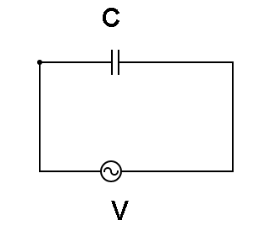
We are suppose to find the voltage ;
We know that:
\[{\chi _c} = \dfrac{1}{{\omega C}}\] (where \[\omega = \]frequency)
Substituting the values of C, \[\omega \] and we get:
\[V = \dfrac{{2 \times {{10}^{ - 2}}}}{{2\pi \times 1000 \times 2 \times {{10}^{ - 6}}}}\]
\[V = 0.16\,V\]
Hence after solving we see that voltage =0.16 V.
Therefore the correct answer is option A.
Additional information: For a purely capacitive AC circuit, instantaneous value of current is given by: \[i = \left( {\dfrac{{{V_0}}}{{\dfrac{1}{{\omega C}}}}} \right)\cos \omega t\]
\[i = {i_0}\sin \left( {\omega t + \phi } \right)\]. This equation tells us that the current leads voltage by \[\left( {\dfrac{\pi }{2}} \right)\].
Note: The capacitive reactance is given by \[{\chi _c} = \dfrac{1}{{\omega C}}\] and inductive reactance is given by \[{\chi _L} = \omega L\].do not get confused with the formulas. In a pure capacitive circuit current always leads the voltage by \[{90^ \circ }\] and average power applied to it is zero. The capacitive reactance increases with decrease in frequency.
Formula used:
\[V = i\dfrac{1}{{\omega C}}\]
where \[{\chi _c}\]=capacitive reactance.
Complete step by step answer:
We know that AC is alternating current which periodically reverses its direction unlike DC. AC is generally used for distribution of power .By ohm’s law we know that,
$V=IR$…………....(I=current, V=voltage ,R=resistor)
As this is an AC circuit the voltage will be given by \[V = i{\chi _c}\].Capacitive reactance Is the opposition offered by capacitor to the change in voltage across the element. Look at the diagram below :
We are suppose to find the voltage ;
We know that:
\[{\chi _c} = \dfrac{1}{{\omega C}}\] (where \[\omega = \]frequency)
Substituting the values of C, \[\omega \] and we get:
\[V = \dfrac{{2 \times {{10}^{ - 2}}}}{{2\pi \times 1000 \times 2 \times {{10}^{ - 6}}}}\]
\[V = 0.16\,V\]
Hence after solving we see that voltage =0.16 V.
Therefore the correct answer is option A.
Additional information: For a purely capacitive AC circuit, instantaneous value of current is given by: \[i = \left( {\dfrac{{{V_0}}}{{\dfrac{1}{{\omega C}}}}} \right)\cos \omega t\]
\[i = {i_0}\sin \left( {\omega t + \phi } \right)\]. This equation tells us that the current leads voltage by \[\left( {\dfrac{\pi }{2}} \right)\].
Note: The capacitive reactance is given by \[{\chi _c} = \dfrac{1}{{\omega C}}\] and inductive reactance is given by \[{\chi _L} = \omega L\].do not get confused with the formulas. In a pure capacitive circuit current always leads the voltage by \[{90^ \circ }\] and average power applied to it is zero. The capacitive reactance increases with decrease in frequency.
Recently Updated Pages
Master Class 12 Economics: Engaging Questions & Answers for Success

Master Class 12 Physics: Engaging Questions & Answers for Success
Master Class 12 English: Engaging Questions & Answers for Success
Master Class 12 Social Science: Engaging Questions & Answers for Success
Master Class 12 Maths: Engaging Questions & Answers for Success
Master Class 12 Business Studies: Engaging Questions & Answers for Success
Trending doubts
Which are the Top 10 Largest Countries of the World?
What are the major means of transport Explain each class 12 social science CBSE
Draw a labelled sketch of the human eye class 12 physics CBSE
Why cannot DNA pass through cell membranes class 12 biology CBSE
Differentiate between insitu conservation and exsitu class 12 biology CBSE
Draw a neat and well labeled diagram of TS of ovary class 12 biology CBSE