




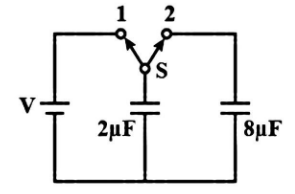
A capacitor of \[2\mu F\] is charged as shown in the diagram. When the switch \[S\] is turned to position \[2\] , the percentage of its stored energy dissipated is:
A. $0\% $
B. $20\% $
C. $75\% $
D. $80\% $
Answer
 Verified
515.1k+ views
Hint: In order to solve this question first of all we will find the initial energy of capacitance and then find the final energy stored in the capacitor formula of energy stored in a capacitor. After that inorder to get the heat dissipated in the circuit we will find the difference between the final and initial energy.
Complete step by step answer:
Initially, the energy stored in \[2\mu F\] capacitor is
${U_i} = \dfrac{1}{2}C{V^2} \\
\Rightarrow {U_i} = \dfrac{1}{2}\left( {2 \times {{10}^{ - 6}}} \right){V^2} \\
\Rightarrow {U_i} = {V^2} \times {10^{ - 6}}J$
Initially, the charge stored in \[2\mu F\] capacitor is ${Q_i} = CV = \left( {2 \times {{10}^{ - 6}}} \right)V = 2V \times {10^{ - 6}}$ Coulomb. When switch $S$ Is turned to position 2, the charge flow and both the capacitors share charges till a common potential ${V_C}$ is reached.
${V_C} = \dfrac{{total\,charge}}{{total\,capacitance}} \\
\Rightarrow {V_C} = \dfrac{{2V \times {{10}^{ - 6}}}}{{\left( {2 + 8} \right) \times {{10}^{ - 6}}}}
\Rightarrow {V_C} = \dfrac{V}{5}volt \\ $
Therefore, finally the energy stored in both the capacitors is
${U_f} = \dfrac{1}{2}\left[ {\left( {2 + 8} \right) \times {{10}^{ - 6}}} \right]{\left( {\dfrac{V}{5}} \right)^2} \\
\Rightarrow {U_f}= \dfrac{{{V^2}}}{5} \times {10^{ - 6}}J \\ $
$\% $ Loss of energy, $\Delta U = \dfrac{{{U_i} - {U_f}}}{{{U_i}}} \times 100\% $
$\Delta U = \dfrac{{\left( {\dfrac{{{V^2} - {V^2}}}{5}} \right) \times {{10}^{ - 6}}}}{{{V^2} \times {{10}^{ - 6}}}} \times 100\% \\
\therefore \Delta U= 80\% $
Hence the correct option is D.
Note: One should take care that there is no flow of charge in open circuit, in order to maintain the flow of change closed circuit is must. When the switch is shifted from one position to another then there will be a change in the charge flowing path which will change the energy and hence there will be some heat loss.
Complete step by step answer:
Initially, the energy stored in \[2\mu F\] capacitor is
${U_i} = \dfrac{1}{2}C{V^2} \\
\Rightarrow {U_i} = \dfrac{1}{2}\left( {2 \times {{10}^{ - 6}}} \right){V^2} \\
\Rightarrow {U_i} = {V^2} \times {10^{ - 6}}J$
Initially, the charge stored in \[2\mu F\] capacitor is ${Q_i} = CV = \left( {2 \times {{10}^{ - 6}}} \right)V = 2V \times {10^{ - 6}}$ Coulomb. When switch $S$ Is turned to position 2, the charge flow and both the capacitors share charges till a common potential ${V_C}$ is reached.
${V_C} = \dfrac{{total\,charge}}{{total\,capacitance}} \\
\Rightarrow {V_C} = \dfrac{{2V \times {{10}^{ - 6}}}}{{\left( {2 + 8} \right) \times {{10}^{ - 6}}}}
\Rightarrow {V_C} = \dfrac{V}{5}volt \\ $
Therefore, finally the energy stored in both the capacitors is
${U_f} = \dfrac{1}{2}\left[ {\left( {2 + 8} \right) \times {{10}^{ - 6}}} \right]{\left( {\dfrac{V}{5}} \right)^2} \\
\Rightarrow {U_f}= \dfrac{{{V^2}}}{5} \times {10^{ - 6}}J \\ $
$\% $ Loss of energy, $\Delta U = \dfrac{{{U_i} - {U_f}}}{{{U_i}}} \times 100\% $
$\Delta U = \dfrac{{\left( {\dfrac{{{V^2} - {V^2}}}{5}} \right) \times {{10}^{ - 6}}}}{{{V^2} \times {{10}^{ - 6}}}} \times 100\% \\
\therefore \Delta U= 80\% $
Hence the correct option is D.
Note: One should take care that there is no flow of charge in open circuit, in order to maintain the flow of change closed circuit is must. When the switch is shifted from one position to another then there will be a change in the charge flowing path which will change the energy and hence there will be some heat loss.
Recently Updated Pages
Basicity of sulphurous acid and sulphuric acid are

Master Class 12 English: Engaging Questions & Answers for Success
Master Class 12 Social Science: Engaging Questions & Answers for Success
Master Class 12 Maths: Engaging Questions & Answers for Success
Master Class 12 Economics: Engaging Questions & Answers for Success
Master Class 12 Physics: Engaging Questions & Answers for Success
Trending doubts
Which country did Danny Casey play for class 12 english CBSE
Give 10 examples of unisexual and bisexual flowers
Coming together federation is practiced in A India class 12 social science CBSE
Write the formula to find the shortest distance between class 12 maths CBSE
Find the foot of the perpendicular from point232to class 12 maths CBSE
How was the Civil Disobedience Movement different from class 12 social science CBSE