




A candidate is required to answer $6$ out of $10$ questions which are divided into two groups each containing $5$ questions and he is not permitted to attempt more than $4$ from each group. In how many ways can he make up his choice?
Answer
 Verified
647.4k+ views
Hint: This is a question based on combination concept. Let there be two sections (A and B) in the question paper and each section has $5$ different questions in it. So the candidate has to select some question from section A and some question from section B, and the total attempted question should be$6$. So we will make all cases of selecting questions and the total selected question should be six. For selecting questions we will use a combination concept.
Complete step-by-step answer:
Combination: If we have to select $r$ different things from total $n$ different things, total numbers of ways to select are –
${}^{n}{{C}_{r}}=\dfrac{n!}{r!\left( n-r \right)!}$
Now, let us assume that the question paper has $2$ different sections, A and B, which has $5$ different questions each.

Now we have to select a total $6$ out of $10$ questions in the paper. So possible cases for this selection:
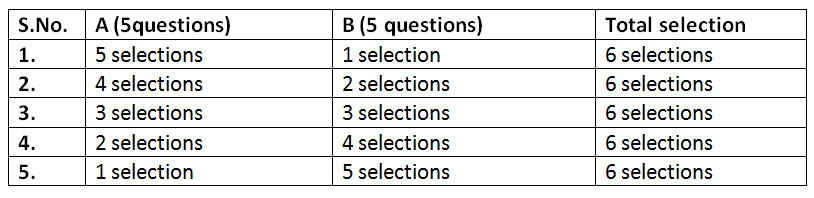
But the question has said that the candidate is not permitted to answer more than $4$ questions from each section, so we will reject case (1) and case (5), because in these cases we are selecting $5$ questions from one section.
So our favorable cases are:

Now we will calculate the number of ways for different cases.
(i) So for the first case, we have to select $4$ questions from section A and $2$ questions from section B. So number of ways of selecting $4$ questions out of $5$questions are ${}^{5}{{C}_{4}}$ and $2$ questions out of $5$ questions are${}^{5}{{C}_{2}}$. But these events are simultaneous, so total number of ways for case (1):
${}^{5}{{C}_{4}}\times {}^{5}{{C}_{2}}$
$\Rightarrow \dfrac{5!}{4!1!}\times \dfrac{5!}{3!2!}$
$\Rightarrow \dfrac{5}{1}\times \dfrac{5\times 4}{2}$
$\Rightarrow 5\times 10$
$\Rightarrow 50 $ways.
(ii) For the second case, we have to select $3$ questions from section A and section B each. So the number of ways of selecting $3$ questions out of $5$questions are${}^{5}{{C}_{3}}$. So, total number of ways for case (2):
${}^{5}{{C}_{3}}\times {}^{5}{{C}_{3}}$
$\Rightarrow \dfrac{5!}{3!2!}\times \dfrac{5!}{3!2!}$
$\Rightarrow \dfrac{5\times 4}{2}\times \dfrac{5\times 4}{2}$
$\Rightarrow 10\times 10$
$\Rightarrow 100$ways.
(iii) And for the second case, we have to select $2$ questions from section A and $4$questions from section B. So, total number of ways for case (3):
${}^{5}{{C}_{2}}\times {}^{5}{{C}_{4}}$
$\Rightarrow \dfrac{5!}{2!3!}\times \dfrac{5!}{4!1!}$
$\Rightarrow \dfrac{5\times 4}{2}\times 5$
$\Rightarrow 10\times 5$
$\Rightarrow 50$ ways.
So total number of ways for selecting total $6$ out of $10$questions are:
$=$ no. of ways for case (1) + no. of ways for case (2) + no. of ways for case (3)
$=$ $50$ways + $100$ways + $50$ways
$=200$ ways.
Note: (i) For this question, we have method-2 also. We have to select a total $6$ out of $10$questions but the condition is that we don’t have to select more than $4$questions from each section/group.
So, here we select $6$ out of $10$questions and then subtract the number of ways where we select $5$ questions from one of two different sections. So total numbers of ways are:
\[{}^{10}{{C}_{6}}-\left( {}^{2}{{C}_{1}}\times {}^{5}{{C}_{5}} \right)\times {}^{5}{{C}_{1}}\]
$\Rightarrow {}^{10}{{C}_{6}}-{}^{2}{{C}_{1}}\times {}^{5}{{C}_{5}}\times {}^{5}{{C}_{1}}$
$\Rightarrow \dfrac{10!}{6!4!}-\dfrac{2!}{1!1!}\times \dfrac{5!}{5!10!}\times \dfrac{5!}{1!4!}$
\[\Rightarrow \dfrac{10\times 9\times 8\times 7}{4\times 3\times 2\times 1}-2\times 1\times 5\]
\[\Rightarrow 10\times 3\times 7-10\]
$\Rightarrow 210-10$
$\Rightarrow 200 $ways.
(ii) In this question, students should take care of all cases carefully. Since calculations are a little tough, keep in mind that check all cases at least once at the end of the questions.
Complete step-by-step answer:
Combination: If we have to select $r$ different things from total $n$ different things, total numbers of ways to select are –
${}^{n}{{C}_{r}}=\dfrac{n!}{r!\left( n-r \right)!}$
Now, let us assume that the question paper has $2$ different sections, A and B, which has $5$ different questions each.
Now we have to select a total $6$ out of $10$ questions in the paper. So possible cases for this selection:
But the question has said that the candidate is not permitted to answer more than $4$ questions from each section, so we will reject case (1) and case (5), because in these cases we are selecting $5$ questions from one section.
So our favorable cases are:
Now we will calculate the number of ways for different cases.
(i) So for the first case, we have to select $4$ questions from section A and $2$ questions from section B. So number of ways of selecting $4$ questions out of $5$questions are ${}^{5}{{C}_{4}}$ and $2$ questions out of $5$ questions are${}^{5}{{C}_{2}}$. But these events are simultaneous, so total number of ways for case (1):
${}^{5}{{C}_{4}}\times {}^{5}{{C}_{2}}$
$\Rightarrow \dfrac{5!}{4!1!}\times \dfrac{5!}{3!2!}$
$\Rightarrow \dfrac{5}{1}\times \dfrac{5\times 4}{2}$
$\Rightarrow 5\times 10$
$\Rightarrow 50 $ways.
(ii) For the second case, we have to select $3$ questions from section A and section B each. So the number of ways of selecting $3$ questions out of $5$questions are${}^{5}{{C}_{3}}$. So, total number of ways for case (2):
${}^{5}{{C}_{3}}\times {}^{5}{{C}_{3}}$
$\Rightarrow \dfrac{5!}{3!2!}\times \dfrac{5!}{3!2!}$
$\Rightarrow \dfrac{5\times 4}{2}\times \dfrac{5\times 4}{2}$
$\Rightarrow 10\times 10$
$\Rightarrow 100$ways.
(iii) And for the second case, we have to select $2$ questions from section A and $4$questions from section B. So, total number of ways for case (3):
${}^{5}{{C}_{2}}\times {}^{5}{{C}_{4}}$
$\Rightarrow \dfrac{5!}{2!3!}\times \dfrac{5!}{4!1!}$
$\Rightarrow \dfrac{5\times 4}{2}\times 5$
$\Rightarrow 10\times 5$
$\Rightarrow 50$ ways.
So total number of ways for selecting total $6$ out of $10$questions are:
$=$ no. of ways for case (1) + no. of ways for case (2) + no. of ways for case (3)
$=$ $50$ways + $100$ways + $50$ways
$=200$ ways.
Note: (i) For this question, we have method-2 also. We have to select a total $6$ out of $10$questions but the condition is that we don’t have to select more than $4$questions from each section/group.
So, here we select $6$ out of $10$questions and then subtract the number of ways where we select $5$ questions from one of two different sections. So total numbers of ways are:
\[{}^{10}{{C}_{6}}-\left( {}^{2}{{C}_{1}}\times {}^{5}{{C}_{5}} \right)\times {}^{5}{{C}_{1}}\]
$\Rightarrow {}^{10}{{C}_{6}}-{}^{2}{{C}_{1}}\times {}^{5}{{C}_{5}}\times {}^{5}{{C}_{1}}$
$\Rightarrow \dfrac{10!}{6!4!}-\dfrac{2!}{1!1!}\times \dfrac{5!}{5!10!}\times \dfrac{5!}{1!4!}$
\[\Rightarrow \dfrac{10\times 9\times 8\times 7}{4\times 3\times 2\times 1}-2\times 1\times 5\]
\[\Rightarrow 10\times 3\times 7-10\]
$\Rightarrow 210-10$
$\Rightarrow 200 $ways.
(ii) In this question, students should take care of all cases carefully. Since calculations are a little tough, keep in mind that check all cases at least once at the end of the questions.
Recently Updated Pages
Explain the structure of megasporangium class 12 biology CBSE

Why is chloroform kept in dark coloured bottles class 12 chemistry CBSE
Derive the balancing condition of a Wheatstone bri class 12 physics CBSE
Draw VI characteristics of a pn junction diode Explain class 12 physics CBSE
Is it possible to carry pride in ones language too class 12 english CBSE
In a population at Hardy Weinberg equilibrium the allele class 12 biology CBSE
Trending doubts
Draw a labelled sketch of the human eye class 12 physics CBSE
Which are the Top 10 Largest Countries of the World?
Draw ray diagrams each showing i myopic eye and ii class 12 physics CBSE
Which is the correct genotypic ratio of mendel dihybrid class 12 biology CBSE
Differentiate between homogeneous and heterogeneous class 12 chemistry CBSE
Which animal never drinks water in its entire life class 12 biology CBSE