




A bullet fired into a fixed target loses half of its velocity after penetrating 3cm. How much further it will penetrate before coming to rest assuming that it faces constant resistance to motion?
A. 2.0cm
B. 3.0cm
C. 1.0cm
D. 1.5cm
Answer
 Verified
566.5k+ views
Hint: Firstly, you could make a neat diagram of the situation that is discussed in the question. Then you could first find the acceleration of the body by applying an equation of motion for the motion of 3cm. Then you could use the equation of motion for finding the distance penetrated by the bullet before coming to rest.
Formula used:
Equation of motion,
${{v}^{2}}-{{u}^{2}}=2as$
Complete Step by step solution:
In the question, we are told that a bullet is being fired into a fixed target. While penetrating into this fixed target, the bullet loses half of its velocity after 3cm. We are asked to find the distance penetrated by this bullet before coming to rest. Assume that the bullet faces constant resistance to motion.
As a first step, let us depict the given situation in a neat diagram.
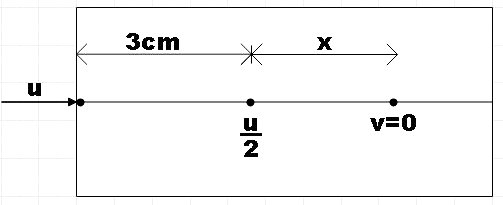
Let the initial and final velocities of the bullet be u and v respectively while penetrating the first 3cm. Then, from Newton’s equations of motion, we have,
${{v}^{2}}-{{u}^{2}}=2as$
Where, $a$ is the constant acceleration of the bullet and $s=3cm$
Also,
$v=\dfrac{u}{2}$
So,
${{\left( \dfrac{u}{2} \right)}^{2}}-{{u}^{2}}=2a\left( 3 \right)$
$\Rightarrow a=-\dfrac{3{{u}^{2}}}{24}$
$\therefore a=-\dfrac{{{u}^{2}}}{8}$ …………………………………………….. (1)
Now for finding the distance penetrated by the bullet after this, let us use the same equation of motion again. But, the initial velocity now will be $\dfrac{u}{2}$ and final velocity is zero. So,
$0-{{\left( \dfrac{u}{2} \right)}^{2}}=2ax$
Substituting (1) we get,
$-{{\left( \dfrac{u}{2} \right)}^{2}}=2\left( -\dfrac{{{u}^{2}}}{8} \right)x$
$\therefore x=1cm$
Therefore, we found that the bullet will penetrate 1cm more into the fixed target before coming to rest.
Hence, option C is found to be the correct answer.
Note:
We should understand that, it is the acceleration of the bullet that is being described as the resistance to motion in the question. From that sentence, it is very clear that the bullet is having constant acceleration of motion. We have assumed this condition throughout the solution.
Formula used:
Equation of motion,
${{v}^{2}}-{{u}^{2}}=2as$
Complete Step by step solution:
In the question, we are told that a bullet is being fired into a fixed target. While penetrating into this fixed target, the bullet loses half of its velocity after 3cm. We are asked to find the distance penetrated by this bullet before coming to rest. Assume that the bullet faces constant resistance to motion.
As a first step, let us depict the given situation in a neat diagram.
Let the initial and final velocities of the bullet be u and v respectively while penetrating the first 3cm. Then, from Newton’s equations of motion, we have,
${{v}^{2}}-{{u}^{2}}=2as$
Where, $a$ is the constant acceleration of the bullet and $s=3cm$
Also,
$v=\dfrac{u}{2}$
So,
${{\left( \dfrac{u}{2} \right)}^{2}}-{{u}^{2}}=2a\left( 3 \right)$
$\Rightarrow a=-\dfrac{3{{u}^{2}}}{24}$
$\therefore a=-\dfrac{{{u}^{2}}}{8}$ …………………………………………….. (1)
Now for finding the distance penetrated by the bullet after this, let us use the same equation of motion again. But, the initial velocity now will be $\dfrac{u}{2}$ and final velocity is zero. So,
$0-{{\left( \dfrac{u}{2} \right)}^{2}}=2ax$
Substituting (1) we get,
$-{{\left( \dfrac{u}{2} \right)}^{2}}=2\left( -\dfrac{{{u}^{2}}}{8} \right)x$
$\therefore x=1cm$
Therefore, we found that the bullet will penetrate 1cm more into the fixed target before coming to rest.
Hence, option C is found to be the correct answer.
Note:
We should understand that, it is the acceleration of the bullet that is being described as the resistance to motion in the question. From that sentence, it is very clear that the bullet is having constant acceleration of motion. We have assumed this condition throughout the solution.
Recently Updated Pages
Master Class 12 Business Studies: Engaging Questions & Answers for Success

Master Class 12 Chemistry: Engaging Questions & Answers for Success
Master Class 12 Biology: Engaging Questions & Answers for Success
Class 12 Question and Answer - Your Ultimate Solutions Guide
Master Class 11 English: Engaging Questions & Answers for Success
Master Class 11 Social Science: Engaging Questions & Answers for Success
Trending doubts
Which are the Top 10 Largest Countries of the World?
Draw a labelled sketch of the human eye class 12 physics CBSE
Differentiate between homogeneous and heterogeneous class 12 chemistry CBSE
In order to find out the different types of gametes class 12 biology NEET_UG
Why is the cell called the structural and functional class 12 biology CBSE
Draw ray diagrams each showing i myopic eye and ii class 12 physics CBSE