




A boy of length 10 m, to see his own complete image, requires a mirror of length at least equal to.
(A) $ \dfrac{{10}}{4} $
(B) $ \dfrac{{10}}{3} $
(C) $ \dfrac{{10}}{2} $
(D) $ 10 $
Answer
 Verified
593.7k+ views
Hint
We proceed to solve this question by drawing a ray diagram of the boy standing in front of the mirror. Then compare the length of the boy to the length of the mirror using properties of reflection of light. Refer to the diagram in the complete solution for a better understanding.
Complete step by step answer
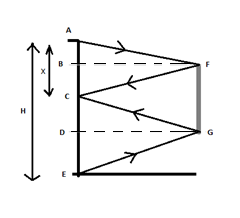
The line ABCDE represents the height of the boy. A is the top of the head, C is where the eyes are located and E is the feet. The light from the head as well as feet get reflected and reach the eyes to give vision.
Let us consider the length of the line ABCDE as $ H $ and the length of the mirror as FG. FG is equal to the length of BCD.
Taking the distance AC as $ X $ , we get the length of CE as $ H-X $ .
$ \angle AFB $ is equal to the angle $ \angle BFC $ ( $ \because $ angle of incidence is equal to the angle of reflection)
From this, we know that the length of AB and BC are the same and equal to $ \dfrac{X}{2} $
Similarly, $ \angle CGD $ and $ \angle DGE $ are equal ( $ \because $ angle of incidence is equal to the angle of reflection)
This tells us that line CD and DE are of the same length and equal to $ \dfrac{H-X}{2} $
We know that the length of the mirror FG is equal to the sum of BC and CD. Length of mirror FG is equal to $ \dfrac{{H - X}}{2} + \dfrac{X}{2} = \dfrac{H}{2} $
From the question, we know that the height of the boy is $ 10m $ . So, the minimum length of the mirror should be equal to $ \dfrac{{10}}{2} = 5m $
Hence option (C) $ \dfrac{{10}}{2} = 5m $ is the correct answer.
Note
This minimum length of the mirror required to see the entire body is regardless of the distance between the mirror and the object. The distance between the image and object is always twice the distance between the object and mirror.
We proceed to solve this question by drawing a ray diagram of the boy standing in front of the mirror. Then compare the length of the boy to the length of the mirror using properties of reflection of light. Refer to the diagram in the complete solution for a better understanding.
Complete step by step answer
The line ABCDE represents the height of the boy. A is the top of the head, C is where the eyes are located and E is the feet. The light from the head as well as feet get reflected and reach the eyes to give vision.
Let us consider the length of the line ABCDE as $ H $ and the length of the mirror as FG. FG is equal to the length of BCD.
Taking the distance AC as $ X $ , we get the length of CE as $ H-X $ .
$ \angle AFB $ is equal to the angle $ \angle BFC $ ( $ \because $ angle of incidence is equal to the angle of reflection)
From this, we know that the length of AB and BC are the same and equal to $ \dfrac{X}{2} $
Similarly, $ \angle CGD $ and $ \angle DGE $ are equal ( $ \because $ angle of incidence is equal to the angle of reflection)
This tells us that line CD and DE are of the same length and equal to $ \dfrac{H-X}{2} $
We know that the length of the mirror FG is equal to the sum of BC and CD. Length of mirror FG is equal to $ \dfrac{{H - X}}{2} + \dfrac{X}{2} = \dfrac{H}{2} $
From the question, we know that the height of the boy is $ 10m $ . So, the minimum length of the mirror should be equal to $ \dfrac{{10}}{2} = 5m $
Hence option (C) $ \dfrac{{10}}{2} = 5m $ is the correct answer.
Note
This minimum length of the mirror required to see the entire body is regardless of the distance between the mirror and the object. The distance between the image and object is always twice the distance between the object and mirror.
Recently Updated Pages
Master Class 12 Business Studies: Engaging Questions & Answers for Success

Master Class 12 Biology: Engaging Questions & Answers for Success
Master Class 12 Chemistry: Engaging Questions & Answers for Success
Class 12 Question and Answer - Your Ultimate Solutions Guide
Master Class 11 Social Science: Engaging Questions & Answers for Success
Master Class 11 English: Engaging Questions & Answers for Success
Trending doubts
Which is more stable and why class 12 chemistry CBSE
Which are the Top 10 Largest Countries of the World?
Draw a labelled sketch of the human eye class 12 physics CBSE
Differentiate between homogeneous and heterogeneous class 12 chemistry CBSE
What are the major means of transport Explain each class 12 social science CBSE
Sulphuric acid is known as the king of acids State class 12 chemistry CBSE