




A boy and a man carry a uniform rod of length \[L\] , horizontally in such a way that the boy gets 1/4th load. If the boy is at one end of the road, the distance of the man from the other end is
A. $L/3$
B. $L/4$
C. $2L/3$
D. $3L/4$
Answer
 Verified
614.7k+ views
Hint:To find the position of men, we must have knowledge of centre of mass. For now, we can understand it as a point on or outside the body where we can say the whole mass of the system is concentrated. In order to find the correct position of men we should be very much careful that, whole system should be in rotational equilibrium about the centre of mass of the rod. So, net torque about the centre of mass should be zero.
$\sum \tau = 0$
Here $\tau $ is torque.
Apply the conditions, you will get the answer
Complete step-by-step solution:
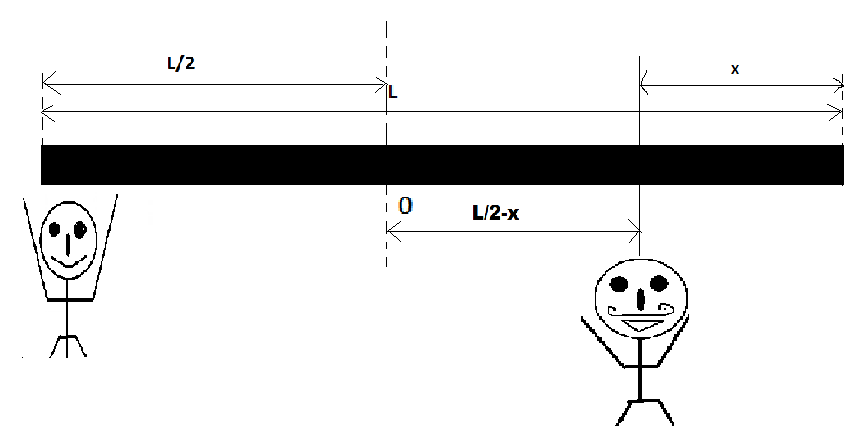
Since we already know, the rod is uniform so it’s centre of mass will be at L/2. According to the question , the boy is standing at the corner of one end and gets 1/4th weight of rod. We have to find the position of the man who gets the 3/4th weight of the rod from the other end. As we know this system should be rotational equilibrium so it is also quite expected that men will be on the other side of the centre of mass, at x distance from the other end. Refer the figure
So, let’s do it mathematically,
If the rod is in rotational equilibrium, net torque acting on it must be equal to zero. Keeping centre of mass as origin
$\sum \tau = 0$
Here $\tau $ is torque.
We know torque = Force x perpendicular distance (from axis to point of action)
Both reaction forces tend to oppose each other’s rotational motion. Reaction force of the boy at left tends to rotate clockwise whereas the reaction force of the person at right is anticlockwise.
$\dfrac{W}{4} \times \dfrac{L}{2} - \dfrac{{3W}}{4} \times \left( {\dfrac{L}{2} - x} \right) = 0$
On further solving,
$
\dfrac{W}{4} \times \dfrac{L}{2} = \dfrac{{3W}}{4} \times \left( {\dfrac{L}{2} - x} \right) \\
\Rightarrow x = \dfrac{L}{3} \\
$
Here,
L = Length of Rod
W= Weight of Rod
Note:- Always take care to check rotational equilibrium in such questions after applying all conditions as sometimes other constraints may not give you the proper result or may give several satisfying conditions. Formula to find centre of mass of a body is \[Xcm = \dfrac{{\sum\nolimits_{i = 1}^n {MiXi} }}{{\sum\nolimits_{i = 1}^n {Mi} }}\]
here,
\[Mi = \]Mass of $i$ th part
\[Xi = \] position of $i$ th particle from reference point.
$\sum \tau = 0$
Here $\tau $ is torque.
Apply the conditions, you will get the answer
Complete step-by-step solution:
Since we already know, the rod is uniform so it’s centre of mass will be at L/2. According to the question , the boy is standing at the corner of one end and gets 1/4th weight of rod. We have to find the position of the man who gets the 3/4th weight of the rod from the other end. As we know this system should be rotational equilibrium so it is also quite expected that men will be on the other side of the centre of mass, at x distance from the other end. Refer the figure
So, let’s do it mathematically,
If the rod is in rotational equilibrium, net torque acting on it must be equal to zero. Keeping centre of mass as origin
$\sum \tau = 0$
Here $\tau $ is torque.
We know torque = Force x perpendicular distance (from axis to point of action)
Both reaction forces tend to oppose each other’s rotational motion. Reaction force of the boy at left tends to rotate clockwise whereas the reaction force of the person at right is anticlockwise.
$\dfrac{W}{4} \times \dfrac{L}{2} - \dfrac{{3W}}{4} \times \left( {\dfrac{L}{2} - x} \right) = 0$
On further solving,
$
\dfrac{W}{4} \times \dfrac{L}{2} = \dfrac{{3W}}{4} \times \left( {\dfrac{L}{2} - x} \right) \\
\Rightarrow x = \dfrac{L}{3} \\
$
Here,
L = Length of Rod
W= Weight of Rod
Note:- Always take care to check rotational equilibrium in such questions after applying all conditions as sometimes other constraints may not give you the proper result or may give several satisfying conditions. Formula to find centre of mass of a body is \[Xcm = \dfrac{{\sum\nolimits_{i = 1}^n {MiXi} }}{{\sum\nolimits_{i = 1}^n {Mi} }}\]
here,
\[Mi = \]Mass of $i$ th part
\[Xi = \] position of $i$ th particle from reference point.
Recently Updated Pages
Master Class 12 Business Studies: Engaging Questions & Answers for Success

Master Class 12 Chemistry: Engaging Questions & Answers for Success
Master Class 12 Biology: Engaging Questions & Answers for Success
Class 12 Question and Answer - Your Ultimate Solutions Guide
Master Class 9 General Knowledge: Engaging Questions & Answers for Success
Master Class 9 Maths: Engaging Questions & Answers for Success
Trending doubts
Which are the Top 10 Largest Countries of the World?
Name the crygenes that control cotton bollworm and class 12 biology CBSE
Differentiate between homogeneous and heterogeneous class 12 chemistry CBSE
In a transcription unit the promoter is said to be class 12 biology CBSE
Sulphuric acid is known as the king of acids State class 12 chemistry CBSE
A dentist uses a small mirror that gives a magnification class 12 physics CBSE