




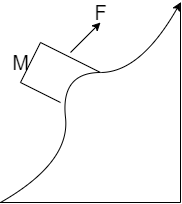
A body of mass M was slowly hauled up on a rough hill by a force F which at each point was directed along a tangent to the hill. Work done by the force
A. Is independent of the shape of trajectory
B. Depends upon the vertical component of displacement but is independent of horizontal component
C. Depends on both the components
D. Does not depends upon the coefficient of friction
Answer
 Verified
599.7k+ views
Hint:-When two surfaces come in contact with each other or slide against each other, then a force is generated. This force is known as frictional force. This force tends to reduce or oppose the motion of the object.
Complete step-by-step solution:
Step I:
The frictional force is acting tangential to the path along the gravity and opposing the force. Therefore net work done by the force is given by the sum of work done by gravitational force and frictional force.
Step II:
Let $dS$ be an infinitely small area of the hill on which the body is placed. This small area can be considered as a plane. If the mass M makes an angle $\theta $ with the horizontal, then the force acting in upwards direction is the normal force N. The normal force is the force exerted on the body that is in contact with the hill. It’s formula is
$N = mg$
In Case of an inclined surface, the normal force is given by $N = mg\cos \theta $.
Step III:
The frictional force will act in an opposite direction to the movement of the block. If $\nu $ is the coefficient of friction then work done by frictional force is given by
${W_{friction}} = - \nu .N.dS$
$W = - \nu .mg\cos \theta .dS$
$W = - \nu .mg.(dS\cos \theta )$
$W = - \nu .mg.l$
Step IV:
Work done by gravitational force is given by
${W_{gravitation}} = - m.g.h$
Step V:
The frictional force depends only on the path followed by the object and not on the shape or size of the path. If ‘l' is the length of the bass of the hill and ‘h' is the height, then a work energy theorem will be used here.
According to the work energy theorem, the work done is equal to the difference in kinetic energies of the object.
$Work Done = {K_{initial}} - {K_{final}}$
Since the mass is hauled very slowly so kinetic energy is considered zero. Hence work done Will be
${W_{net}} + {W_{friction}} + {W_{gravitation}} = 0$
${W_{net}} = - \{ {W_{friction}} + {W_{gravitation}}\} $
$ = - \{ - \nu mgl - mgh)$
$ = \nu mgl + mgh$
Step VI:
Option A and C are the correct answer.
Note:- It is to be noted that the frictional force is affected by the angle and position of the object. If the object is pushed against the surface, then frictional force will increase and become more than the weight of the object. On the other hand, if the objects are just placed in contact with each other then the frictional force will be equal to the weight of the object.
Complete step-by-step solution:
Step I:
The frictional force is acting tangential to the path along the gravity and opposing the force. Therefore net work done by the force is given by the sum of work done by gravitational force and frictional force.
Step II:
Let $dS$ be an infinitely small area of the hill on which the body is placed. This small area can be considered as a plane. If the mass M makes an angle $\theta $ with the horizontal, then the force acting in upwards direction is the normal force N. The normal force is the force exerted on the body that is in contact with the hill. It’s formula is
$N = mg$
In Case of an inclined surface, the normal force is given by $N = mg\cos \theta $.
Step III:
The frictional force will act in an opposite direction to the movement of the block. If $\nu $ is the coefficient of friction then work done by frictional force is given by
${W_{friction}} = - \nu .N.dS$
$W = - \nu .mg\cos \theta .dS$
$W = - \nu .mg.(dS\cos \theta )$
$W = - \nu .mg.l$
Step IV:
Work done by gravitational force is given by
${W_{gravitation}} = - m.g.h$
Step V:
The frictional force depends only on the path followed by the object and not on the shape or size of the path. If ‘l' is the length of the bass of the hill and ‘h' is the height, then a work energy theorem will be used here.
According to the work energy theorem, the work done is equal to the difference in kinetic energies of the object.
$Work Done = {K_{initial}} - {K_{final}}$
Since the mass is hauled very slowly so kinetic energy is considered zero. Hence work done Will be
${W_{net}} + {W_{friction}} + {W_{gravitation}} = 0$
${W_{net}} = - \{ {W_{friction}} + {W_{gravitation}}\} $
$ = - \{ - \nu mgl - mgh)$
$ = \nu mgl + mgh$
Step VI:
Option A and C are the correct answer.
Note:- It is to be noted that the frictional force is affected by the angle and position of the object. If the object is pushed against the surface, then frictional force will increase and become more than the weight of the object. On the other hand, if the objects are just placed in contact with each other then the frictional force will be equal to the weight of the object.
Recently Updated Pages
Three beakers labelled as A B and C each containing 25 mL of water were taken A small amount of NaOH anhydrous CuSO4 and NaCl were added to the beakers A B and C respectively It was observed that there was an increase in the temperature of the solutions contained in beakers A and B whereas in case of beaker C the temperature of the solution falls Which one of the following statements isarecorrect i In beakers A and B exothermic process has occurred ii In beakers A and B endothermic process has occurred iii In beaker C exothermic process has occurred iv In beaker C endothermic process has occurred

Master Class 12 Social Science: Engaging Questions & Answers for Success
Master Class 12 Physics: Engaging Questions & Answers for Success
Master Class 12 Maths: Engaging Questions & Answers for Success
Master Class 12 Economics: Engaging Questions & Answers for Success
Master Class 12 Chemistry: Engaging Questions & Answers for Success
Three beakers labelled as A B and C each containing 25 mL of water were taken A small amount of NaOH anhydrous CuSO4 and NaCl were added to the beakers A B and C respectively It was observed that there was an increase in the temperature of the solutions contained in beakers A and B whereas in case of beaker C the temperature of the solution falls Which one of the following statements isarecorrect i In beakers A and B exothermic process has occurred ii In beakers A and B endothermic process has occurred iii In beaker C exothermic process has occurred iv In beaker C endothermic process has occurred
Master Class 12 Social Science: Engaging Questions & Answers for Success
Master Class 12 Physics: Engaging Questions & Answers for Success
Trending doubts
Which are the Top 10 Largest Countries of the World?
Draw a labelled sketch of the human eye class 12 physics CBSE
Differentiate between homogeneous and heterogeneous class 12 chemistry CBSE
What are the major means of transport Explain each class 12 social science CBSE
Sulphuric acid is known as the king of acids State class 12 chemistry CBSE
Why should a magnesium ribbon be cleaned before burning class 12 chemistry CBSE