




A body of mass \[2{\text{ }}kg\] is kept by pressing to a vertical wall by a force of \[100{\text{ }}N\] the coefficient of friction between wall and body is \[0.3.\] then the frictional force is equal to:
A. $6N$
B. $20N$
C. $600N$
D. $700N$
Answer
 Verified
519.6k+ views
Hint:Friction between two or more solid objects that are not moving relative to each other is known as static friction. In order to answer the question we will see that this issue is based on the notion of friction force, which is a resistive force that acts in the opposite direction of motion for a moving body.
Formula used:
The friction force formula is,
$F = \mu N$
Where \[N\] is the net normal force acting on the object perpendicular to the surface of motion of the object and $\mu $ is the coefficient of friction.
Complete step by step answer:
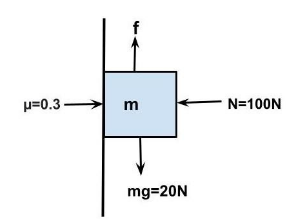
The force that holds an object at rest is known as static friction. It must be overcome before the thing may be moved. When a little amount of force is applied to an object, static friction increases in the opposite direction by the same amount. It is given in the question that;
Coefficient of friction \[\left( \mu \right) = 0.3\]
Normal force \[ = 100N\]
So, ${f_{\max }}$ (Maximum friction force) \[ = 100 \times 0.3 = 30N\].
Force trying to produce motion \[ = mg = 2 \times 10 = 20N\].
So, frictional force \[ = 20\,N\].
Therefore, the correct option is B.
Note:Friction force functions as a barrier or opposing force in the motion of anything, such as machinery, cars, and produces a lot of wear and tear, as well as dread of friction, but it is also very important in some circumstances, such as when we walk on the road. Between 0 and 90 degrees is the angle of repose.
Formula used:
The friction force formula is,
$F = \mu N$
Where \[N\] is the net normal force acting on the object perpendicular to the surface of motion of the object and $\mu $ is the coefficient of friction.
Complete step by step answer:
The force that holds an object at rest is known as static friction. It must be overcome before the thing may be moved. When a little amount of force is applied to an object, static friction increases in the opposite direction by the same amount. It is given in the question that;
Coefficient of friction \[\left( \mu \right) = 0.3\]
Normal force \[ = 100N\]
So, ${f_{\max }}$ (Maximum friction force) \[ = 100 \times 0.3 = 30N\].
Force trying to produce motion \[ = mg = 2 \times 10 = 20N\].
So, frictional force \[ = 20\,N\].
Therefore, the correct option is B.
Note:Friction force functions as a barrier or opposing force in the motion of anything, such as machinery, cars, and produces a lot of wear and tear, as well as dread of friction, but it is also very important in some circumstances, such as when we walk on the road. Between 0 and 90 degrees is the angle of repose.
Recently Updated Pages
Master Class 11 Economics: Engaging Questions & Answers for Success

Master Class 11 English: Engaging Questions & Answers for Success
Master Class 11 Maths: Engaging Questions & Answers for Success
Class 11 Question and Answer - Your Ultimate Solutions Guide
Master Class 11 Social Science: Engaging Questions & Answers for Success
Master Class 11 Business Studies: Engaging Questions & Answers for Success
Trending doubts
Differentiate between an exothermic and an endothermic class 11 chemistry CBSE
One Metric ton is equal to kg A 10000 B 1000 C 100 class 11 physics CBSE
There are 720 permutations of the digits 1 2 3 4 5 class 11 maths CBSE
In what year Guru Nanak Dev ji was born A15 April 1469 class 11 social science CBSE
Difference Between Prokaryotic Cells and Eukaryotic Cells
Draw a diagram of a plant cell and label at least eight class 11 biology CBSE