




A body is thrown with velocity of $\mathbf{40}{\mathbf{ms}}^{-\mathbf{1}}$ in a direction making an angle of 300 with the horizontal. Calculate (i)Horizontal range, (ii) Maximum height and (iii) Time taken to reach the maximum height.
A) (i) 131.4 m
(ii) 20.41 m
(iii) 2.041 s
B) (i) 121.4 m
(ii) 24.41 m
(iii) 2.091 s
C) (i) 141.4 m
(ii) 20.41 m
(iii) 2.041 s
D) (i) 161.4 m
(ii) 10.41 m
(iii) 2.051 s
Answer
 Verified
592.2k+ views
Hint:To solve this problem the formulas can be derived by using equations of motion which we use in one dimensional case. Here we suppose to find the horizontal distance covered, maximum height reached and also time taken to reach maximum height by relation initial velocity, angle of projection and acceleration due to gravity.
Complete step by step answer:
Let us analyse this question by drawing a rough diagram which is helpful to understand this clearly.
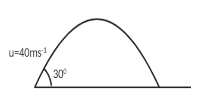
A body is thrown with a velocity of $40{\rm ms}^{-1}$ in a direction making an angle of 300 with the horizontal. Then the object will follow a parabolic path as shown in the figure.
Since the body has projected with some angle with respect to horizontal it covers vertical distance as well as horizontal distance. The path taken by the body is as shown in the figure.
Now, we have to find the horizontal range covered by the body, maximum height reached and also the time taken to reach the maximum height. Let us write all the given factors, then find one by one.
The velocity of the body which is projected is $u=40{\rm ms}^{-1}$ and angle of projection $\theta={30}^0$
(i) To find horizontal distance covered by the body
$R=\dfrac{u^2sin2\theta}{g}$
Where R is the horizontal range covered by the body, \theta is the angle of projection, u is the initial velocity and g is the acceleration due to gravity \left(g=9.8ms^{-1}\right)
Now, to find the horizontal range we substitute all the values in this equation,
$R=\dfrac{{40}^2\times sin\left(2\times 30\right)}{9.8} \\
\Rightarrow R=\dfrac{40\times 40 sin 60}{9.8} \\$
Now we reduce this equation by substituting the values of sin60 i.e, sin60=\dfrac{\sqrt 3}{2}
$R=\dfrac{40\times40\times\sqrt 3}{9.8\times2} \\
\Rightarrow R=\dfrac{1600\times\sqrt 3}{9.8} \\
\Rightarrow R=141.4m\\
$
(ii) To find maximum height reached by the body
$H=\dfrac{u^2\sin^2\theta}{2g}$
Where H is the height maximum reached by the body, , \theta is the angle of projection, u is the initial velocity and g is the acceleration due to gravity \left(g=9.8ms^{-1}\right)
Now, we substitute all the given data in this equation.
$H=\dfrac{{40}^2\left(sin30\right)^2}{2\times9.8} \\
\Rightarrow H=\dfrac{1600\left(\dfrac{1}{2}\right)^2}{2\times9.8}\\
\Rightarrow H=\dfrac{1600\times 1}{2\times9.8\times4}\\
$
After simplifying we get
$H=\dfrac{200}{9.8}=20.408m$ This can be rounded off as 20.41m
(iii) To find the total time taken by the body to reach the maximum height
$T=\dfrac{2u sin\theta}{g}$
Where T is time taken by the body to reach maximum height, , \theta is the angle of projection, u is the initial velocity and g is the acceleration due to gravity $\left(g=9.8ms^{-1}\right)\\
T=\dfrac{40\times sin 30}{9.8}\\
T=\dfrac{40\times 1}{9.8\times 2}\\
T=2.041s\\
$
Hence,
(i) The horizontal distance covered by the body is 141.4m
(ii) The maximum height reached by the body is 20.41m
(iii) The total time taken by the body to reach the maximum height is 2.041s
Hence,the correct answer is option (C).
Note: In question can also be asked in another way to find the total time taken by the body to cover the parabolic path. In this case we have to remember that time taken to reach maximum height is equal to the time taken to come back also.
Complete step by step answer:
Let us analyse this question by drawing a rough diagram which is helpful to understand this clearly.
A body is thrown with a velocity of $40{\rm ms}^{-1}$ in a direction making an angle of 300 with the horizontal. Then the object will follow a parabolic path as shown in the figure.
Since the body has projected with some angle with respect to horizontal it covers vertical distance as well as horizontal distance. The path taken by the body is as shown in the figure.
Now, we have to find the horizontal range covered by the body, maximum height reached and also the time taken to reach the maximum height. Let us write all the given factors, then find one by one.
The velocity of the body which is projected is $u=40{\rm ms}^{-1}$ and angle of projection $\theta={30}^0$
(i) To find horizontal distance covered by the body
$R=\dfrac{u^2sin2\theta}{g}$
Where R is the horizontal range covered by the body, \theta is the angle of projection, u is the initial velocity and g is the acceleration due to gravity \left(g=9.8ms^{-1}\right)
Now, to find the horizontal range we substitute all the values in this equation,
$R=\dfrac{{40}^2\times sin\left(2\times 30\right)}{9.8} \\
\Rightarrow R=\dfrac{40\times 40 sin 60}{9.8} \\$
Now we reduce this equation by substituting the values of sin60 i.e, sin60=\dfrac{\sqrt 3}{2}
$R=\dfrac{40\times40\times\sqrt 3}{9.8\times2} \\
\Rightarrow R=\dfrac{1600\times\sqrt 3}{9.8} \\
\Rightarrow R=141.4m\\
$
(ii) To find maximum height reached by the body
$H=\dfrac{u^2\sin^2\theta}{2g}$
Where H is the height maximum reached by the body, , \theta is the angle of projection, u is the initial velocity and g is the acceleration due to gravity \left(g=9.8ms^{-1}\right)
Now, we substitute all the given data in this equation.
$H=\dfrac{{40}^2\left(sin30\right)^2}{2\times9.8} \\
\Rightarrow H=\dfrac{1600\left(\dfrac{1}{2}\right)^2}{2\times9.8}\\
\Rightarrow H=\dfrac{1600\times 1}{2\times9.8\times4}\\
$
After simplifying we get
$H=\dfrac{200}{9.8}=20.408m$ This can be rounded off as 20.41m
(iii) To find the total time taken by the body to reach the maximum height
$T=\dfrac{2u sin\theta}{g}$
Where T is time taken by the body to reach maximum height, , \theta is the angle of projection, u is the initial velocity and g is the acceleration due to gravity $\left(g=9.8ms^{-1}\right)\\
T=\dfrac{40\times sin 30}{9.8}\\
T=\dfrac{40\times 1}{9.8\times 2}\\
T=2.041s\\
$
Hence,
(i) The horizontal distance covered by the body is 141.4m
(ii) The maximum height reached by the body is 20.41m
(iii) The total time taken by the body to reach the maximum height is 2.041s
Hence,the correct answer is option (C).
Note: In question can also be asked in another way to find the total time taken by the body to cover the parabolic path. In this case we have to remember that time taken to reach maximum height is equal to the time taken to come back also.
Recently Updated Pages
Basicity of sulphurous acid and sulphuric acid are

Master Class 11 Business Studies: Engaging Questions & Answers for Success
Master Class 11 Computer Science: Engaging Questions & Answers for Success
Master Class 11 Economics: Engaging Questions & Answers for Success
Master Class 11 Social Science: Engaging Questions & Answers for Success
Master Class 11 English: Engaging Questions & Answers for Success
Trending doubts
The largest wind power cluster is located in the state class 11 social science CBSE
Explain zero factorial class 11 maths CBSE
Which among the following are examples of coming together class 11 social science CBSE
Can anyone list 10 advantages and disadvantages of friction
State the laws of reflection of light
Draw a diagram of a plant cell and label at least eight class 11 biology CBSE