




A body is thrown vertically upwards from the ground. If it reaches a maximum height of 20m in 5 s. after what time it will reach the ground from its maximum height position?
A. 10 s
B. 5 s
C. 2.5 s
D. 25 s
Answer
 Verified
619.2k+ views
Hint: In this question, we have two stages. In the first stage, the body is moving in an upwards direction and in the second stage the body is returning back. Since acceleration due to gravity is the same in both the stages therefore time taken by the body to reach maximum height is equal to the time taken by the particle (body) to come to ground from maximum height.
Complete step by step answer:
We have been provided with a body which is thrown vertically in upwards direction from the ground as shown in figure. The maximum distance travel by the body in upwards direction is 20m in 5 seconds duration. Now we need to calculate time or during for which the body will reach the ground from the maximum height position.
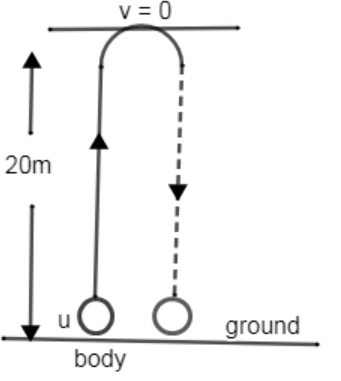
Let, u is the initial velocity and v is the final velocity. When the body moves in upwards direction its velocity is u and when it reaches its maximum height it velocity is zero i.e. v=0 when the body returns from its maximum height it velocity is equal to initial velocity is u.
Initially, kinetic energy of body is given by,
$\dfrac{1}{2}m{{v}^{2}}=mgh.....\left( 1 \right)$
Where, m is the mass of the body
V is the velocity of the body
h is the maximum height
g is the acceleration due to gravity.
Since, acceleration due to gravity (g) in both the cases is the same (i.e. in initial and final). Therefore time taken to go up is equal to time taken to come down i.e. 5 seconds. Hence, 5 second time it will reach the ground from its maximum height position.
So, the correct answer is “Option B”.
Note: Equation (1) shows conservation of energy since gravity is not changing and velocity in both the cases are the same. Here, we have neglected air resistance. When the body returns or falls, it picks up speed and the increases in speed leads to an increase in the amount of air resistance.
Complete step by step answer:
We have been provided with a body which is thrown vertically in upwards direction from the ground as shown in figure. The maximum distance travel by the body in upwards direction is 20m in 5 seconds duration. Now we need to calculate time or during for which the body will reach the ground from the maximum height position.
Let, u is the initial velocity and v is the final velocity. When the body moves in upwards direction its velocity is u and when it reaches its maximum height it velocity is zero i.e. v=0 when the body returns from its maximum height it velocity is equal to initial velocity is u.
Initially, kinetic energy of body is given by,
$\dfrac{1}{2}m{{v}^{2}}=mgh.....\left( 1 \right)$
Where, m is the mass of the body
V is the velocity of the body
h is the maximum height
g is the acceleration due to gravity.
Since, acceleration due to gravity (g) in both the cases is the same (i.e. in initial and final). Therefore time taken to go up is equal to time taken to come down i.e. 5 seconds. Hence, 5 second time it will reach the ground from its maximum height position.
So, the correct answer is “Option B”.
Note: Equation (1) shows conservation of energy since gravity is not changing and velocity in both the cases are the same. Here, we have neglected air resistance. When the body returns or falls, it picks up speed and the increases in speed leads to an increase in the amount of air resistance.
Recently Updated Pages
Master Class 11 English: Engaging Questions & Answers for Success

Master Class 11 Social Science: Engaging Questions & Answers for Success
Master Class 11 Maths: Engaging Questions & Answers for Success
Master Class 11 Biology: Engaging Questions & Answers for Success
Master Class 11 Physics: Engaging Questions & Answers for Success
Master Class 11 Chemistry: Engaging Questions & Answers for Success
Trending doubts
One Metric ton is equal to kg A 10000 B 1000 C 100 class 11 physics CBSE
Difference Between Prokaryotic Cells and Eukaryotic Cells
Find the value of the expression given below sin 30circ class 11 maths CBSE
Two of the body parts which do not appear in MRI are class 11 biology CBSE
Draw a diagram of a plant cell and label at least eight class 11 biology CBSE
10 examples of friction in our daily life