




A block of mass m slides from the rim of a hemispherical bowl of radius R. The velocity of the block at the bottom will be
A. $\sqrt {3Rg} $
B. $\sqrt {2gR} $
C. $\sqrt {Rg} $
D. $\sqrt {4gR} $
Answer
 Verified
591.9k+ views
Hint: When some amount of work is done against the conservative force then the work done will be stored in the system as the potential energy as energy can neither be created nor destroyed. Along the direction of conservative force then potential energy of the system decreases. By using these two principles we will solve the question.
Formula used:
$U = mgh$
Complete answer:
When a block slides from a certain height it will reach the base with certain velocity and it is due to the law of conservation of mechanical energy. Total initial potential energy a block has will be converted into the kinetic energy by the time it reaches the base of the bowl.
The given situation is represented in the below diagram
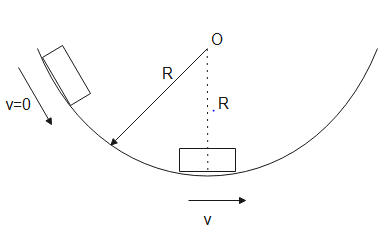
Initially velocity is zero. Except for gravitational force, no other force is acting on the block. So if the block slides down, its potential energy will decrease. The decrease in potential energy will appear as an increase in kinetic energy at the bottom. So as the kinetic energy is increased, its velocity will also increase.
Loss in potential energy is
$\eqalign{
& U = mgh \cr
& \therefore U = mgR \cr} $
Gain in kinetic energy will be
$K = \dfrac{1}{2}m{v^2}$
If we equate both we will get
$\eqalign{
& U = K \cr
& \Rightarrow mgR = \dfrac{1}{2}m{v^2} \cr
& \therefore v = \sqrt {2gR} \cr} $
Hence option B is correct.
Note:
Potential energy is valid only if conservative forces are present. Gravity, spring force are the examples for conservative forces. Law of conservation of energy is valid everywhere but the law of conservation of mechanical energy is valid only when no non conservative force acts. Mechanical energy means the sum of potential and kinetic energies.
Formula used:
$U = mgh$
Complete answer:
When a block slides from a certain height it will reach the base with certain velocity and it is due to the law of conservation of mechanical energy. Total initial potential energy a block has will be converted into the kinetic energy by the time it reaches the base of the bowl.
The given situation is represented in the below diagram
Initially velocity is zero. Except for gravitational force, no other force is acting on the block. So if the block slides down, its potential energy will decrease. The decrease in potential energy will appear as an increase in kinetic energy at the bottom. So as the kinetic energy is increased, its velocity will also increase.
Loss in potential energy is
$\eqalign{
& U = mgh \cr
& \therefore U = mgR \cr} $
Gain in kinetic energy will be
$K = \dfrac{1}{2}m{v^2}$
If we equate both we will get
$\eqalign{
& U = K \cr
& \Rightarrow mgR = \dfrac{1}{2}m{v^2} \cr
& \therefore v = \sqrt {2gR} \cr} $
Hence option B is correct.
Note:
Potential energy is valid only if conservative forces are present. Gravity, spring force are the examples for conservative forces. Law of conservation of energy is valid everywhere but the law of conservation of mechanical energy is valid only when no non conservative force acts. Mechanical energy means the sum of potential and kinetic energies.
Recently Updated Pages
Three beakers labelled as A B and C each containing 25 mL of water were taken A small amount of NaOH anhydrous CuSO4 and NaCl were added to the beakers A B and C respectively It was observed that there was an increase in the temperature of the solutions contained in beakers A and B whereas in case of beaker C the temperature of the solution falls Which one of the following statements isarecorrect i In beakers A and B exothermic process has occurred ii In beakers A and B endothermic process has occurred iii In beaker C exothermic process has occurred iv In beaker C endothermic process has occurred

Master Class 11 Social Science: Engaging Questions & Answers for Success
Master Class 11 Physics: Engaging Questions & Answers for Success
Master Class 11 Maths: Engaging Questions & Answers for Success
Master Class 11 Economics: Engaging Questions & Answers for Success
Master Class 11 Computer Science: Engaging Questions & Answers for Success
Three beakers labelled as A B and C each containing 25 mL of water were taken A small amount of NaOH anhydrous CuSO4 and NaCl were added to the beakers A B and C respectively It was observed that there was an increase in the temperature of the solutions contained in beakers A and B whereas in case of beaker C the temperature of the solution falls Which one of the following statements isarecorrect i In beakers A and B exothermic process has occurred ii In beakers A and B endothermic process has occurred iii In beaker C exothermic process has occurred iv In beaker C endothermic process has occurred
Master Class 11 Social Science: Engaging Questions & Answers for Success
Master Class 11 Physics: Engaging Questions & Answers for Success
Trending doubts
One Metric ton is equal to kg A 10000 B 1000 C 100 class 11 physics CBSE
There are 720 permutations of the digits 1 2 3 4 5 class 11 maths CBSE
State and prove Bernoullis theorem class 11 physics CBSE
Draw a diagram of a plant cell and label at least eight class 11 biology CBSE
Difference Between Prokaryotic Cells and Eukaryotic Cells
1 Quintal is equal to a 110 kg b 10 kg c 100kg d 1000 class 11 physics CBSE